Filter by

Migration and the Welfare State: Political-Economy Policy Formation
This title presents a unified formal framework for studying how social benefits-immigration conflicts are resolved in a range of policy regimes.OCLC-licensed vendor bibliographic record.
- Edition
- -
- ISBN/ISSN
- 9780262298377
- Collation
- 1 online resource (xii, 168 pages) :illustrations
- Series Title
- -
- Call Number
- -
Tap :unlocking the mobile economy
"Consumers create a data trail by tapping their phones; businesses can tap into this trail to harness the power of the more than three trillion dollar mobile economy. According to Anindya Ghose, a global authority on the mobile economy, this two-way exchange can benefit both customers and businesses. In Tap, Ghose welcomes us to the mobile economy of smartphones, smarter companies, and value-se…
- Edition
- -
- ISBN/ISSN
- 9780262340427
- Collation
- 1 online resource (ix, 230 pages) :illustrations
- Series Title
- -
- Call Number
- -

Wine economics
"An interdisciplinary exploration of the economics of wine, drawing on a variety of academic literatures"--OCLC-licensed vendor bibliographic record.
- Edition
- -
- ISBN/ISSN
- 0262361027
- Collation
- 1 online resource.
- Series Title
- -
- Call Number
- -

Russia: Long View
Translated from the Russian.An important Russian economist and politician takes a long view of economic history and Russia's development.OCLC-licensed vendor bibliographic record.
- Edition
- -
- ISBN/ISSN
- 9780262305303
- Collation
- 1 online resource (xviii, 543 pages) :illustrations
- Series Title
- -
- Call Number
- -
Fred Forest's utopia :media art and activism
The innovative French media artist and prankster-provocateur Fred Forest first gained notoriety in 1972 when he inserted a small blank space in Le Monde, called it 150 cm 2 of Newspaper (150 cm 2 de papier journal), and invited readers to fill in the space with their own work and mail their efforts to him. In 1977, he satirized speculation in both the art and real estate markets by offering the…
- Edition
- -
- ISBN/ISSN
- 9780262339926
- Collation
- 1 online resource (xii, 245 pages).
- Series Title
- -
- Call Number
- -

Foolproof, and other mathematical meditations
A non-mathematician explores mathematical terrain, reporting accessibly and engagingly on topics from Sudoku to probability. Brian Hayes wants to convince us that mathematics is too important and too much fun to be left to the mathematicians. Foolproof, and Other Mathematical Meditations is his entertaining and accessible exploration of mathematical terrain both far-flung and nearby, bringing r…
- Edition
- -
- ISBN/ISSN
- 9780262342681
- Collation
- 1 online resource (248 pages)
- Series Title
- -
- Call Number
- -
Effortless Attention: A New Perspective in the Cognitive Science of Attention…
The phenomena of effortless attention, action & the challenges they pose to current cognitive models of attention & action are discussed in this volume.OCLC-licensed vendor bibliographic record.
- Edition
- -
- ISBN/ISSN
- 9780262269438
- Collation
- 1 online resource (viii, 449 pages) :illustrations.
- Series Title
- -
- Call Number
- -
Understanding ignorance :the surprising impact of what we don't know
Ignorance is trending. Politicians boast, "I'm not a scientist." Angry citizens object to a proposed state motto because it is in Latin, and "This is America, not Mexico or Latin America." Lack of experience, not expertise, becomes a credential. Fake news and repeated falsehoods are accepted and shape firm belief. Ignorance about American government and history is so alarming that the ideal of …
- Edition
- -
- ISBN/ISSN
- 9780262341035
- Collation
- 1 online resource.
- Series Title
- -
- Call Number
- -

Panpsychism in the West
An updated edition of a comprehensive study of the theory that mind exists, in some form, in all living and nonliving things.OCLC-licensed vendor bibliographic record.
- Edition
- Revised edition.
- ISBN/ISSN
- 9780262341523
- Collation
- 1 online resource (372 pages)
- Series Title
- -
- Call Number
- -
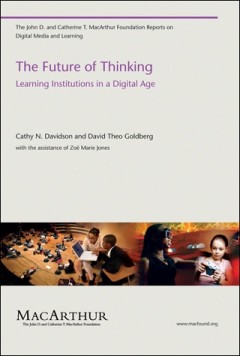
The Future of Thinking: Learning Institutions in a Digital Age
How traditional learning institutions can become as innovative, flexible, robust, and collaborative as the best social networking sites. Over the past two decades, the way we learn has changed dramatically. We have new sources of information and new ways to exchange and to interact with information. But our schools and the way we teach have remained largely the same for years, even centuries…
- Edition
- -
- ISBN/ISSN
- 9780262266529
- Collation
- -
- Series Title
- -
- Call Number
- -
 Computer Science, Information & General Works
  Philosophy & Psychology
  Religion
  Social Sciences
  Language
  Pure Science
  Applied Sciences
  Art & Recreation
  Literature
  History & Geography