Filter by

Digital Countercultures and the Struggle for Community
How countercultural communities have made the Internet meet their needs, subverting established norms of digital technology use. Whether by accidental keystroke or deliberate tinkering, technology is often used in ways that are unintended and unimagined by its designers and inventors. In this book, Jessa Lingel offers an account of digital technology use that looks beyond Silicon Valley and col…
- Edition
- -
- ISBN/ISSN
- 9780262340151
- Collation
- -
- Series Title
- -
- Call Number
- -

Heteromation, and Other Stories of Computing and Capitalism
An exploration of a new division of labor between machines and humans, in which people provide value to the economy with little or no compensation. The computerization of the economy—and everyday life—has transformed the division of labor between humans and machines, shifting many people into work that is hidden, poorly compensated, or accepted as part of being a “user” of digital techn…
- Edition
- -
- ISBN/ISSN
- 9780262340328
- Collation
- -
- Series Title
- -
- Call Number
- -

Worried About the Wrong Things: Youth, Risk, and Opportunity in the Digital W…
Why media panics about online dangers overlook another urgent concern: creating equitable online opportunities for marginalized youth. It's a familiar narrative in both real life and fiction, from news reports to television storylines: a young person is bullied online, or targeted by an online predator, or exposed to sexually explicit content. The consequences are bleak; the young person is shu…
- Edition
- -
- ISBN/ISSN
- 9780262339339
- Collation
- -
- Series Title
- -
- Call Number
- -

Remaking the News: Essays on the Future of Journalism Scholarship in the Digi…
Leading scholars chart the future of studies on technology and journalism in the digital age. The use of digital technology has transformed the way news is produced, distributed, and received. Just as media organizations and journalists have realized that technology is a central and indispensable part of their enterprise, scholars of journalism have shifted their focus to the role of technology…
- Edition
- -
- ISBN/ISSN
- 9780262339681
- Collation
- -
- Series Title
- -
- Call Number
- -

Nonhuman voices in Anglo-Saxon literature and material culture
"Anglo-Saxon ‘things’ could talk. Nonhuman voices leap out from the Exeter Book Riddles, telling us how they were made or how they behave. The Franks Casket is a box of bone that alludes to its former fate as a whale that swam aground onto the shingle, and the Ruthwell monument is a stone column that speaks as if it were living wood, or a wounded body. In this book, James Paz uncovers the v…
- Edition
- -
- ISBN/ISSN
- 9781526115997
- Collation
- 248 halaman
- Series Title
- -
- Call Number
- 800 PAZ n
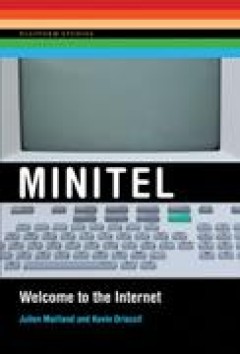
Minitel: Welcome to the Internet
The first scholarly book in English on Minitel, the pioneering French computer network, offers a history of a technical system and a cultural phenomenon. A decade before the Internet became a medium for the masses in the United States, tens of millions of users in France had access to a network for e-mail, e-commerce, chat, research, game playing, blogging, and even an early form of online porn…
- Edition
- -
- ISBN/ISSN
- 9780262340205
- Collation
- -
- Series Title
- -
- Call Number
- -

The Narratology of Comic Art
By placing comics in a lively dialogue with contemporary narrative theory, The Narratology of Comic Art builds a systematic theory of narrative comics, going beyond the typical focus on the Anglophone tradition. This involves not just the exploration of those properties in comics that can be meaningfully investigated with existing narrative theory, but an interpretive study of the potential in …
- Edition
- -
- ISBN/ISSN
- 9781315410128
- Collation
- 324 halaman
- Series Title
- -
- Call Number
- 700 MIK n

Technically Together: Reconstructing Community in a Networked World
Why we should not accept “networked individualism” as the inevitable future of community. If social interaction by social media has become “the modern front porch” (as one sociologist argues), offering richer and more various contexts for community and personal connection, why do we often feel lonelier after checking Facebook? For one thing, as Taylor Dotson writes in Technically Togeth…
- Edition
- -
- ISBN/ISSN
- 9780262340861
- Collation
- -
- Series Title
- -
- Call Number
- -

All and Nothing: A Digital Apocalypse
Why 1 = presence and 0 = absence and the digital world formula is x = x n : an exploration of meaning in a universe of infinite replication. In the beginning was the Zero, and the Zero was with God, and God was the One. — All and Nothing In 1854, the British mathematician George Boole presented the idea of a universe the elements of which could be understood in terms of the logic of absence a…
- Edition
- -
- ISBN/ISSN
- 9780262342742
- Collation
- -
- Series Title
- -
- Call Number
- -

Literature and Cartography: Theories, Histories, Genres
The relationship of texts and maps, and the mappability of literature, examined from Homer to Houellebecq. Literary authors have frequently called on elements of cartography to ground fictional space, to visualize sites, and to help readers get their bearings in the imaginative world of the text. Today, the convergence of digital mapping and globalization has spurred a cartographic turn in lite…
- Edition
- -
- ISBN/ISSN
- 9780262342247
- Collation
- -
- Series Title
- -
- Call Number
- -
 Computer Science, Information & General Works
  Philosophy & Psychology
  Religion
  Social Sciences
  Language
  Pure Science
  Applied Sciences
  Art & Recreation
  Literature
  History & Geography