Filter by

Spam: A Shadow History of the Internet
What spam is, how it works, and how it has shaped online communities and the Internet itself. The vast majority of all email sent every day is spam, a variety of idiosyncratically spelled requests to provide account information, invitations to spend money on dubious products, and pleas to send cash overseas. Most of it is caught by filters before ever reaching an in-box. Where does it come f…
- Edition
- -
- ISBN/ISSN
- -
- Collation
- -
- Series Title
- -
- Call Number
- -
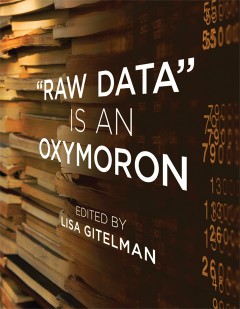
"Raw Data" Is an Oxymoron
Episodes in the history of data, from early modern math problems to today's inescapable “dataveillance,” that demonstrate the dependence of data on culture. We live in the era of Big Data, with storage and transmission capacity measured not just in terabytes but in petabytes (where peta- denotes a quadrillion, or a thousand trillion). Data collection is constant and even insidious, with …
- Edition
- -
- ISBN/ISSN
- 9780262312325
- Collation
- -
- Series Title
- -
- Call Number
- -

Taken for Grantedness: The Embedding of Mobile Communication into Society
An examination of how the mobile phone has become part of the fabric of society—as did such earlier technologies as the clock and the car. Why do we feel insulted or exasperated when our friends and family don't answer their mobile phones? If the Internet has allowed us to broaden our social world into a virtual friend-net, the mobile phone is an instrument of a more intimate social sphere…
- Edition
- -
- ISBN/ISSN
- 9780262305266
- Collation
- -
- Series Title
- -
- Call Number
- -

Virtual Knowledge: Experimenting in the Humanities and the Social Sciences
An examination of emerging forms of knowledge creation using Web-based technologies, analyzed from an interdisciplinary perspective. Today we are witnessing dramatic changes in the way scientific and scholarly knowledge is created, codified, and communicated. This transformation is connected to the use of digital technologies and the virtualization of knowledge. In this book, scholars from a…
- Edition
- -
- ISBN/ISSN
- 9780262305754
- Collation
- -
- Series Title
- -
- Call Number
- -

The Digital Rights Movement: The Role of Technology in Subverting Digital Cop…
The evolution of activism against the expansion of copyright in the digital domain, with case studies of resistance including eBook and iTunes hacks. The movement against restrictive digital copyright protection arose largely in response to the excesses of the Digital Millennium Copyright Act (DMCA) of 1998. In The Digital Rights Movement, Hector Postigo shows that what began as an assertion…
- Edition
- -
- ISBN/ISSN
- 9780262305334
- Collation
- -
- Series Title
- -
- Call Number
- -
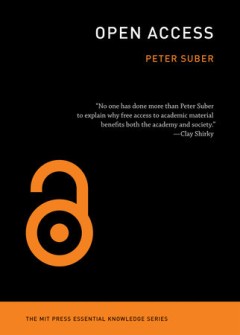
Open Access
A concise introduction to the basics of open access, describing what it is (and isn't) and showing that it is easy, fast, inexpensive, legal, and beneficial. The Internet lets us share perfect copies of our work with a worldwide audience at virtually no cost. We take advantage of this revolutionary opportunity when we make our work “open access”: digital, online, free of charge, and free…
- Edition
- -
- ISBN/ISSN
- 9780262301732
- Collation
- -
- Series Title
- -
- Call Number
- -

Computer algebra in scientific computing : 17th International Workshop, CASC …
This book constitutes the proceedings of the 17th International Workshop on Computer Algebra in Scientific Computing, CASC 2015, held in Aachen, Germany, in September 2015. The 35 full papers presented in this volume were carefully reviewed and selected from 42 submissions. They deal with the ongoing progress both in theoretical computer algebra and its expanding applications. New and closer in…
- Edition
- -
- ISBN/ISSN
- 9783319240213
- Collation
- xiii, 494 pages
- Series Title
- -
- Call Number
- 004

Computer analysis of images and patterns : 16th International Conference, CAI…
The two volume set LNCS 9256 and 9257 constitutes the refereed proceedings of the 16th International Conference on Computer Analysis of Images and Patterns, CAIP 2015, held in Valletta, Malta, in September 2015. The 138 papers presented were carefully reviewed and selected from numerous submissions. CAIP 2015 is the sixteenth in the CAIP series of biennial international conferences devoted to a…
- Edition
- -
- ISBN/ISSN
- 9783319231921
- Collation
- xxii, 841 pages
- Series Title
- -
- Call Number
- 004

Computer assisted assessment : research into e-assessment : 18th Internationa…
This book constitutes the refereed proceedings of the 18th International Conference on Computer Assisted Assessment, CAA 2015, held in Zeist, The Netherlands, in June 2015. The 15 revised full papers presented were carefully reviewed and selected from numerous submissions. The papers present current developments in technology-enhanced assessment. Topics covered include: automatic item generatio…
- Edition
- -
- ISBN/ISSN
- 9783319277042
- Collation
- x, 155 pages
- Series Title
- -
- Call Number
- 004

Computer engineering and technology : 18th CCF Conference, NCCET 2014, Guiyan…
This book constitutes the refereed proceedings of the 18th National Conference on Computer Engineering and Technology, NCCET 2014, held in Guiyang, China, during July/August 2014. The 18 papers presented were carefully reviewed and selected from 85 submissions. They are organized in topical sections on processor architecture; computer application and software optimization; technology on the hor…
- Edition
- -
- ISBN/ISSN
- 9783662458150
- Collation
- xii, 188 pages
- Series Title
- -
- Call Number
- 004
 Computer Science, Information & General Works
 Philosophy & Psychology
 Religion
 Social Sciences
 Language
 Pure Science
 Applied Sciences
 Art & Recreation
 Literature
 History & Geography