Filter by

The Communism of Thought
The Communism of Thought takes as its point of departure a passage in a letter from Dionys Mascolo to Gilles Deleuze: “I have called this communism of thought in the past. And I placed it under the auspices of Hölderlin, who may have only fled thought because he was unable to live it: ‘The life of the spirit between friends, the thoughts that form in the exchange of words, by writing or in…
- Edition
- -
- ISBN/ISSN
- 9780615986968
- Collation
- -
- Series Title
- -
- Call Number
- -

Atopological Trilogy
Atopological Trilogy creates new concepts for Deleuze-Guattarian thought without any heed for sectarian, sermonising, or dutiful readings of the philosophers. In Part I of the trilogy, “Becoming-Sexual of the Sexual,” Aracagök demonstrates the ways in which quantum theory and the concept of “complementarity” inform Deleuze and Guattari’s thought, especially in relation to “becoming…
- Edition
- -
- ISBN/ISSN
- 9780692403723
- Collation
- -
- Series Title
- -
- Call Number
- -

and Another Thing
And Another Thing: Nonanthropocentrism and Art, Katherine Behar and Emmy Mikelson explore how artists engage with nonanthropocentrism, one of the primary tenets shared by recent speculative realist and new materialist philosophies. Extending their investigations in And Another Thing, an exhibition which the authors curated in 2011, this volume documents both that exhibition and expands on two o…
- Edition
- -
- ISBN/ISSN
- 9780692652664
- Collation
- -
- Series Title
- -
- Call Number
- -
Chapter Writing, Copying, Translating
What do Mesoamerica, Greece, Byzantium, Island, Chad, Ethiopia, India, Tibet, China and Japan have in common? Like many other cultures of the world, they share a particular form of cultural heritage: ancient handwritten documents. This volume offers in 16 articles on philological, cultural, and material aspects of manuscripts a common ground across disciplines and cultures.
- Edition
- -
- ISBN/ISSN
- 9783110225631
- Collation
- -
- Series Title
- -
- Call Number
- -
Chapter Quantitative explorations of the worldwide distribution of rare chara…
In this article, the distribution of rare features among the world’s languages is investigated based on the data from the World Atlas of Language Structures (Haspelmath et al. 2005). A Rarity Index for a language is defined, resulting in a listing of the world’s languages by mean rarity. Further, a Group Rarity Index is defined to be able to measure average rarity of genealogical or areal g…
- Edition
- -
- ISBN/ISSN
- 9783110219098
- Collation
- -
- Series Title
- -
- Call Number
- -
Chapter Ki issues in Turkish
De Vries’ (2006 et seq.) addition of ‘par-Merge’ to the extant Merger operations utilized by the narrow syntax provides a means by which to model parataxis and yet maintain that paratactic constituents (i.e. parentheticals) are concatenated with their host in the narrow syntax in the structural position in which they are observed. A principal ingredient of the par-Merge approach to parata…
- Edition
- -
- ISBN/ISSN
- 9781614514831
- Collation
- -
- Series Title
- -
- Call Number
- -
Chapter 87 Scalar implicature as a grammatical phenomenon
This article develops various arguments for the view that scalar implicatures should be de-rived within grammar and not by a theory of language use (pragmatics). We focus primarily on arguments that scalar implicatures can be computed in embedded positions, a conclusion incompatible with existing pragmatic accounts. We also briefly review additional observations that come from a variety of empi…
- Edition
- -
- ISBN/ISSN
- 9783110253382
- Collation
- -
- Series Title
- -
- Call Number
- -

Chapter 6 On representing anchored parentheses in syntax
The paper is organised as follows. In order to establish which kinds of parentheses should be considered ‘anchored’, I present a global overview in §2. This is followed by a discussion of the core properties of anchored parentheses, focusing on the relation between anchor and parenthesis, and their ‘specificational’ interpretation. §3discusses anchored parenthesis in the domain of par…
- Edition
- -
- ISBN/ISSN
- 9781614517900
- Collation
- -
- Series Title
- -
- Call Number
- -

Technical politics
This is the first monograph devoted to the work of one of the foremost contemporary advocates of contemporary critical theory, Andrew Feenberg. It focuses on Feenberg’s central concept, technical politics, and explores his suggestion that democratising technology design is key to a strategic understanding of the process of civilisational change. In this way, it presents Feenberg’s intervent…
- Edition
- -
- ISBN/ISSN
- 9781526105349
- Collation
- -
- Series Title
- -
- Call Number
- -
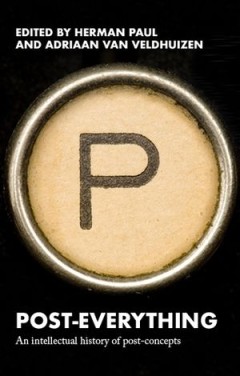
Post-everything
What does it mean to live in an era of ‘posts’? At a time when ‘post-truth’ is on everyone’s lips, this volume seeks to uncover the logic of post-constructions – postmodernism, post-secularism, postfeminism, post-colonialism, post-capitalism, post-structuralism, post-humanism, post-tradition, post-Christian, post-Keynesian and post-ideology – across a wide array of contexts. It sh…
- Edition
- -
- ISBN/ISSN
- 9781526148179
- Collation
- -
- Series Title
- -
- Call Number
- -
 Computer Science, Information & General Works
  Philosophy & Psychology
  Religion
  Social Sciences
  Language
  Pure Science
  Applied Sciences
  Art & Recreation
  Literature
  History & Geography