Filter by
Nonmonotonic reasoning
Nonmonotonic reasoning provides formal methods that enable intelligent systems to operate adequately when faced with incomplete or changing information. In particular, it provides rigorous mechanisms for taking back conclusions that, in the presence of new information, turn out to be wrong and for deriving new, alternative conclusions instead. Nonmonotonic reasoning methods provide rigor simila…
- Edition
- -
- ISBN/ISSN
- 0585037035
- Collation
- 1 online resource (xii, 285 pages) :illustrations.
- Series Title
- -
- Call Number
- -

Noxious New York :the racial politics of urban health and environmental justice
'Noxious New York' examines the culture, politics, and history of the movement for environmental justice in New York City, tracking activism in four neighborhoods on issues of public health, garbage, and energy systems in the context of privatisation, deregulation, and globalisation.OCLC-licensed vendor bibliographic record.
- Edition
- -
- ISBN/ISSN
- 9780262284646
- Collation
- 1 online resource (x, 282 pages) :illustrations, map.
- Series Title
- -
- Call Number
- -
Data action :using data for public good
"Data Action will offer a model for reading, collecting, visualizing, and putting data to work on civic change. Using arresting graphics and influential case studies, as well as incorporating cultural and historical context, Data Action presents a helpful corrective to standard practice. Historically, data has been used and manipulated to make policy decisions without input from the general pub…
- Edition
- -
- ISBN/ISSN
- 0262359146
- Collation
- 1 online resource.
- Series Title
- -
- Call Number
- -

Scientists under surveillance :the FBI files
Cold War-era FBI files on famous scientists, including Neil Armstrong, Isaac Asimov, Albert Einstein, Richard Feynman, Alfred Kinsey, and Timothy Leary. Armed with ignorance, misinformation, and unfounded suspicions, the FBI under J. Edgar Hoover cast a suspicious eye on scientists in disciplines ranging from physics to sex research. If the Bureau surveilled writers because of what they believe…
- Edition
- -
- ISBN/ISSN
- 9780262353021
- Collation
- 1 online resource (440 pages).
- Series Title
- -
- Call Number
- -
The open handbook of linguistic data management
A guide to principles and methods for the management, archiving, sharing, and citing of linguistic research data, especially digital data.Doing language science depends on collecting, transcribing, annotating, analyzing, storing, and sharing linguistic research data. This volume offers a guide to linguistic data management, engaging with current trends toward the transformation of linguistics i…
- Edition
- -
- ISBN/ISSN
- 9780262362177
- Collation
- 1 online resource.
- Series Title
- -
- Call Number
- -
Machines we trust :perspectives on dependable AI
"A collection of critical essays dealing with the social and ethical impacts of AI including issues of trust, reliability, and bias"--OCLC-licensed vendor bibliographic record.
- Edition
- -
- ISBN/ISSN
- 0262366215
- Collation
- 1 online resource.
- Series Title
- -
- Call Number
- -

Government's place in the market
In his first book, the former New York governor and current CNN cohost offers a manifesto on the economy and the public interest.OCLC-licensed vendor bibliographic record.
- Edition
- -
- ISBN/ISSN
- 9780262295987
- Collation
- 1 online resource (83 pages).
- Series Title
- -
- Call Number
- -

What it all means
"An introduction to semantics for the general reader. How things mean, from animal communication to music"--OCLC-licensed vendor bibliographic record.
- Edition
- -
- ISBN/ISSN
- 9780262371780
- Collation
- 1 online resource.
- Series Title
- -
- Call Number
- -
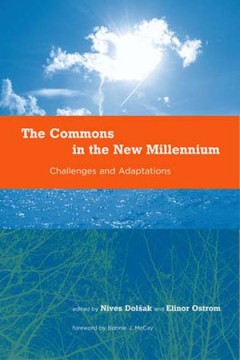
The Commons in the New Millennium: Challenges and Adaptation
Based on papers given at the 2000 conference held in Bloomington, Indiana.Globalization, population growth, and resource depletion are drawing increased attention to the importance of common resources such as forests, water resources, and fisheries. It is critical that these resources be governed in an equitable and sustainable way. The Commons in the New Millennium presents cutting-edge resear…
- Edition
- -
- ISBN/ISSN
- 9780262271868
- Collation
- 1 online resource (xxiv, 369 pages) :illustrations, map.
- Series Title
- -
- Call Number
- -
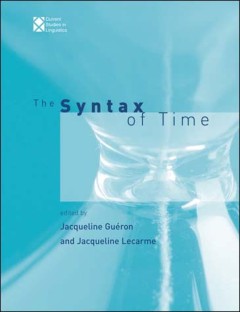
The Syntax of Time
Updated versions of talks first presented at the International Round Table on the Syntax of Tense and Aspect in November 2000 at the Universit?e Paris 7"--Preface.Any analysis of the syntax of time is based on a paradox: it must include a syntax-based theory of both tense construal and event construal. Yet while time is undimensional, events have a complex spatiotemporal structure that reflects…
- Edition
- -
- ISBN/ISSN
- 9780262274494
- Collation
- 1 online resource (x, 662 pages) :illustrations.
- Series Title
- -
- Call Number
- -
 Computer Science, Information & General Works
  Philosophy & Psychology
  Religion
  Social Sciences
  Language
  Pure Science
  Applied Sciences
  Art & Recreation
  Literature
  History & Geography