Filter by

Spectral Geometry of Partial Differential Operators
The aim of Spectral Geometry of Partial Differential Operators is to provide a basic and self-contained introduction to the ideas underpinning spectral geometric inequalities arising in the theory of partial differential equations.Historically, one of the first inequalities of the spectral geometry was the minimization problem of the first eigenvalue of the Dirichlet Laplacian. Nowadays, this t…
- Edition
- -
- ISBN/ISSN
- 9780429780561,
- Collation
- -
- Series Title
- -
- Call Number
- -

What Is Philosophy?
“Every written work,” Giorgio Agamben opens the preface to Infancy and History, “can be regarded as the prologue (or rather, the broken cast) of a work never penned, and destined to remain so.” Although that observation applies to any work of writing, the exemplary case is that of a work of philosophy. While every written work is put to work in its nonexistent successor, a work of philo…
- Edition
- -
- ISBN/ISSN
- 9780615685137
- Collation
- -
- Series Title
- -
- Call Number
- -

Theory Is Like a Surging Sea
In a 1917 letter to Gershom Scholem, Walter Benjamin writes, “Theory is like a surging sea.” This small book takes more than its title from that line—it takes that line as a point of departure in Erich Auerbach’s sense, an Ansatzpunkt, as a compositional principle so that what follows can be read in its entirety as a gloss on the remainder of Benjamin’s sentence: “Theory is like a s…
- Edition
- -
- ISBN/ISSN
- 9780692283950
- Collation
- -
- Series Title
- -
- Call Number
- -

of Learned Ignorance
What is a problem? What’s asked in that question, and how does one even begin to take its measure? How else could one begin, except as one does with any other problem—by way of its impulsion. Of Learned Ignorance: Idea of a Treatise in Philosophy is about philosophy because philosophy is about problems: philosophy, in a word, is where problems become a problem. After Anti-Oedipus, in the Ka…
- Edition
- -
- ISBN/ISSN
- 9780615822549
- Collation
- -
- Series Title
- -
- Call Number
- -

Nicholas of Cusa and The Kairos of Modernity
In this far-reaching essay, historian Michael Edward Moore examines modernity as an historical epoch following the end of the medieval period — and as a “messianic concept of time.” In the early twentieth century, a debate over the meaning and origins of modernity unfolded among the philosophers Ernst Cassirer, Hans-Georg Gadamer and Hans Blumenberg. These thinkers tried to resolve the pu…
- Edition
- -
- ISBN/ISSN
- 9780615840550
- Collation
- -
- Series Title
- -
- Call Number
- -

The Communism of Thought
The Communism of Thought takes as its point of departure a passage in a letter from Dionys Mascolo to Gilles Deleuze: “I have called this communism of thought in the past. And I placed it under the auspices of Hölderlin, who may have only fled thought because he was unable to live it: ‘The life of the spirit between friends, the thoughts that form in the exchange of words, by writing or in…
- Edition
- -
- ISBN/ISSN
- 9780615986968
- Collation
- -
- Series Title
- -
- Call Number
- -
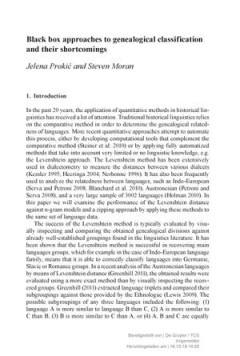
Chapter Quantitative explorations of the worldwide distribution of rare chara…
In this article, the distribution of rare features among the world’s languages is investigated based on the data from the World Atlas of Language Structures (Haspelmath et al. 2005). A Rarity Index for a language is defined, resulting in a listing of the world’s languages by mean rarity. Further, a Group Rarity Index is defined to be able to measure average rarity of genealogical or areal g…
- Edition
- -
- ISBN/ISSN
- 9783110219098
- Collation
- -
- Series Title
- -
- Call Number
- -
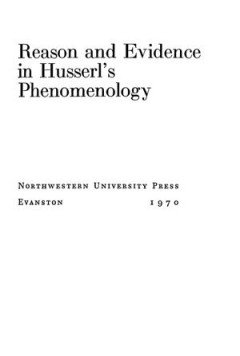
Reason and Evidence in Husserl's Phenomenology
In Reason and Evidence in Husserl’s Phenomenology, David Michael Kleinberg-Levin examines Husserl’s concept of necessary, a priori, and absolutely certain indubitable evidence, which he terms apodictic, and his related concept of complete evidence, which he terms adequate. To do so it explicates some of the more general relevant features of phenomenology as a whole.
- Edition
- -
- ISBN/ISSN
- 9780810138513
- Collation
- -
- Series Title
- -
- Call Number
- -

The Philosophical Salon: Speculations, Reflections, Interventions
Through the interpretative lens of today’s leading thinkers, The Philosophical Salon illuminates the persistent intellectual queries and the most disquieting concerns of our actuality. Across its three main divisions—Speculations, Reflections, and Interventions—the volume constructs a complex mirror, in which our age might be able to recognize itself with all its imperfections, shadowy sp…
- Edition
- -
- ISBN/ISSN
- 9781785420382
- Collation
- -
- Series Title
- -
- Call Number
- -

The Chernobyl Herbarium: Fragments Of An Exploded Consciousness
We entrust readers with thirty fragments of reflections, meditations, recollections, and images — one for each year that has passed since the explosion that rocked and destroyed a part of the Chernobyl nuclear power station in April 1986. The aesthetic visions, thoughts, and experiences that have made their way into this book hover in a grey region between the singular and self-enclosed, on t…
- Edition
- -
- ISBN/ISSN
- 9781785420269
- Collation
- -
- Series Title
- -
- Call Number
- -
 Computer Science, Information & General Works
  Philosophy & Psychology
  Religion
  Social Sciences
  Language
  Pure Science
  Applied Sciences
  Art & Recreation
  Literature
  History & Geography