Filter by

All and Nothing: A Digital Apocalypse
In 1854, the British mathematician George Boole presented the idea of a universe the elements of which could be understood in terms of the logic of absence and presence: 0 and 1, all and nothing—the foundation of binary code. The Boolean digits 0 and 1 do not designate a quantity. In the Boolean world, x times x always equals x; all and nothing meet in the formula x = xn. As everything become…
- Edition
- -
- ISBN/ISSN
- 9780262342742
- Collation
- -
- Series Title
- -
- Call Number
- -
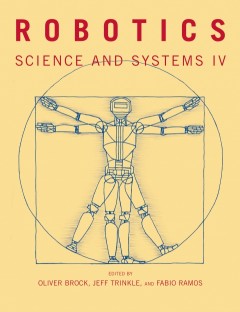
Robotics: Science and systems IV
Robotics: Science and Systems IV spans a wide spectrum of robotics, bringing together researchers working on the foundations of robotics, robotics applications, and analysis of robotics systems. This volume presents the proceedings of the fourth annual Robotics: Science and Systems conference, held in 2008 at the Swiss Federal Institute of Technology in Zurich. The papers presented cover a rang…
- Edition
- -
- ISBN/ISSN
- 9780262258623
- Collation
- 1 online resource (xv, 317 pages) :illustrations
- Series Title
- -
- Call Number
- -
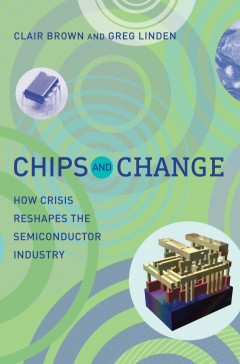
Chips and change: How crisis reshapes the semiconductor industry
How the chip industry has responded to a series of crises over the past twenty-five years, often reinventing itself and shifting the basis for global competitive advantage. For decades the semiconductor industry has been a driver of global economic growth and social change. Semiconductors, particularly the microchips essential to most electronic devices, have transformed computing, communica…
- Edition
- -
- ISBN/ISSN
- 9780262258654
- Collation
- 1 online resource (xi, 257 pages): illustrations
- Series Title
- -
- Call Number
- -
Asset price bubbles :implications for monetary, regulatory, and international…
Revised papers of a conference sponsored by the Federal Reserve Bank of Chicago and the World Bank.In both the industrialized and developing worlds, a distinctive feature of the last two decades has been prolonged buildups and sharp collapses in asset markets such as stock, housing, and exchange markets. The volatility has sparked intense debate in academic and policy circles over the appropria…
- Edition
- -
- ISBN/ISSN
- 9780262275910
- Collation
- 1 online resource (xxvi, 581 pages) :illustrations
- Series Title
- -
- Call Number
- -

The Strip: Las Vegas and the Architecture of the American Dream
Maps showing the Las Vegas Strip over time on front and back endpapers."The Las Vegas Strip has impersonated the Wild West, with saloon doors and wagon wheels; it has decked itself out in midcentury modern sleekness. It has illuminated itself with twenty-story-high neon signs, then junked them. After that came Disney-like theme parks featuring castles and pirates, followed by replicas of Veneti…
- Edition
- -
- ISBN/ISSN
- 9780262338219
- Collation
- 1 online resource (254 pages) :illustrations (chiefly color)
- Series Title
- -
- Call Number
- -
The Spontaneous Brain: From the Mind–Body to the World–Brain Problem
An argument for a Copernican revolution in our consideration of mental features -- a shift in which the world-brain problem supersedes the mind-body problem. Philosophers have long debated the mind-body problem -- whether to attribute such mental features as consciousness to mind or to body. Meanwhile, neuroscientists search for empirical answers, seeking neural correlates for consciousness, se…
- Edition
- -
- ISBN/ISSN
- 9780262346962
- Collation
- 1 online resource (xxvi, 506 pages) :illustrations
- Series Title
- -
- Call Number
- -

Associative engines :connectionism, concepts, and representational change
"A Bradford book."Connectionist approaches, Andy Clark argues, are driving cognitive science toward a radical reconception of its explanatory endeavor. At the heart of this reconception lies a shift toward a new and more deeply developmental vision of the mind - a vision that has important implications for the philosophical and psychological understanding of the nature of concepts, of mental ca…
- Edition
- -
- ISBN/ISSN
- 9780262270427
- Collation
- 1 online resource (xiii, 252 pages) :illustrations
- Series Title
- -
- Call Number
- -

The asymmetrical brain
Revised edition of: Brain asymmetry / edited by Richard J. Davidson and Kenneth Hugdahl. c1995."A Bradford book."The folk belief that the left brain hemisphere is dominant for language and the right for visuospatial functions is incomplete and even misleading. Research shows that asymmetries exist at all levels of the nervous system and apply to emotional as well as to higher cognitive processe…
- Edition
- -
- ISBN/ISSN
- 9780262275842
- Collation
- 1 online resource (xiii, 796 pages, 8 unnumbered pages of plates) :illustrations (some color)
- Series Title
- -
- Call Number
- -

Asymmetry in morphology
Di Sciullo argues that the asymmetric property of morphological relations is part of the language facility. She proposes a theory of grammar, Asymmetry Theory, according to which generic operations have specific instantiations in parallel deviations of the computational space.OCLC-licensed vendor bibliographic record.
- Edition
- -
- ISBN/ISSN
- 9780262302845
- Collation
- 1 online resource (xix, 234 pages) :illustrations.
- Series Title
- -
- Call Number
- -

At a distance :precursors to art and activism on the Internet
Networked collaborations of artists did not begin on the Internet. In this multidisciplinary look at the practice of art that takes place across a distance -- geographical, temporal, or emotional -- theorists and practitioners examine the ways that art, activism, and media fundamentally reconfigured each other in experimental networked projects of the 1970s and 1980s. By providing a context for…
- Edition
- -
- ISBN/ISSN
- 9780262270144
- Collation
- 1 online resource (xiv, 486 pages) :illustrations.
- Series Title
- -
- Call Number
- -
 Computer Science, Information & General Works
  Philosophy & Psychology
  Religion
  Social Sciences
  Language
  Pure Science
  Applied Sciences
  Art & Recreation
  Literature
  History & Geography