Filter by
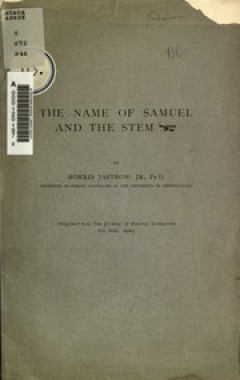
The Name of Samuel and The Stem
Generally the writer contents himself with a single reference to the interpretation of a person's name given in the account of his birth, but in the case of Samuel, as in that of Isaac, he dwells upon the interpretation with an emphasis which is unmistakable and which is clearly intentional.2 It is not surprising, in view of the difficulties involved in the first chapter of Samuel where the bir…
- Edition
- -
- ISBN/ISSN
- -
- Collation
- p. 83-105,
- Series Title
- -
- Call Number
- 222.4

'Neath Monterey pines
- Edition
- -
- ISBN/ISSN
- -
- Collation
- 12 p. 19 cm,Cover title
- Series Title
- -
- Call Number
- 298344
- Edition
- -
- ISBN/ISSN
- -
- Collation
- 12 p. 19 cm,Cover title
- Series Title
- -
- Call Number
- 298344

Studies of Christianity, or, Timely Thoughts for Religious Thinkers : a serie…
- Edition
- -
- ISBN/ISSN
- -
- Collation
- xlix, 494 p.400-1
- Series Title
- -
- Call Number
- 230
- Edition
- -
- ISBN/ISSN
- -
- Collation
- xlix, 494 p.400-1
- Series Title
- -
- Call Number
- 230

The practice of Christian perfection volume 2
- Edition
- -
- ISBN/ISSN
- -
- Collation
- 3 v,Translation from the French copy rather than the Spanish original
- Series Title
- -
- Call Number
- 292 ROD p
- Edition
- -
- ISBN/ISSN
- -
- Collation
- 3 v,Translation from the French copy rather than the Spanish original
- Series Title
- -
- Call Number
- 292 ROD p

Milk and Honey: Technologies of Plenty in the Making of a Holy Land
An innovative historical analysis of the intersection of religion and technology in making the modern state, focusing on bodily production and reproduction across the human-animal divide. In Milk and Honey, Tamar Novick writes a revolutionary environmental history of the state that centers on the intersection of technology and religion in modern Palestine/Israel. Focusing on animals and the …
- Edition
- -
- ISBN/ISSN
- 9780262374552
- Collation
- -
- Series Title
- -
- Call Number
- 215

Rousseau and the Problem of Human Relations
Among Jean-Jacques Rousseau's chief preoccupations was the problem of self-interest implicit in all social relationships. A person with divided loyalties (i.e., to both himself and his cohorts) was, in Rousseau's thinking, a divided person. According to John Warner's Rousseau and the Problem of Human Relations, not only did Rousseau never solve this problem, he believed it was fundamentally uns…
- Edition
- -
- ISBN/ISSN
- 9780271071008
- Collation
- -
- Series Title
- -
- Call Number
- 210.1

Derrida After the End of Writing: Political Theology and New Materialism
This book explores some of the implications of interpreting Derrida through the new materialist lens of technicity or plasticity, attending to the significance of ethics, religion and politics in his later work. Here the intersection of religion and politics becomes the site for Derrida to develop a “political theology without sovereignty.” By reading Derrida from a new materialist perspect…
- Edition
- -
- ISBN/ISSN
- 9780823277834
- Collation
- -
- Series Title
- -
- Call Number
- 297.272

A Woman of Valour the Biography of Marie-Louise Bouchard Labelle
A Woman of Valour is the biography of Marie-Louise Bouchard Labelle, a French-Canadian woman who found love with a priest thirty-three years her senior. Against all social convention, they lived, produced three children, and built a life together after fleeing their village. However, after several years together, Bouchard’s husband ultimately chose to return to the priesthood, abandoning his …
- Edition
- -
- ISBN/ISSN
- 9781897425848.01
- Collation
- -
- Series Title
- Our Lives: Diary, Memoir, and Letters
- Call Number
- 256 pages
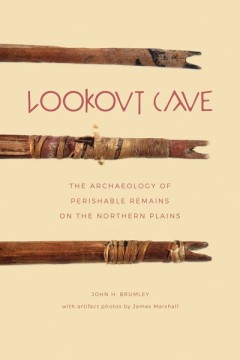
Lookout Cave the Archaeology of Perishable Remains on the Northern Plains
In the mid-1960s as a young high school student John Brumley visited Lookout Cave for the first time and knew immediately that the site was exceptional. The cave, located in north central Montana, was initially discovered in 1920 but it wasn’t until 1969 that a field crew from the University of Montana excavated a large portion of the remote site. The materials recovered in that excavation re…
- Edition
- -
- ISBN/ISSN
- 9781771991803
- Collation
- -
- Series Title
- Recovering the Past: Studies in Archaeology
- Call Number
- 280 pages
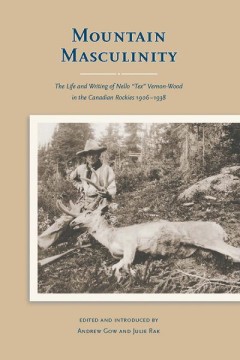
Mountain Masculinity the Life and Writing of Nello “Tex” Vernon-Wood in …
In 1906, Nello Vernon-Wood (1882–1978) reinvented himself as Tex Wood, Banff hunting guide and writer of “yarns of the wilderness by a competent outdoorsman.” His homespun stories of a vanishing era, in such periodicals as The Sportsman, Hunting and Fishing, and the Canadian Alpine Journal, have much to tell us about the west as envisioned by those who wanted to leave the industrialized w…
- Edition
- Andrew Gow and Julie Rak
- ISBN/ISSN
- 9781897425022.01
- Collation
- -
- Series Title
- -
- Call Number
- 237 pages
 Computer Science, Information & General Works
 Philosophy & Psychology
 Religion
 Social Sciences
 Language
 Pure Science
 Applied Sciences
 Art & Recreation
 Literature
 History & Geography