Filter by

Mistrust: An Ethnographic Theory
Trust occupies a unique place in contemporary discourse. Seen as both necessary and good, it is variously depicted as enhancing the social fabric, lowering crime rates, increasing happiness, and generating prosperity. It allows for complex political systems, permits human communication, underpins financial instruments and economic institutions, and holds society itself together. There is scant …
- Edition
- -
- ISBN/ISSN
- 9780997367522
- Collation
- -
- Series Title
- -
- Call Number
- 300

The Logic of Invention
In this long-awaited sequel to The Invention of Culture, Roy Wagner tackles the logic and motives that underlie cultural invention. Could there be a single, logical factor that makes the invention of the distinction between self and other possible, much as specific human genes allow for language? Wagner explores what he calls “the reciprocity of perspectivesâ€_x009d_ through a journey …
- Edition
- -
- ISBN/ISSN
- 9780999157053
- Collation
- -
- Series Title
- -
- Call Number
- 300
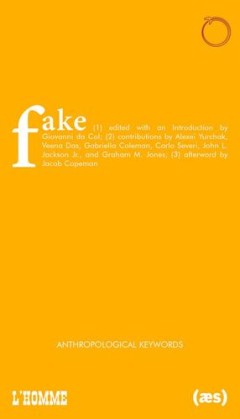
'Fake: Anthropological Keywords
Fakes, forgery, counterfeits, hoaxes, bullshit, frauds, knock offs—such terms speak, ostensibly, to the inverse of truth or the obverse of authenticity and sincerity. But what does the modern human obsession with fabrications and frauds tell us about ourselves? And what can anthropology tell us about this obsession? This timely book is the product of the first Annual Debate of Anthropological…
- Edition
- -
- ISBN/ISSN
- 9780997367577
- Collation
- -
- Series Title
- -
- Call Number
- 300

Marriage by Force?
With forced marriage, as with so many human rights issues, the sensationalized hides the mundane, and oversimplified popular discourses miss the range of experiences. In sub-Saharan Africa, the relationship between coercion and consent in marriage is a complex one that has changed over time and place, rendering impossible any single interpretation or explanation. The legal experts, anthropol…
- Edition
- -
- ISBN/ISSN
- 9780821445495
- Collation
- -
- Series Title
- -
- Call Number
- 300

BEING PROFILED : COGITAS ERGO SUM, 10 Years of Profiling the European Citizen
This book celebrates and mourns the increasing relevance of the 2008 volume of 'Profiling the European Citizen. Cross-Disciplinary Perspectives' (edited by Mireille Hildebrandt & Serge Gutwirth). Both volumes contain in-depth investigations by lawyers, philosophers and computer scientists into the legal, philosophical and computational background of the emerging algorithmic order. In BEING PROF…
- Edition
- -
- ISBN/ISSN
- 9789048550180
- Collation
- -
- Series Title
- -
- Call Number
- 323.6 BEI

Being and Hearing : Making Intelligible Worlds in Deaf Kathmandu
How do deaf people in different societies perceive and conceive the world around them? Drawing on four years of anthropological fieldwork in Nepali deaf communities, Being and Hearing shows how questions of cultural difference are profoundly shaped by local habits of perception. Beginning with the premise that philosophy and cultural intuition are separated only by genre and pedigree, Peter Gra…
- Edition
- -
- ISBN/ISSN
- 978-0-9991570-3-9
- Collation
- -
- Series Title
- -
- Call Number
- 305.908 2 GRA b
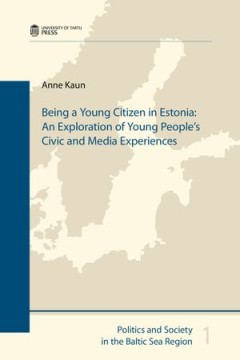
Being a Young Citizen in Estonia : An Exploration of Young People’s Civic a…
The book gives an intriguing insight into how young people in Estonia, twenty years after the establishment of democracy, perceive their own role as citizens. It does so in a theoretical framework that stresses the embeddedness of the civic experiences in a media-dominated environment, thus closely linking civic and media experiences. Based on the analysis of both qualitative interview data and…
- Edition
- -
- ISBN/ISSN
- 978–9949–32–275–6
- Collation
- -
- Series Title
- Politics and Society in the Baltic Sea Region 1
- Call Number
- 323.352 KAU b

Before Kukulkán : Bioarchaeology of Maya Life, Death, and Identity at Classi…
This volume illuminates human lifeways in the northern Maya lowlands prior to the rise of Chichén Itzá. This period and area have been poorly understood on their own terms, obscured by scholarly focus on the central lowland Maya kingdoms. "Before Kukulkán" is anchored in three decades of interdisciplinary research at the Classic Maya capital of Yaxuná, located at a contentious crossroads of…
- Edition
- -
- ISBN/ISSN
- 978-0-8165-3264-3
- Collation
- -
- Series Title
- -
- Call Number
- 305.897 BEF

Before and After Gender : Sexual Mythologies of Everyday Life
Written in the early 1970s amidst widespread debate over the causes of gender inequality, Marilyn Strathern's Before and After Gender was intended as a widely accessible analysis of gender as a powerful cultural code and sex as a defining mythology. But when the series for which it was written unexpectedly folded, the manuscript went into storage, where it remained for more than four decades. T…
- Edition
- -
- ISBN/ISSN
- 978-0-9861325-3-7
- Collation
- -
- Series Title
- -
- Call Number
- 305.3 STR b

Classifying the Zhuangzi Chapters
The relationships, both historical and philosophical, among the Zhuangzi’s Inner, Outer, and Miscellaneous chapters are the subject of ancient and enduring controversy.
- Edition
- -
- ISBN/ISSN
- 9780472901340
- Collation
- -
- Series Title
- -
- Call Number
- 305.8 SAV c
 Computer Science, Information & General Works
  Philosophy & Psychology
  Religion
  Social Sciences
  Language
  Pure Science
  Applied Sciences
  Art & Recreation
  Literature
  History & Geography