Filter by
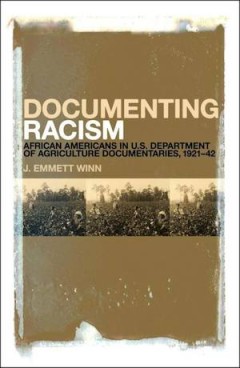
Documenting Racism: African Americans in US Department of Agriculture Documen…
From the silent era through the 1950s, the U.S. Department of Agriculture was the preeminent government filmmaking organization. In the United States, USDA films were shown in movie theaters, public and private schools at all educational levels, churches, libraries and even in open fields. For many Americans in the early 1900s, the USDA films were the first motion pictures they watched. And yet…
- Edition
- -
- ISBN/ISSN
- 9780826405555
- Collation
- -
- Series Title
- -
- Call Number
- 791.43 WIN d
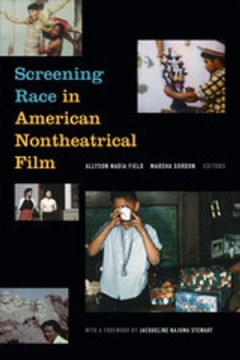
Screening Race in American Nontheatrical Film
Although overlooked by most narratives of American cinema history, films made for purposes outside of theatrical entertainment dominated twentieth-century motion picture production. This volume adds to the growing study of nontheatrical films by focusing on the way filmmakers developed and audiences encountered ideas about race, identity, politics, and community outside the borders of theatrica…
- Edition
- -
- ISBN/ISSN
- 9781478004141
- Collation
- -
- Series Title
- -
- Call Number
- 791.43 SCR s
John C. Parkin, Archives and Photography : Reflections on the Practice and Pr…
Architectural practice in post-World War II Canada brought substantial change to the face of the Canadian built environment, led by the contribution of John C. Parkin. As senior partner at the Toronto-based architectural firm John B. Parkin Associates (no relation) from 1947 to the 1970s, Parkin oversaw the creation of a large number of modernist projects, including hospitals, airports, schools…
- Edition
- -
- ISBN/ISSN
- 978-1-55238-639-2
- Collation
- -
- Series Title
- -
- Call Number
- 720.92
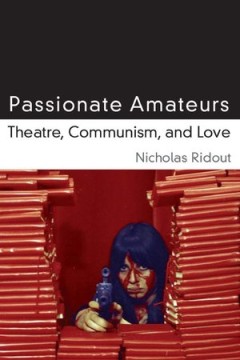
Passionate Amateurs: Theatre, Communism and Love
Beginning with Chekhov's Uncle Vanya, Passionate Amateurs tells a new story about modern theater: the story of a romantic attachment to theater's potential to produce surprising experiences of human community. Ridout argues that theater in modern capitalism can help us think afresh about notions of work, time, and freedom.Passionate Amateurs tells a new story about modern theater: the story of …
- Edition
- -
- ISBN/ISSN
- 9780472029594
- Collation
- -
- Series Title
- -
- Call Number
- 790 RID p

Screening Auschwitz: Wanda Jakubowska's The Last Stage and the Politics of Co…
This book about the early screen representation of Auschwitz-Birkenau deals with the classic Holocaust film made in 1948 in Poland by Auschwitz survivor, director Wanda Jakubowska. The Last Stage (or The Last Stop) is a pioneering work – the first narrative film to portray the former Nazi German camp. Haltof discusses Jakubowska's life and career before World War II, her imprisonment dur…
- Edition
- -
- ISBN/ISSN
- 9780810136083
- Collation
- -
- Series Title
- -
- Call Number
- 791.43 HAL s
Cinema of Confinement
"In this book, Thomas J. Connelly draws on a number of key psychoanalytic concepts from the works of Jacques Lacan, Slavoj Žižek, Joan Copjec, Michel Chion, and Todd McGowan to identify and describe a genre of cinema characterized by spatial confinement. Examining classic films such as Alfred Hitchcock's Rope and Stanley Kubrick's The Shining, as well as current films such as Room, Green Room…
- Edition
- -
- ISBN/ISSN
- 9780810139237
- Collation
- -
- Series Title
- -
- Call Number
- 791.43 CON c
Science Fiction Cinema and 1950s Britain: Recontextualising the Golden Age
For the last fifty years, discussion of 1950s science fiction cinema has been dominated by the view that the genre reflected US paranoia about Soviet brainwashing and the nuclear bomb. However, classic films, such as Invasion of the Body Snatchers (1956) and It Came from Outer Space (1953), were regularly exported to countries across the world. The histories of their encounters with foreign aud…
- Edition
- -
- ISBN/ISSN
- 9781501322532
- Collation
- -
- Series Title
- -
- Call Number
- 791.435 JON s

Martin Scorsese's Divine Comedy: Movies and Religion
Catherine O'Brien draws on the structure of Dante's Divine Comedy to explore Scorsese's feature films from Who's that knocking at my door (1967-69) to Silence (2016). In Dante's poem in 100 cantos, the Pilgrim is guided by the poet Virgil down through the circles of Hell in Inferno; he then climbs the steep Mountain of the Seven Deadly Sins in Purgatory; and he finally encounters God in Paradis…
- Edition
- -
- ISBN/ISSN
- 9781350003279
- Collation
- -
- Series Title
- -
- Call Number
- 791.43 OBR m
Lessons in Perception: The Avant-Garde Filmmaker as Practical Psychologist
Lessons in Perception seeks to clarify notoriously elusive themes of the avant-garde with the use of existing research from the field of psychology. There is a long-standing history of reference to psychological concepts in relation to avant-garde film, such as its unique relationship to memory, visual perception, narrative comprehension, and synesthesia. Yet direct analysis of these topics in …
- Edition
- -
- ISBN/ISSN
- 9781785336416
- Collation
- -
- Series Title
- -
- Call Number
- 791.43 TAB l
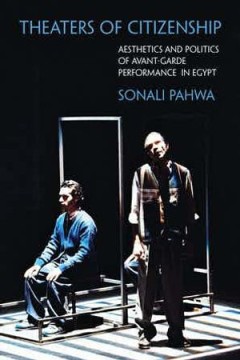
Theaters of Citizenship: Aesthetics and Politics of Avant-Gardist Performance…
Theaters of Citizenship investigates the Egyptian movement for free theater, arguing that it evolved from an avant-gardist movement to an undercommons of revolutionary cultural practice. Using historiography, ethnography, and performance analysis, the book tells a story of this avant-garde from 2004-2014, analyzing its staging of rights claims, generational identity politics, and post-revolutio…
- Edition
- -
- ISBN/ISSN
- 9780810141766
- Collation
- -
- Series Title
- -
- Call Number
- 792 PAH t
 Computer Science, Information & General Works
  Philosophy & Psychology
  Religion
  Social Sciences
  Language
  Pure Science
  Applied Sciences
  Art & Recreation
  Literature
  History & Geography