Text
Lamak: Ritual objects in Bali
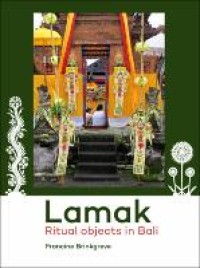
This is the first study to examine in detail ritual objects known as ‘Lamak’, a fascinating and unique form of ephemeral material culture which is a prominent feature of Balinese creativity. A lamak is a long narrow ritual hanging that is an essential requirement at almost all rituals in Bali. It is hung from altars and shrines at temple festivals and on festive holy days. Made usually of palm leaves, it is by nature ephemeral and it is made time and again. Even though permanent forms of the lamak, made of cloth or coins, do exist, the ephemeral palm leaf form must be present. Sometimes reaching a length of several metres and decorated with a range of motifs, its most elaborate forms are made by specialist craftsmen and women. The lamak serves as base for offerings and attracts deities and deified ancestors to them. Decorative motifs representing sources of life are ordered according to Balinese concepts of the vertical structure of the cosmos. Best known among the motifs is the cili, a human figure in female form that symbolizes human fertility and regeneration. Through offerings and the active role of the lamak, worshippers offer thanks to their deities and request prosperity and protection. Despite decades of change and modernization that have affected all aspects of life in Bali, the essential role of the lamak has survived intact. Although there are many studies of Bali’s internationally appreciated arts and crafts, this is the first one to examine in detail this fascinating and unique form of ephemeral material culture which is a prominent feature of Balinese creativity. The study answers the question: why do Balinese make lamak and why do they continue to make them time and again? It examines the use and function of the lamak in ritual, the motifs that decorate them, the materials and techniques to make them, regional and individual styles, and processes of change and commercialization.
Availability
No copy data
Detail Information
- Series Title
-
-
- Call Number
-
-
- Publisher
- Leiden : Sidestone Press., 2016
- Collation
-
274 pages
- Language
-
English
- ISBN/ISSN
-
-
- Classification
-
NONE
- Content Type
-
text
- Media Type
-
computer
- Carrier Type
-
online resource
- Edition
-
-
- Subject(s)
-
-
- Specific Detail Info
-
-
- Statement of Responsibility
-
Brinkgreve, Francine
Other Information
- Cataloger
-
Kholif Basri
- Source
-
https://library.oapen.org/handle/20.500.12657/47199
- Validator
-
-
- Digital Object Identifier (DOI)
-
-
- Journal Volume
-
-
- Journal Issue
-
-
- Subtitle
-
-
- Parallel Title
-
-
Other version/related
No other version available
File Attachment
Comments
You must be logged in to post a comment
 Computer Science, Information & General Works
  Philosophy & Psychology
  Religion
  Social Sciences
  Language
  Pure Science
  Applied Sciences
  Art & Recreation
  Literature
  History & Geography