Text
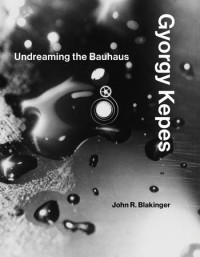
Gyorgy Kepes
Gyorgy Kepes (1906–2001) was the last disciple of Bauhaus modernism, an acolyte of László Moholy-Nagy and a self-styled revolutionary artist. But by midcentury, transplanted to America, Kepes found he was trapped in the military-industrial-aesthetic complex. In this first book-length study of Kepes, John Blakinger argues that Kepes, by opening the research laboratory to the arts, established a new paradigm for creative practice: the artist as technocrat. First at Chicago's New Bauhaus and then for many years at MIT, Kepes pioneered interdisciplinary collaboration between the arts and sciences—what he termed “interthinking” and “interseeing.” Kepes and his colleagues—ranging from metallurgists to mathematicians—became part of an important but little-explored constellation: the Cold War avant-garde.
Availability
No copy data
Detail Information
- Series Title
-
-
- Call Number
-
-
- Publisher
- : The MIT Press., 2019
- Collation
-
1 online resource
- Language
-
English
- ISBN/ISSN
-
9780262352994
- Classification
-
NONE
- Content Type
-
-
- Media Type
-
-
- Carrier Type
-
-
- Edition
-
-
- Subject(s)
-
-
- Specific Detail Info
-
-
- Statement of Responsibility
-
John R. Blakinger
Other Information
- Cataloger
-
Tedy
- Source
-
-
- Validator
-
-
- Digital Object Identifier (DOI)
-
https://doi.org/10.7551/mitpress/11890.001.0001
- Journal Volume
-
-
- Journal Issue
-
-
- Subtitle
-
-
- Parallel Title
-
-
Other version/related
No other version available
File Attachment
Comments
You must be logged in to post a comment
 Computer Science, Information & General Works
  Philosophy & Psychology
  Religion
  Social Sciences
  Language
  Pure Science
  Applied Sciences
  Art & Recreation
  Literature
  History & Geography