Text
Becoming Free
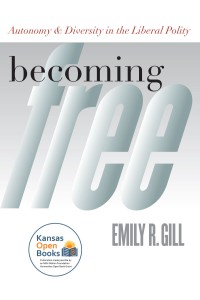
As ethnic, racial, religious, and genderbased groups demand rights to pursue radically diverse lifestyles or maintain their cultural traditions, conflict seems inevitable, even in a free society. Government may offer remedies to social dilemmas—such as affirmative action, curbs on immigration, or protection of gay rights—but these may only fan the flames of resentment. Yet any society that tolerates and protects diversity is more likely to preserve the freedom to live one's life without interference.Emily Gill reexamines the liberal tradition to reconcile its core commitments to autonomy and diversityvalues that in theory are complementary but in practice are often at oddsand to show that the interaction of these values determines how we as individuals become free. In Becoming Free, she argues that true freedom is enhanced through the promotion of diversity and the encouragement of rational reflection on the options it allowsand that limited choice or ignorance diminishes such freedom. Yet an incomplete freedom is what many individuals, groups, and states advocate when they commit to particular cultural traditions or religious beliefs, despite the autonomy they themselves enjoy.Gill traces the implications of these conflicting views by drawing on recent scholarship and legal decisions in six areas: national citizenship, cultural membership, ethnicity and gender, religious belief, sexuality, and civic education. By exploring the tensions between autonomy and diversity in such instances as Boy Scouts membership restrictions, gay rights legislation, and education among the Amish, she not only offers an insightful commentary on current issues but also explores the moral foundations of liberal thought.Unlike those who criticize liberalism for its shallow philosophical grounding, Gill shows it to have a substantive moral content grounded in the individual's capacity to make rational decisions based on critical reflection. In her tightly woven arguments, she explores realworld problems in a meaningful way for students and for anyone concerned with the future of liberalism, showing that becoming free is an ongoing process of human and social development.
Availability
No copy data
Detail Information
- Series Title
-
-
- Call Number
-
-
- Publisher
- : ., 2001
- Collation
-
-
- Language
-
- ISBN/ISSN
-
9780700630929
- Classification
-
NONE
- Content Type
-
text
- Media Type
-
computer
- Carrier Type
-
online resource
- Edition
-
-
- Subject(s)
-
-
- Specific Detail Info
-
-
- Statement of Responsibility
-
Gill, Emily R.
Other Information
- Cataloger
-
Heri
- Source
-
-
- Validator
-
-
- Digital Object Identifier (DOI)
-
10.1353/book.81023
- Journal Volume
-
-
- Journal Issue
-
-
- Subtitle
-
-
- Parallel Title
-
-
Other version/related
No other version available
File Attachment
Comments
You must be logged in to post a comment
 Computer Science, Information & General Works
  Philosophy & Psychology
  Religion
  Social Sciences
  Language
  Pure Science
  Applied Sciences
  Art & Recreation
  Literature
  History & Geography