Text
Chapter The “dining table revolution” in China: the question read through the lens of newspapers
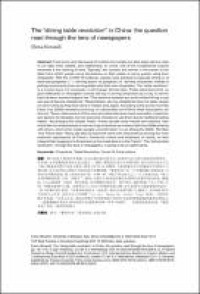
Food is not only the source of nutrition for humans but also plays various roles in our daily lives, beliefs, and relationship. In China, one of the fundamental cultural elements is the sharing of food. Typically, the courses are served in the center of the table from which guests serve themselves on their plates or serve guests using their chopsticks. With the COVID-19 outbreak, people were advised to separate dining or at least use gongshao 公勺'serving spoon' or gongkuai公筷'serving chopsticks' instead of picking food directly from serving plates with their own chopsticks. The “table revolution” is a crucial issue: if it succeeds, it will change China's face. Public advertisements, as giant billboards on Shanghai's streets talking of serving chopsticks as a way to set the heart at ease, showed slogans like: "The distance between you and civilized dining is just one pair of serving chopsticks". Nevertheless, serving chopsticks have not quite caught on yet in China as they have done in Taiwan and Japan. According to the survey from Ma Lihua et al. (2020) resistance is strong. In a declaration from China Hotel Association, we find out: "Some restaurants in China have provided individual meals and public chopsticks and spoons for decades, but not everyone chooses to use them due to traditional eating habits". According to the Global Times, "if they eat with close friends and relatives, they would feel too embarrassed to use serving chopsticks as it seems like they dislike sharing with others, which often makes people uncomfortable" (Li Lei, Zhang Hu, Global Times 2020). The New York Times adds: "Many see sharing food with one's own chopsticks as among the most authentic expressions of China's communal culture and emphasis on family, no less integral than hugging is to Americans or the cheek kiss is to the French". The “dining table revolution”, through the lens of newspapers, is going to be an uphill battle.
Availability
No copy data
Detail Information
- Series Title
-
-
- Call Number
-
-
- Publisher
- Florence : Firenze University Press., 2021
- Collation
-
-
- Language
-
English
- ISBN/ISSN
-
9788855185066
- Classification
-
NONE
- Content Type
-
text
- Media Type
-
computer
- Carrier Type
-
online resource
- Edition
-
-
- Subject(s)
- Specific Detail Info
-
-
- Statement of Responsibility
-
-
Other Information
- Cataloger
-
Candra
- Source
-
-
- Validator
-
-
- Digital Object Identifier (DOI)
-
10.36253/978-88-5518-506-6.14
- Journal Volume
-
-
- Journal Issue
-
-
- Subtitle
-
-
- Parallel Title
-
-
Other version/related
No other version available
File Attachment
Comments
You must be logged in to post a comment
 Computer Science, Information & General Works
  Philosophy & Psychology
  Religion
  Social Sciences
  Language
  Pure Science
  Applied Sciences
  Art & Recreation
  Literature
  History & Geography