Filter by
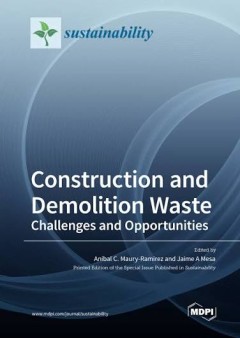
Construction and Demolition Waste: Challenges and Opportunities
Nowadays, construction, maintenance, reparation, rehabilitation, retrofitting, and demolition from infrastructure and buildings generate large amounts of urban waste, which usually are inadequately disposed due to high costs and technical limitations
- Edition
- -
- ISBN/ISSN
- 9783036550503, 9783036550497
- Collation
- 2022
- Series Title
- -
- Call Number
- -

Chapter The management of dredged materials: the «long and winding road» fr…
Both the dredging operations and the management of dredged materials may have heavy impacts on coastal and marine ecosystems. Dredged materials, in particular, have been considered for a very long time nothing more than a waste meant for disposal. Now the time has come to move from the ‘disposal approach’ to the ‘waste recovery’ or, even better, to the ‘waste can be a non-waste’ one…
- Edition
- -
- ISBN/ISSN
- 9788855181471
- Collation
- -
- Series Title
- -
- Call Number
- -

Chapter The ephemerality of an organic material and its implications A conte…
Industrial / commercial art & design
- Edition
- -
- ISBN/ISSN
- 9789401496476
- Collation
- -
- Series Title
- -
- Call Number
- -

Chapter 4 Nanomaterials
- Edition
- -
- ISBN/ISSN
- 9781032359014
- Collation
- -
- Series Title
- -
- Call Number
- -
- Edition
- -
- ISBN/ISSN
- 9781032359014
- Collation
- -
- Series Title
- -
- Call Number
- -
Assessment and Management of Radioactive and Electronic Wastes
Hazardous waste has been defined as waste that is either in a solid, liquid, or gas form, which contributes significantly to serious irreversible or incapacitating reversible illnesses and poses a potential hazard to human health or the environment, depending on its quantity, concentration, and physical, chemical, or infectious characteristics. Hazardous waste risk assessment is a quantitative …
- Edition
- -
- ISBN/ISSN
- 9781789851182
- Collation
- -
- Series Title
- -
- Call Number
- Waste treatment and disposal
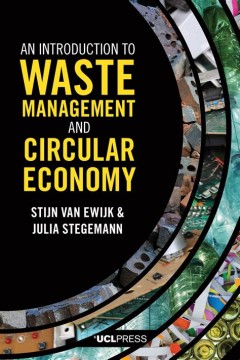
An Introduction to Waste Management and Circular Economy
This introductory textbook provides an essential interdisciplinary guide to waste management and circular economy. It helps students to understand the drivers of waste, the environmental, social, and economic impacts of waste generation, and best practices and technologies for waste management, recycling, energy recovery and disposal. With helpful, full-colour diagrams throughout, each chapt…
- Edition
- -
- ISBN/ISSN
- 9781800084681
- Collation
- 409 hlm; ill., lamp.,
- Series Title
- -
- Call Number
- -

Bioenergy and Biochar: Repurposing Waste to Sustainable Energy and Materials
Dear Colleagues,All types of biomass, and their waste, comprised one the pillars of the preindustrial,pre-fossil fuel, agriculture-based economies of the past. Traditionalpractices of biomass waste management were applied, but not necessarily in asophisticated and efficient way, and included everything from agricultural activitiesto food production, animal feed, natural fiber separation, and pr…
- Edition
- -
- ISBN/ISSN
- 9783036518565, 9783036518558
- Collation
- 180
- Series Title
- -
- Call Number
- -
Biodegradation Technology of Organic and Inorganic Pollutants
Bioremediation technologies for environments contaminated by organic and inorganic pollutants are a major focus of researchers and scientists worldwide. The chemical control of agricultural pests and advocacy for sustainable agriculture have led to the development of new paradigms in environmental remediation. This book covers recent advances in the bioremediation technology of organic and inor…
- Edition
- -
- ISBN/ISSN
- 9781839688966
- Collation
- 494
- Series Title
- -
- Call Number
- -

Biodegradation and Bioremediation of Polluted Systems: New Advances and Techn…
This book contains a collection of research works focused on the biodegradation of different types of pollutants, both in water and solids. The book is divided in three major sections: A) Biodegradation of organic pollutants in solids and wastewater, B) Biodegradation of complex pollutants, and C) Novel technologies in biodegradation and bioremediation.
- Edition
- -
- ISBN/ISSN
- 9789535122388
- Collation
- 178
- Series Title
- -
- Call Number
- -

Advanced Oxidation Processes for Emerging Contaminant Removal
This Special Issue includes manuscripts on mechanistic understanding, development, and implementation of advanced oxidation processes (AOPs) for the removal of contaminants of emerging concern in water and wastewater treatment. The main goal was successfully achieved under the joint effort of authors, anonymous reviewers, and editorial managers. In total, one review and 15 research papers are i…
- Edition
- -
- ISBN/ISSN
- 9783036566115, 9783036566108
- Collation
- 298 hlm; ill., lamp.,
- Series Title
- -
- Call Number
- -
 Computer Science, Information & General Works
 Philosophy & Psychology
 Religion
 Social Sciences
 Language
 Pure Science
 Applied Sciences
 Art & Recreation
 Literature
 History & Geography