Filter by
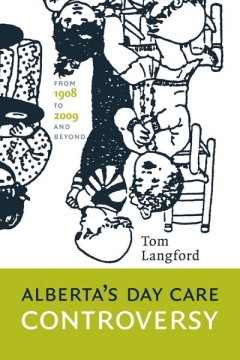
Alberta’s Day Care Controversy From 1908 to 2009 and Beyond
Day care in Alberta has had a remarkably durable history as a controversial issue. Since the late 1950s, disputes over day care programs, policies, and funding have been a recurring feature of political life in the province. Alberta’s Day Care Controversy traces the development of day care policies and programs in Alberta, with particular emphasis on policy decisions and program initiatives t…
- Edition
- -
- ISBN/ISSN
- 978-1-926836-02-7
- Collation
- -
- Series Title
- -
- Call Number
- 425 pages
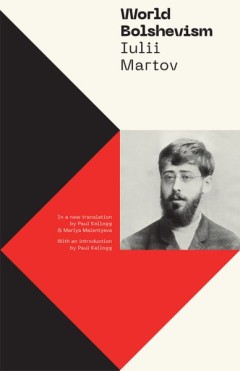
World Bolshevism
Following Martov’s untimely death in 1923, a Russian-language edition of one of his books, World Bolshevism, was published. But it was only in 2000, after decades of extreme censorship, that parts of the book were legally published in Russia. In English, this work has reached the public in pieces, often as a part of pamphlets with limited circulation. This edition, which includes an introduct…
- Edition
- -
- ISBN/ISSN
- 9781771992732.01
- Collation
- -
- Series Title
- -
- Call Number
- 194 pages
Working People in Alberta A History
Published on the occasion of the 100th anniversary of the Alberta Federation of Labour, Working People in Alberta contrasts the stories of workers who were union members and those who were not. In its depictions of union organizing drives, strikes, and working-class life in cities and towns, this lavishly illustrated volume creates a composite portrait of the men and women who have worked to bu…
- Edition
- -
- ISBN/ISSN
- 978-1-926836-58-4
- Collation
- -
- Series Title
- -
- Call Number
- 10.5 x 9, 359 pages
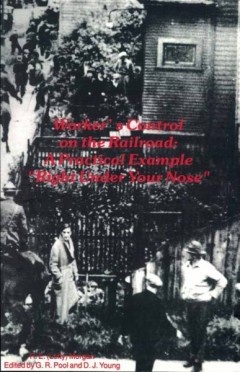
Workers’ Control on the Railroad A Practical Example “Right Under Your N…
The late “Lefty” Morgan, a British Columbia railway engineer, outlines his philosophy of workers’ control in this fascinating volume. The volume has a scholarly introduction by University of New Brunswick anthropologist, Gail Pool, and University of Toronto PhD student in anthropology, Donna Young. They situate Lefty politically and historically and locate Lefty’s work in current debate…
- Edition
- -
- ISBN/ISSN
- 0-9695835-4-0
- Collation
- -
- Series Title
- CCLH Publications
- Call Number
- -
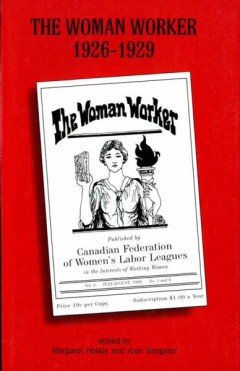
The Woman Worker 1926-1929
This volume presents the inaugural issue and articles from The Woman Worker, the official newspaper of the Canadian Federation of Women’s Labor Leagues, during its 1926 to 1929 run. Edited by prominent Communist Party of Canada leader Florence Custance, The Woman Worker’s objective was to “champion the Protection of Womanhood, and the cause of the Workers generally.” In this collection,…
- Edition
- -
- ISBN/ISSN
- 1-894000-01-3
- Collation
- -
- Series Title
- CCLH Publications
- Call Number
- -

Without Apology Writings on Abortion in Canada
With contributions by Aalya Ahmad, Tracey L. Anderson, Jane Cawthorne, Peggy Cooke, Shannon Dea, Carolyn Egan, Linda Gardner, Laura Gillespie, Sterling Haynes, E.K. Hornbeck, Clarissa Hurley, “Dr. James”, H. Bindy K. Kang, Kristen, Natalie Lochwin, Mackenzie, Colleen MacQuarrie, Ruth Miller, Judith Mintz, Erin Mullan, Jen Rinaldi, Sadie Roberts, Martha Solomon, Shannon Stettner, Karen Stote…
- Edition
- -
- ISBN/ISSN
- 9781771991599.01
- Collation
- -
- Series Title
- -
- Call Number
- 366 pages
The West and Beyond New Perspectives on an Imagined Region
The West and Beyond explores the state of Western Canadian history, showcasing the research interests of a new generation of scholars while charting new directions for the future and stimulating further interrogation of our past. This dynamic collection encourages dialogue among generations of historians of the West, and among practitioners of diverse approaches to the past. It also reflects a …
- Edition
- -
- ISBN/ISSN
- 978–1–897425–80–0
- Collation
- -
- Series Title
- The West Unbound: Social and Cultural Studies
- Call Number
- 461 pages

We Are Coming Home Repatriation and the Restoration of Blackfoot Cultural Co…
We Are Coming Home is the story of the highly complex process of repatriation as described by those intimately involved in the work, notably the Piikani, Siksika, and Kainai elders who provided essential oversight and guidance. We also hear from the Glenbow Museum’s president and CEO at the time and from an archaeologist then employed at the Provincial Museum of Alberta who provides an inside…
- Edition
- -
- ISBN/ISSN
- 9781771990172.01
- Collation
- -
- Series Title
- -
- Call Number
- 304 pages
The Wages of Relief Cities and the Unemployed in Prairie Canada, 1929–39
Setting municipal relief administrations of the 1930s within a wider literature on welfare and urban poor relief, Strikwerda highlights the legacy on which relief policymakers relied in determining policy directions, as well as the experiences of the individuals and families who depended on relief for their survival. Focusing on three prairie cities—Edmonton, Saskatoon, and Winnipeg—Strikwe…
- Edition
- -
- ISBN/ISSN
- 978-1-927356-05-0
- Collation
- -
- Series Title
- Working Canadians: Books from the CCLH
- Call Number
- 333 pages

The Accusation Model Before the International Criminal Court
This book examines how the functioning of the International Criminal Court has become a forum of convergence between the common law and civil law criminal justice systems. Four countries were selected as primary examples of these two legal traditions: the United States, England and Wales, Germany and Poland. The first layer of analysis focuses on selected elements of the model of accusation th…
- Edition
- -
- ISBN/ISSN
- 978-3-319-17626-0
- Collation
- XIII, 409
- Series Title
- -
- Call Number
- -
 Computer Science, Information & General Works
  Philosophy & Psychology
  Religion
  Social Sciences
  Language
  Pure Science
  Applied Sciences
  Art & Recreation
  Literature
  History & Geography