Filter by

The psychology of art and the evolution of the conscious brain
How did the human brain evolve so that consciousness of art could develop? In The Psychology of Art and the Evolution of the Conscious Brain, Robert Solso describes how a consciousness that evolved for other purposes perceives and creates art. Drawing on his earlier book Cognition and the Visual Arts and ten years of new findings in cognitive research (as well as new ideas in anthropology and a…
- Edition
- -
- ISBN/ISSN
- 9780262284059
- Collation
- 1 online resource (xv, 278 pages) :illustrations.
- Series Title
- -
- Call Number
- -
Race in the making :cognition, culture, and the child's construction of human…
OCLC-licensed vendor bibliographic record.
- Edition
- -
- ISBN/ISSN
- 9780262275415
- Collation
- 1 online resource (xvi, 225 pages) :illustrations.
- Series Title
- -
- Call Number
- -
Roots of social sensibility and neural function
"A Bradford book."We are social animals, with evolved mechanisms to discern the beliefs and desires of others. This social reason is linked to the concept of intentionality, the ability to attribute beliefs and desires to others. In this book Jay Schulkin explores social reason from philosophical, psychological, and cognitive neuroscientific perspectives. He argues for a pragmatist approach, in…
- Edition
- -
- ISBN/ISSN
- 9780262283281
- Collation
- 1 online resource (xviii, 206 pages) :illustrations
- Series Title
- -
- Call Number
- -
Sex and Cognition.
AnnotationOCLC-licensed vendor bibliographic record.
- Edition
- -
- ISBN/ISSN
- 9780262277136
- Collation
- 1 online resource (230 pages)
- Series Title
- -
- Call Number
- -
Semantic cognition :a parallel distributed processing approach
This groundbreaking monograph offers a mechanistic theory of the representation and use of semantic knowledge, integrating the strengths and overcoming many of the weaknesses of hierarchical, categorization-based approaches, similarity-based approaches, and the approach often called "theory theory." Building on earlier models by Geoffrey Hinton in the 1980s and David Rumelhart in the early 1990…
- Edition
- -
- ISBN/ISSN
- 9780262282505
- Collation
- 1 online resource (xiv, 425 pages) :illustrations
- Series Title
- -
- Call Number
- -
Schools for thought :a science of learning in the classroom
"A Bradford book."OCLC-licensed vendor bibliographic record.
- Edition
- -
- ISBN/ISSN
- 9780262269384
- Collation
- 1 online resource (x, 324 pages) :illustrations
- Series Title
- -
- Call Number
- -
Seeing and visualizing :it's not what you think
"In Seeing and Visualizing Zenon Pylyshyn argues that seeing is different from thinking and that to see is not, as it may seem intuitively, to create an inner replica of the world. Pylyshyn examines how we see and how we visualize and why the scientific account does not align with the way these processes seem to us "from the inside." In doing so, he addresses issues in vision science, cognitive…
- Edition
- -
- ISBN/ISSN
- 9780262316316
- Collation
- 1 online resource (xviii, 563 pages) :illustrations.
- Series Title
- -
- Call Number
- -
Representation and Recognition in Vision.
AnnotationOCLC-licensed vendor bibliographic record.
- Edition
- -
- ISBN/ISSN
- 9780262272155
- Collation
- 1 online resource (402 pages)
- Series Title
- -
- Call Number
- -
Species of Mind :The Philosophy and Biology of Cognitive Ethology.
AnnotationOCLC-licensed vendor bibliographic record.
- Edition
- -
- ISBN/ISSN
- 9780262267021
- Collation
- 1 online resource (231 pages)
- Series Title
- -
- Call Number
- -
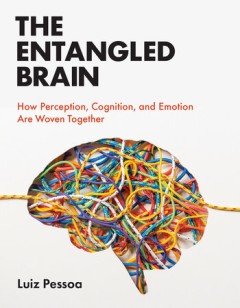
The Entangled Brain: How Perception, Cognition, and Emotion Are Woven Together
A new vision of the brain as a fully integrated, networked organ. Popular neuroscience accounts often focus on specific mind-brain aspects like addiction, cognition, or memory, but The Entangled Brain tackles a much bigger question: What kind of object is the brain? Neuroscientist Luiz Pessoa describes the brain as a highly networked, interconnected system that cannot be neatly decomposed in…
- Edition
- Ed. 1
- ISBN/ISSN
- 9780262372107
- Collation
- -
- Series Title
- -
- Call Number
- 155.2 PES e
 Computer Science, Information & General Works
  Philosophy & Psychology
  Religion
  Social Sciences
  Language
  Pure Science
  Applied Sciences
  Art & Recreation
  Literature
  History & Geography