Filter by

We Are Coming Home Repatriation and the Restoration of Blackfoot Cultural Co…
In 1990, Gerald Conaty was hired as senior curator of ethnology at the Glenbow Museum, with the particular mandate of improving the museum’s relationship with Aboriginal communities. That same year, the Glenbow had taken its first tentative steps toward repatriation by returning sacred objects to First Nations’ peoples. These efforts drew harsh criticism from members of the provincial gover…
- Edition
- -
- ISBN/ISSN
- 9781771990172.01
- Collation
- -
- Series Title
- -
- Call Number
- 304 pages
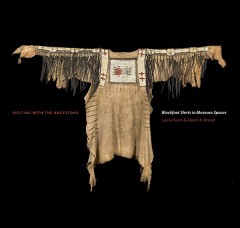
Visiting With the Ancestors Blackfoot Shirts in Museum Spaces
In 2010, five magnificent Blackfoot shirts, now owned by the University of Oxford’s Pitt Rivers Museum, were brought to Alberta to be exhibited at the Glenbow Museum, in Calgary, and the Galt Museum, in Lethbridge. The shirts had not returned to Blackfoot territory since 1841, when officers of the Hudson’s Bay Company acquired them. The shirts were later transported to England, where they h…
- Edition
- -
- ISBN/ISSN
- 9781771990370.01
- Collation
- -
- Series Title
- -
- Call Number
- 10.5 x 10, 232 pages

Screening Nature and Nation The Environmental Documentaries of the National …
The stunning portrayals of the Canadian landscape in the documentaries produced by the National Film Board of Canada not only influenced cinematic language, but shaped our perception of the environment. In the early days of the organization, nature films produced by the NFB supported the Canadian government’s nation-building project and show the state as an active participant in the cultural …
- Edition
- -
- ISBN/ISSN
- 9781771993357.01
- Collation
- -
- Series Title
- -
- Call Number
- 6x9, 232 pages

Reel Time Movie Exhibitors and Movie Audiences in Prairie Canada, 1896 to 1986
In this authoritative work, Seiler and Seiler argues that the establishment and development of moviegoing and movie exhibition in Prairie Canada is best understood in the context of changing late-nineteenth-century and early-twentieth-century social, economic, and technological developments. From the first entrepreneurs who attempted to lure customers in to movie exhibition halls, to the digita…
- Edition
- -
- ISBN/ISSN
- 9781926836997.01
- Collation
- -
- Series Title
- -
- Call Number
- 397 pages

Recollecting Lives of Aboriginal Women of the Canadian Northwest and Borderl…
Some essays focus on individuals—a trader, a performer, a non-human woman. Other essays examine cohorts of women—wives, midwives, seamstresses, nuns. Authors look beyond the documentary record and standard representations of women, drawing on records generated by the women themselves, including their beadwork, other material culture, and oral histories. Exploring the constraints and boundar…
- Edition
- -
- ISBN/ISSN
- 9781897425824.01
- Collation
- -
- Series Title
- The West Unbound: Social and Cultural Studies
- Call Number
- 432 pages

Unforgetting Private Charles Smith
Private Charles Smith had been dead for close to a century when Jonathan Hart discovered the soldier’s small diary in the Baldwin Collection at the Toronto Public Library. The diary’s first entry was marked 28 June 1915. After some research, Hart discovered that Charles Smith was an Anglo-Canadian, born in Kent, and that this diary was almost all that remained of this forgotten man, who lik…
- Edition
- -
- ISBN/ISSN
- 9781771992534.01
- Collation
- -
- Series Title
- -
- Call Number
- 4.5 x 6.5, 80 pages

World Bolshevism
Following Martov’s untimely death in 1923, a Russian-language edition of one of his books, World Bolshevism, was published. But it was only in 2000, after decades of extreme censorship, that parts of the book were legally published in Russia. In English, this work has reached the public in pieces, often as a part of pamphlets with limited circulation. This edition, which includes an introduct…
- Edition
- -
- ISBN/ISSN
- 9781771992732.01
- Collation
- -
- Series Title
- -
- Call Number
- 194 pages

Under Siege The Independent Labour Party in Interwar Britain
Despite this reversal of fortunes, during the 1930s—years that witnessed the ascendancy of both Stalin and Hitler—the ILP demonstrated an unswerving commitment to democratic socialist thinking. Drawing extensively on the ILP’s Labour Leader and other contemporary left-wing newspapers, as well as on ILP publications and internal party documents, Bullock examines the debates and ideological…
- Edition
- -
- ISBN/ISSN
- 9781771991551.01
- Collation
- -
- Series Title
- -
- Call Number
- 6 x 9, 430 pages

Truth Behind Bars” Reflections on the Fate of the Russian Revolution
Paul Kellogg uses the story of Vorkuta as a frame with which to re-assess the Russian Revolution. In particular, he turns to the contributions of Iulii Martov, a contemporary of Lenin, and his analysis of the central role played in the revolution by a temporary class of peasants-in-uniform. Kellogg explores the persistence and creativity of workers’ resistance in even the darkest hours of aut…
- Edition
- -
- ISBN/ISSN
- 9781771992459.01
- Collation
- -
- Series Title
- -
- Call Number
- 6x9, 440 pages

Social Democracy After the Cold War
Offering a comparative look at social democratic experience since the Cold War, the volume examines countries where social democracy has long been an influential political force—Sweden, Germany, Britain, and Australia—while also considering the history of Canada’s NDP and the emergence of New Left parties in Germany and the province of Québec. The case studies point to a social democracy…
- Edition
- -
- ISBN/ISSN
- 9781926836874.01
- Collation
- -
- Series Title
- -
- Call Number
- 340 pages
 Computer Science, Information & General Works
  Philosophy & Psychology
  Religion
  Social Sciences
  Language
  Pure Science
  Applied Sciences
  Art & Recreation
  Literature
  History & Geography