Filter by
The Onlife Manifesto
What is the impact of information and communication technologies (ICTs) on the human condition? In order to address this question, in 2012 the European Commission organized a research project entitled The Onlife Initiative: concept reengineering for rethinking societal concerns in the digital transition. This volume collects the work of the Onlife Initiative. It explores how the development and…
- Edition
- 1
- ISBN/ISSN
- 978-3-319-04093-6
- Collation
- -
- Series Title
- XIV, 264
- Call Number
- -
The Olive Tree Genome
This book provides an introduction to the genetics, genomics, and breeding of the olive tree, a multi-functional long-lived crop plant that is relevant not only for culinary olive and oil production, but also for shaping the landscape and history of many rural areas for centuries. Today, the recognized health benefits of extra-virgin olive oil provide new impulses for introducing innovation in …
- Edition
- 1
- ISBN/ISSN
- 978-3-319-48887-5
- Collation
- -
- Series Title
- XI, 193 , 7 b/w illustrations, 35 illustrations in colour
- Call Number
- -

The Northern Sea Route
The topic, "Northern Sea Route" has become a highly relevant point on the strategic radar screen of many business and military leaders, since global climate change now opens up a hitherto impassable sea route and positions it as a strategic alternative to the Suez route. Add to this the discovery of many easily extractable commodities and metals in the arctic area. For entrepreneurs, this setti…
- Edition
- 1
- ISBN/ISSN
- 978-3-658-04081-9
- Collation
- -
- Series Title
- VI, 134, 12 b/w illustrations, 16 illustrations in colour ,
- Call Number
- -
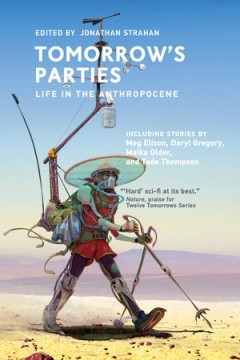
Tomorrow's Parties: Life in the Anthropocene
Twelve visions of living in a climate-changed world. We are living in the Anthropocene—an era of dramatic and violent climate change featuring warming oceans, melting icecaps, extreme weather events, habitat loss, species extinction, and more. What will life be like in a climate-changed world? In Tomorrow's Parties, science fiction authors speculate how we might be able to live and even th…
- Edition
- -
- ISBN/ISSN
- 9780262371544
- Collation
- -
- Series Title
- -
- Call Number
- 808 TOM

Tornado of Life: A Doctor's Journey through Constraints and Creativity in the ER
Stories from the ER: a doctor shows how empathy, creativity, and imagination are the cornerstones of clinical care. To be an emergency room doctor is to be a professional listener to stories. Each patient presents a story; finding the heart of that story is the doctor's most critical task. More technology, more tests, and more data won't work if doctors get the story wrong. When caring for o…
- Edition
- -
- ISBN/ISSN
- 9780262370110
- Collation
- -
- Series Title
- -
- Call Number
- 153 BAR c

What Not
An early novel by Rose Macaulay about a government program of compulsory selective breeding in a dystopian future England. In a near-future England, a new government entity—the Ministry of Brains—attempts to stave off idiocracy through a program of compulsory selective breeding. Kitty Grammont, who shares the author's own ambivalent attitude to life, gets involved in the Ministry's propa…
- Edition
- -
- ISBN/ISSN
- 9780262371162
- Collation
- -
- Series Title
- -
- Call Number
- 808 mac W
Shapes of Imagination: Calculating in Coleridge's Magical Realm
Visual calculating in shape grammars aligns with art and design, bridging the gap between seeing (Coleridge's “imagination”) and combinatoric play (Coleridge's “fancy”). In Shapes of Imagination, George Stiny runs visual calculating in shape grammars through art and design—incorporating Samuel Taylor Coleridge's poetic imagination and Oscar Wilde's corollary to see things as they a…
- Edition
- -
- ISBN/ISSN
- 9780262370653
- Collation
- -
- Series Title
- -
- Call Number
- 153 sti S

Studies in Nietzsche and the Classical Tradition
These fifteen essays deal with Nietzsche's view of various aspects of classical antiquity as compared to those of Augustine, Thomas Aquinas, Dante, Voltaire, Winkelmann, Hamann, Goethe, Schiller, Heine, Byron, the "fin de siècle" Decadents and others. An introductory essay by classical scholar H. Lloyd-Jones plus two essays on Nietzsche's aesthetics by W. Kaufmann and K. Weinberg round out the…
- Edition
- -
- ISBN/ISSN
- 9781469658100
- Collation
- -
- Series Title
- -
- Call Number
- -

Regimes of Mobility: Borders and State Formation in the Middle East, 1918-1946
For the past two decades, insights gained from the burgeoning field of borderlands studies have enabled a new generation of scholars to challenge popular depictions of the emergence of the modern Middle East. For them, the region’s borderlands were not just mere sites of peripheral activity, but rather liminal spaces criss-crossed by global flows and circulations central to state- and nation-…
- Edition
- -
- ISBN/ISSN
- 9781474487986
- Collation
- -
- Series Title
- -
- Call Number
- -

Chinese Environmental Contention: Linking Up against Waste Incineration
A plethora of new actors has in recent years entered China’s environmental arena. In Western countries, the linkages and diffusion processes between such actors often drive environmental movements. Through a study of Chinese anti-incineration contention, *Chinese Environmental Contention: Linking Up against Waste Incineration* investigates how the different contentious actors in China’s gre…
- Edition
- -
- ISBN/ISSN
- -
- Collation
- -
- Series Title
- -
- Call Number
- -
 Computer Science, Information & General Works
 Philosophy & Psychology
 Religion
 Social Sciences
 Language
 Pure Science
 Applied Sciences
 Art & Recreation
 Literature
 History & Geography