Filter by
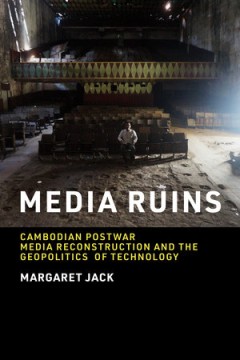
Media Ruins: Cambodian Postwar Media Reconstruction and the Geopolitics of Te…
How a generation of tech-savvy young Cambodians is restoring historical media artifacts from before the war—and, in the process, helping to repair the Khmer Rouge's cultural destruction. During the Khmer Rouge regime (1975–1979), an estimated quarter to a third of the Cambodian population perished from execution, starvation, or disease. The regime especially targeted artists and intellec…
- Edition
- -
- ISBN/ISSN
- 9780262374095
- Collation
- -
- Series Title
- -
- Call Number
- 959.6

Balkan Cyberia: Cold War Computing, Bulgarian Modernization, and the Informat…
How Bulgaria transformed the computer industry behind the Iron Curtain—and the consequences of that transformation for a society that dreamt of a brighter future. Bulgaria in 1963 was a communist country led by a centralized party trying to navigate a multinational Cold War. The state needed money, and it sought prestige. By cultivating a burgeoning computer industry, Bulgaria achieved bot…
- Edition
- -
- ISBN/ISSN
- 9780262373265
- Collation
- -
- Series Title
- -
- Call Number
- 004.09

Francis Bacon's New Atlantis
The New Atlantis has fired the imaginations of its readers since its original appearance in 1627. Often regarded as the apotheosis of Bacon's ideas through its depiction of an advanced 'scientific' society, it is also read as a seminal work of science fiction. Standing at the threshold of early modern culture, this key text incorporates the practical and visionary, utility and utopia. This volu…
- Edition
- -
- ISBN/ISSN
- 9781526137388
- Collation
- 224 halaman
- Series Title
- -
- Call Number
- 900 FRA

The Genocidal Gaze : From German Southwest Africa to the Third Reich
The first genocide of the twentieth century, though not well known, was committed by Germans between 1904–1907 in the country we know today as Namibia, where they exterminated hundreds of Herero and Nama people and subjected the surviving indigenous men, women, and children to forced labor. The perception of Africans as subhuman—lacking any kind of civilization, history, or meanin…
- Edition
- -
- ISBN/ISSN
- 9780814343852
- Collation
- -
- Series Title
- -
- Call Number
- 900 BAE g
Co-Production and Co-Creation : Engaging Citizens in Public Services
Co-production and co-creation occur when citizens participate actively in delivering and designing the services they receive. It has come increasingly onto the agenda of policymakers, as interest in citizen participation has more generally soared. Expectations are high and it is regarded as a possible solution to the public sector’s decreased legitimacy and dwindling resources, by accessing m…
- Edition
- -
- ISBN/ISSN
- 9781315204956
- Collation
- -
- Series Title
- -
- Call Number
- 650

Gender Violence and the Transnational Politics of the Honor Crime
In Gender Violence and the Transnational Politics of the Honor Crime, Dana M. Olwan examines how certain forms of violence become known, recognized, and contested across multiple geopolitical contexts—looking specifically at a particular form of gender-based violence known as the “honor crime” and tracing how a range of legal, political, and literary texts inform normative and critical un…
- Edition
- -
- ISBN/ISSN
- 9780814214664
- Collation
- -
- Series Title
- -
- Call Number
- 362 OLW g

Swamp Rice Farming
This first detailed ethnographic account of the Pahang Malay people of peninsular Malaysia focuses on the society's traditional agricultural system, particularly on its specialization in the production of rice on largely unmodified natural swampland. Dr. Lambert discusses the historical development of Pahang Malay rice farming, its dependence on indigenous knowledge of local ecology, and its ad…
- Edition
- -
- ISBN/ISSN
- 9780429308086
- Collation
- -
- Series Title
- -
- Call Number
- 630
Black Men Teaching in Urban Schools
This volume follows eleven Black male teachers from an urban, predominantly Black school district to reveal a complex set of identity politics and power dynamics that complicate these teachers’ relationships with students and fellow educators. It provides new and important insights into what it means to be a Black male teacher and suggests strategies for school districts, teacher preparation …
- Edition
- -
- ISBN/ISSN
- 9781315696997
- Collation
- -
- Series Title
- -
- Call Number
- 370

Group Theory for the Standard Model of Particle Physics and Beyond
Based on the author’s well-established courses, Group Theory for the Standard Model of Particle Physics and Beyond explores the use of symmetries through descriptions of the techniques of Lie groups and Lie algebras. The text develops the models, theoretical framework, and mathematical tools to understand these symmetries. After linking symmetries with conservation laws, the book works thr…
- Edition
- -
- ISBN/ISSN
- 9780429184550
- Collation
- -
- Series Title
- -
- Call Number
- -

Dynamics in Education Politics : Understanding and explaining the Finnish case
Dynamics in Education Politics: Understanding and Explaining the Finnish Case introduces a new theoretical framework characterised as Comparative Analytics of Dynamics in Education Politics (CADEP). Albeit the topicality of comparative research is obvious in the current era of global large-scale assessment, with its concomitant media visibility and political effects, comparative education is st…
- Edition
- -
- ISBN/ISSN
- 9780203068793
- Collation
- -
- Series Title
- -
- Call Number
- 370
 Computer Science, Information & General Works
 Philosophy & Psychology
 Religion
 Social Sciences
 Language
 Pure Science
 Applied Sciences
 Art & Recreation
 Literature
 History & Geography