Filter by

Chapter 16 George Orwell’s Dystopian Socialism
In this volume, John Farrell shows that political utopias—societies with laws and customs designed to short-circuit the foibles of human nature for the benefit of our collective existence—have a perennial opponent, the honor-based culture of aristocracy that dominated most of the world from ancient times into early modernity and whose status-based competitive psychology persists to the pres…
- Edition
- -
- ISBN/ISSN
- 9781032431574
- Collation
- 22
- Series Title
- -
- Call Number
- 900 THE f

Elizabeth Bishop and the Literary Archive
In a life full of chaos and travel, Elizabeth Bishop managed to preserve and even partially catalog, a large collection—more than 3,500 pages of drafts of poems and prose, notebooks, memorabilia, artwork, hundreds of letters to major poets and writers, and thousands of books—now housed at Vassar College. Informed by archival theory and practice, as well as a deep appreciation of Bishop’s …
- Edition
- -
- ISBN/ISSN
- 9781643150123
- Collation
- -
- Series Title
- -
- Call Number
- 800 ELI
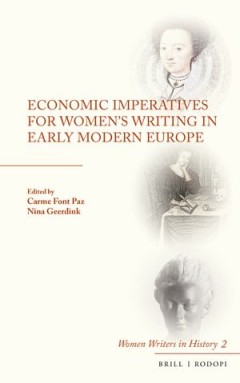
Economic Imperatives for Women's Writing in Early Modern Europe
Economic Imperatives for Women’s Writing in Early Modern Europe delves into the early modern history of women’s authorship and literary production in Europe taking a material turn. The case studies included in the volume represent women writers from various European countries and comparatively reflect the nuances of their participation in a burgeoning commercial market for authors while pro…
- Edition
- -
- ISBN/ISSN
- 9789004383029
- Collation
- -
- Series Title
- -
- Call Number
- 800 PAZ e
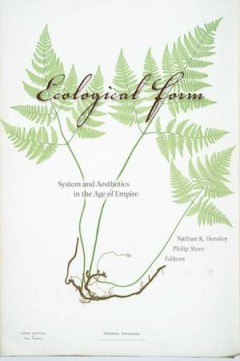
Ecological Form : System and Aesthetics in the Age of Empire
Hensley and Steer look to join the conceptual tools of contemporary ecocriticism with the rich archive of nineteenth century thinking about imperial and ecological intertwinement. This collection of essays draws on that archive to demonstrate the relevance of Victorian thought for current theory and practice. Ecological Form argues that ecology, the empire, and literary thinking were inseparabl…
- Edition
- -
- ISBN/ISSN
- 9780823282128
- Collation
- -
- Series Title
- -
- Call Number
- 800 HEN e

Dream for Dead Bodies : Blackness, Labor, and the Corpus of American Detectiv…
Dreams for Dead Bodies: Blackness, Labor, and the Corpus of American Detective Fiction offers new arguments about the origins of detective fiction in the United States, tracing the lineage of the genre back to unexpected texts and uncovering how authors such as Edgar Allan Poe, Mark Twain, Pauline Hopkins, and Rudolph Fisher made use of the genre's puzzle-elements to explore the shifting dynami…
- Edition
- -
- ISBN/ISSN
- 9780472119813
- Collation
- -
- Series Title
- -
- Call Number
- 800 ROB d

The Dispute Concerning Rhetoric in Hellenistic Thought
This study tries to reconstruct the dispute over rhetoric in Hellenistic thought, by using two main interrelated axes. Firstly, it delineates the exact milieu in which this dispute took place, including locations, dates and persons. Secondly, five main arguments used against rhetoric have been reconstructed, all of which concentrate on rhetoric’s claim to be considered an art.
- Edition
- -
- ISBN/ISSN
- 9783525252949
- Collation
- -
- Series Title
- -
- Call Number
- 800 LIE d

Critical Rhythm : The Poetics of a Literary Life Form
Explores both the theory and practice of rhythm in literature with a focus on nineteenth and twentieth-century poetry. Emphasis on rhythm's role in contemporary literary criticism, including debates about poetic form and genre. This collection intervenes in recent debates over formalism, historicism, poetics, and lyric by focusing on one of literary criticism's most important, most vested, and …
- Edition
- -
- ISBN/ISSN
- 9780823282043
- Collation
- -
- Series Title
- Verbal Arts: Studies in Poetics
- Call Number
- 800 GLA c

Charms of the Cynical Reason : The Trickster's Transformation in Soviet and P…
The impetus for Charms of the Cynical Reason is the phenomenal and little-explored popularity of various tricksters flourishing in official and unofficial Soviet culture, as well as in the post-Soviet era. Mark Lipovetsky interprets this puzzling phenomenon through analysis of the most remarkable and fascinating literary and cinematic images of soviet and post-Soviet tricksters, including such …
- Edition
- -
- ISBN/ISSN
- 9781934843451
- Collation
- -
- Series Title
- -
- Call Number
- 800 LIP c

Bally - A History of Footwear in the Interwar Period
Carl Franz Bally founded a shoe factory in Switzerland in 1851. Within decades, the Bally name had achieved worldwide recognition for its high-quality footwear. The history of modern footwear can be traced through the lens of Bally's corporate evolution. This book brings together the results of research on such topics as the economic importance of fashion, Bally's fortunes in the US, the career…
- Edition
- -
- ISBN/ISSN
- 9783839457382
- Collation
- -
- Series Title
- -
- Call Number
- 900 BAL b

The Wealthy, the Brilliant, the Few: Elite Education in Contemporary American…
How does the US make sense of its elite educational system, given that it seems to be at odds with core American values, such as equality of opportunity or upward mobility? Sophie Spieler explores scholarly and journalistic investigations, self-representational texts, and fictional narratives revolving around the Ivy League and its peers in order to understand elite education and its peculiar p…
- Edition
- -
- ISBN/ISSN
- 9783839457290
- Collation
- -
- Series Title
- -
- Call Number
- 973 SPI w
 Computer Science, Information & General Works
  Philosophy & Psychology
  Religion
  Social Sciences
  Language
  Pure Science
  Applied Sciences
  Art & Recreation
  Literature
  History & Geography