Filter by
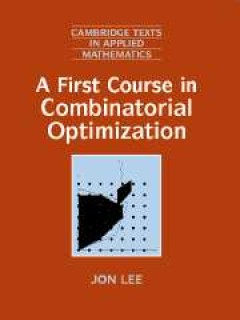
A First Course in Combinatorial Optimization
A First Course in Combinatorial Optimization is a text for a one-semester introductory graduate-level course for students of operations research, mathematics, and computer science. It is a self-contained treatment of the subject, requiring only some mathematical maturity. Topics include: linear and integer programming, polytopes, matroids and matroid optimization, shortest paths, and network fl…
- Edition
- -
- ISBN/ISSN
- 9780511616655
- Collation
- -
- Series Title
- Cambridge Texts in Applied Mathematics (36)
- Call Number
- -
Critical Phenomena in Loop Models
When close to a continuous phase transition, many physical systems can usefully be mapped to ensembles of fluctuating loops, which might represent for example polymer rings, or line defects in a lattice magnet, or worldlines of quantum particles. 'Loop models' provide a unifying geometric language for problems of this kind. This thesis aims to extend this language in two directions. The first p…
- Edition
- -
- ISBN/ISSN
- 9783319064079
- Collation
- -
- Series Title
- -
- Call Number
- -

The Discreet Charm of Protein Binding Sites
This book is a passionate account of the scientific breakthroughs that led to the solution of the first protein structures and to the understanding of their function at atomic resolution. The book is divided into self-standing chapters that each deal with a protein or protein family. The subject is presented in a fluid, non-technical style that will engage student and scientists in biochemistry…
- Edition
- 1
- ISBN/ISSN
- 978-3-319-24996-4
- Collation
- XIII, 60, 6 b/w illustrations, 10 illustrations in colour
- Series Title
- -
- Call Number
- -
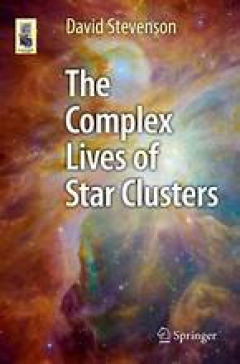
The Complex Lives of Star Clusters
As with the author’s recent books Extreme Explosions and Under a Crimson Sun, the complex topic of star clusters is broken down and made accessible with clear links to other areas of astronomy in a language which the non-specialist can easily read and enjoy. The full range of topics are addressed regarding how star clusters are formed. Why is it some are dense conglomerates of stars while oth…
- Edition
- 1
- ISBN/ISSN
- 978-3-319-14234-0
- Collation
- XV, 343, 64 illustrations in colour
- Series Title
- Astronomers' Universe
- Call Number
- -

The Complex Itinerary of Leibniz’s Planetary Theory The Complex Itinerar…
This book presents new insights into Leibniz’s research on planetary theory and his system of pre-established harmony. Although some aspects of this theory have been explored in the literature, others are less well known. In particular, the book offers new contributions on the connection between the planetary theory and the theory of gravitation. It also provides an in-depth discussion of Kep…
- Edition
- 1
- ISBN/ISSN
- 978-3-319-21236-4
- Collation
- X, 188,
- Series Title
- Science Networks. Historical Studies
- Call Number
- -

The Quantum Dissidents
This book tells the fascinating story of the people and events behind the turbulent changes in attitudes to quantum theory in the second half of the 20th century. The huge success of quantum mechanics as a predictive theory has been accompanied, from the very beginning, by doubts and controversy about its foundations and interpretation. This book looks in detail at how research on foundations e…
- Edition
- 1
- ISBN/ISSN
- 978-3-662-44662-1
- Collation
- XVI, 356, 12 b/w illustrations, 14 illustrations in colour
- Series Title
- -
- Call Number
- -

The Presence of Duns Scotus in the Thought of Edith Stein
This book examines the phenomenological anthropology of Edith Stein. It specifically focuses on the question which Stein addressed in her work Finite and Eternal Being: What is the foundational principle that makes the individual unique and unrepeatable within the human species? Traditional analyses of Edith Stein’s writings have tended to frame her views on this issue as being influenced by …
- Edition
- 1
- ISBN/ISSN
- 978-3-319-15663-7
- Collation
- XV, 184, 6 b/w illustrations
- Series Title
- Analecta Husserliana
- Call Number
- -

Thermo-Mechanical Behaviour of Structural Lightweight Alloys
The need to reduce the ecological footprint of water/land/air vehicles in this era of climate change requires pushing the limits regarding the development of lightweight structures and materials. This requires a thorough understanding of their thermomechanical behavior at several stages of the production chain. Moreover, during service, the response of lightweight alloys under the simultaneous …
- Edition
- -
- ISBN/ISSN
- 978-3-03921-388-7
- Collation
- -
- Series Title
- -
- Call Number
- 530 THE

Thermodynamics and Statistical Mechanics of Small Systems
A challenging frontier in modern statistical physics concerns systems with a small number of degrees of freedom, far from the thermodynamic limit. Beyond the general interest in the foundation of statistical mechanics, the relevance of this subject is due to the recent increase of resolution in the observation and manipulation of biological and man-made objects at micro- and nano-scales. A pecu…
- Edition
- -
- ISBN/ISSN
- 978-3-03897-058-3
- Collation
- -
- Series Title
- -
- Call Number
- 500

Fourier Transformation for Pedestrians
This book is an introduction to Fourier Transformation with a focus on signal analysis, based on the first edition. It is well suited for undergraduate students in physics, mathematics, electronic engineering as well as for scientists in research and development. It gives illustrations and recommendations when using existing Fourier programs and thus helps to avoid frustrations. Moreover, it is…
- Edition
- -
- ISBN/ISSN
- 978-3-319-16985-9
- Collation
- XVIII, 242 pages
- Series Title
- Undergraduate Lecture Notes in Physics
- Call Number
- -
 Computer Science, Information & General Works
  Philosophy & Psychology
  Religion
  Social Sciences
  Language
  Pure Science
  Applied Sciences
  Art & Recreation
  Literature
  History & Geography