Filter by
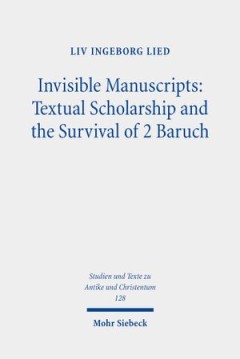
Invisible Manuscripts Textual Scholarship and the Survival of 2 Baruch
In this critical exploration of the role of manuscripts in textual scholarship, Liv Ingeborg Lied studies the Syriac manuscript transmission of 2 Baruch. These manuscripts emerge as salient sources to the long life of 2 Baruch among Syriac speaking Christians, not merely witnesses to an early Jewish text. Inspired by the perspective of New Philology, Lied addresses manuscript materiality and pa…
- Edition
- -
- ISBN/ISSN
- 9783161606731
- Collation
- -
- Series Title
- -
- Call Number
- -
Journal for the Study of Antisemitism Contemporary Antisemitism and Racism i…
This Special Issue of the Journal for the Study of Antisemitism contains a collection of papers that were presented at the International Conference “Contemporary Antisemitism and Racism in the Shadow of the Holocaust”—the midterm conference of the Research Network on Ethnic Relations, Racism and Antisemitism within the European Sociological Association. The network was set up over a decad…
- Edition
- -
- ISBN/ISSN
- 9780000000725
- Collation
- -
- Series Title
- -
- Call Number
- -

Italian Jewry in the Early Modern Era Essays in Intellectual History
Between the years 1550 and 1650, Italy's Jewish intellectuals created a unique and enduring synthesis of the great literary and philosophical heritage of the Andalusian Jews and the Renaissance`s renewal of perspective. While remaining faithful to the beliefs, behaviors, and language of their tradition, Italian Jews proved themselves open to a rapidly evolving world of great richness. The crisi…
- Edition
- -
- ISBN/ISSN
- 9781618112088
- Collation
- -
- Series Title
- -
- Call Number
- -
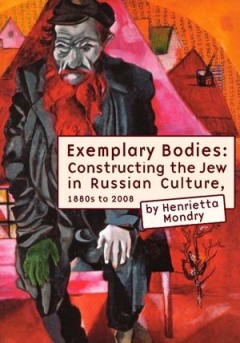
Exemplary Bodies Constructing the Jew in Russian Culture, 1880s to 2008
Exemplary Bodies: Constructing the Jew in Russian Culture, 1880s to 2008 explores the construction of the Jew’s physical and ontological body in Russian culture as represented in literature, film, and non-literary texts from the 1880s to the present. With the rise of the dominance of biological and racialist discourse in the 1880s, the depiction of Jewish characters in Russian literary and cu…
- Edition
- -
- ISBN/ISSN
- 9781934843390
- Collation
- -
- Series Title
- -
- Call Number
- -
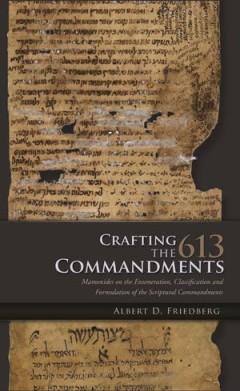
Crafting the 613 Commandments Maimonides on the Enumeration, Classification,…
Rabbinic tradition has it that 613 commandments were given to Moses on Mount Sinai, but it does not specify those included in the enumeration. Maimonides methodically and artfully crafts a list of 613 commandments in a work that serves as a prolegemenon to the Mishneh Torah, his monumental code of law. This book explores the surprising way Maimonides put this tradition to use and his possible r…
- Edition
- -
- ISBN/ISSN
- 9781618111678
- Collation
- -
- Series Title
- -
- Call Number
- -
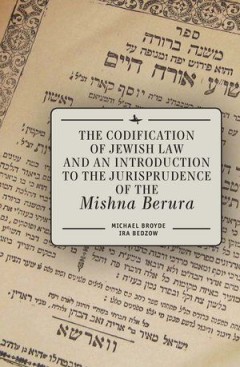
The Codification of Jewish Law and an Introduction to the Jurisprudence of th…
The Mishna Berura is, without a doubt, Rabbi Israel Meir Kagan's greatest and most complex contribution to the canon of Orthodox Jewish Law; it is a singular work that synthesizes Jewish traditions, laws, and mores into a practical halakhic guide to daily religious life. For all of his traditionalism, Rabbi Kagan was an iconoclast, and the Mishna Berura broke from many of the traditional approa…
- Edition
- -
- ISBN/ISSN
- 9781618112781
- Collation
- -
- Series Title
- -
- Call Number
- -
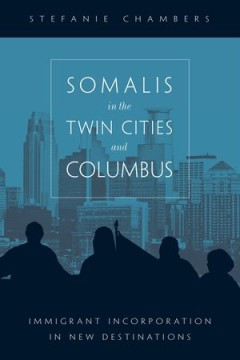
Somalis in the Twin Cities and Columbus: Immigrant Incorporation in New Desti…
Somalis in the Twin Cities and Columbus seeks to understand the integration outcomes of refugees in the Midwest at local and state levels to show how communities struggle with political, social, and economic incorporation. While many immigration titles examine the Latino community, this book focuses on the black Muslim Somalis, providing an important understanding of the lives of this understud…
- Edition
- -
- ISBN/ISSN
- 9781439914410
- Collation
- -
- Series Title
- -
- Call Number
- 300
The Valediction of Moses A Proto-Biblical Book
Moses Wilhelm Shapira's infamous Deuteronomy fragments - long believed to be forgeries - are authentic ancient manuscripts, and they are of far greater significance than ever imagined. The literary work that these manuscripts preserve - which Idan Dershowitz calls "The Valediction of Moses" or "V" - is not based on the book of Deuteronomy. On the contrary, V is a much earlier version of Deutero…
- Edition
- -
- ISBN/ISSN
- 9783161606458
- Collation
- -
- Series Title
- -
- Call Number
- -
Torah, Temple, Land Constructions of Judaism in Antiquity
The present volume contains the proceedings of a conference held in October 2018 at Humboldt University Berlin. The articles reflect the different categories of describing Judaism of the Second Temple Period in view of their sustainability in characterising an ancient religious community in different historical situations and discuss relevant (re)constructions of ancient Judaism in the history …
- Edition
- -
- ISBN/ISSN
- 9783161598548
- Collation
- -
- Series Title
- -
- Call Number
- -

Pyrrhonian Skepticism in Diogenes Laertius
This volume offers the first bilingual edition of a major text in the history of epistemology, Diogenes Laertius's report on Pyrrho and Timon in his Lives of Eminent Philosophers. Leading experts contribute a philosophical introduction, translation, commentary, and scholarly essays on the nature of Diogenes's report as well as core questions in recent research on skepticism.
- Edition
- -
- ISBN/ISSN
- 9783161533365
- Collation
- -
- Series Title
- -
- Call Number
- -
 Computer Science, Information & General Works
  Philosophy & Psychology
  Religion
  Social Sciences
  Language
  Pure Science
  Applied Sciences
  Art & Recreation
  Literature
  History & Geography