Filter by

Project Management for Instructional Designers
Project Management for Instructional Designers (PM4ID) is a textbook about project management tailored specifically for instructional designers, intended for use in graduate programs in educational technology. This book is based on a pre-existing openly licensed textbook which was donated to the commons by a benefactor that desires to remain anonymous, and has been collaboratively revised and r…
- Edition
- -
- ISBN/ISSN
- -
- Collation
- -
- Series Title
- -
- Call Number
- 658 CLE p

Recovery from the Indian Ocean Tsunami: A Ten-Year Journey
During the past 10 years following the 2004 Indian Ocean Tsunami, invaluable lessons have been learned and great changes have been observed. Immediately after the disaster, the second World Conference on Disaster Reduction was held in Kobe, Japan, and formulated the Hyogo Framework for Action (HFA: 2005–2015). HFA provided a platform and framework for changes and innovations, many of which we…
- Edition
- -
- ISBN/ISSN
- 978-4-431-55117-1
- Collation
- -
- Series Title
- -
- Call Number
- 333.72

Uncertainty handling in multi-attribute decision support for industrial risk …
The complexity of today's industrial production networks constitutes a new challenge for industrial risk and safety management. In order to handle potential risks to and emanating from industry and their respective impact on mankind as well as the environment, an integrated approach to industrial risk management is needed, since complex decision situations need to be resolved requiring input fr…
- Edition
- -
- ISBN/ISSN
- 978-3-86644-207-8
- Collation
- -
- Series Title
- -
- Call Number
- 650 BER u
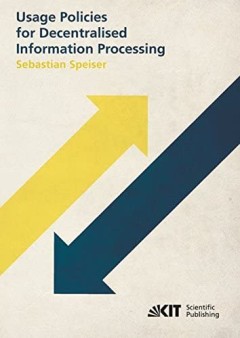
Usage Policies for Decentralised Information Processing
Owners impose usage restrictions on their information, which can be based e.g. on privacy laws, copyright law or social conventions. Often, information is processed in complex constellations without central control. In this work, we introduce technologies to formally express usage restrictions in a machine-interpretable way as so-called policies that enable the creation of decentralised systems…
- Edition
- -
- ISBN/ISSN
- 978-3-86644-987-9
- Collation
- -
- Series Title
- -
- Call Number
- 005 SPE u

Actuarial and Financial Risks in Life Insurance, Pensions and Household Finance
The recent regulatory changes, together with the increasing awareness of the variety of sources of uncertainty that affect the activities of insurance and pension funds, have generated increasing attention towards insurance risk management theory and practice. Against this background, this Special Issue collects relevant contributions on a variety of issues encompassing longevity risk modelling…
- Edition
- -
- ISBN/ISSN
- 978-3-03842-729-2
- Collation
- -
- Series Title
- -
- Call Number
- 650 ACT

Role and dynamics of 'Late-comers' in the global technology competition
Faster developing cycles and economic developments created many emerging economies in the 20th century. For sustainable economic growth, however, the construction and constant preservation of a profound knowledge base and technological pool is crucial. Brazil, China, India and Russia, experienced constant high economic growth rates and begun to evolve to solid economies which are challenging th…
- Edition
- -
- ISBN/ISSN
- 978-3-86644-648-9
- Collation
- -
- Series Title
- -
- Call Number
- 650 TRA r

An Evaluation of Japanese Environmental Regulations: Quantitative Approaches …
Focusing on air pollution, energy efficiency and climate change, this book provides an introduction to Japan’s environmental policies and regulations, and offers economic analyses and RIAs (Regulatory Impact Analysis) of environmental regulations implemented or planned by the national and local governments. The opening chapter reviews environmental economics and outlines the current status of…
- Edition
- Ed. 1
- ISBN/ISSN
- 978-94-017-9947-8
- Collation
- XIII, 191
- Series Title
- -
- Call Number
- 551.6 ARI e
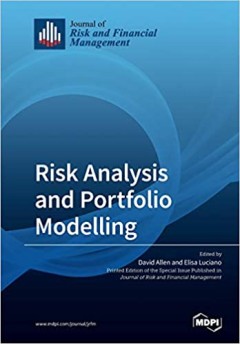
Risk Analysis and Portfolio Modelling
Financial Risk Measurement is a challenging task, because both the types of risk and the techniques evolve very quickly. This book collects a number of novel contributions to the measurement of financial risk, which address either non-fully explored risks or risk takers, and does so in a wide variety of empirical contexts.
- Edition
- -
- ISBN/ISSN
- 978-3-03921-625-3
- Collation
- -
- Series Title
- -
- Call Number
- 650 RIS

Digital Games and Mathematics Learning Potential, Promises and Pitfalls
Digital games offer enormous potential for learning and engagement in mathematics ideas and processes. This volume offers multidisciplinary perspectives--of educators, cognitive scientists, psychologists and sociologists--on how digital games influence the social activities and mathematical ideas of learners/gamers. Contributing authors identify opportunities for broadening current understandin…
- Edition
- -
- ISBN/ISSN
- 9789401795173
- Collation
- xiii, 309 pages
- Series Title
- -
- Call Number
- 370
Risk Measures with Applications in Finance and Economics
Risk measures play a vital role in many subfields of economics and finance. It has been proposed that risk measures could be analysed in relation to the performance of variables extracted from empirical real-world data. For example, risk measures may help inform effective monetary and fiscal policies and, therefore, the further development of pricing models for financial assets such as equities…
- Edition
- -
- ISBN/ISSN
- -
- Collation
- -
- Series Title
- -
- Call Number
- 650 MCA r
 Computer Science, Information & General Works
 Philosophy & Psychology
 Religion
 Social Sciences
 Language
 Pure Science
 Applied Sciences
 Art & Recreation
 Literature
 History & Geography