Filter by
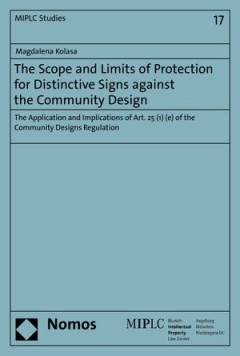
The Scope and Limits of Protection for Distinctive Signs against the Communit…
The Community system of design protection,¹ proved to be appealing for the Internal Market participants.² Its power of attraction owes largely to the fact that it grants a fast and cheap protection for a relatively long period of time. Fast, because the registered Community design does not undergo a substantive examination upon registration³ and the unregistered Community design does not req…
- Edition
- -
- ISBN/ISSN
- 9783845243856
- Collation
- 82 halaman
- Series Title
- -
- Call Number
- 340 halaman
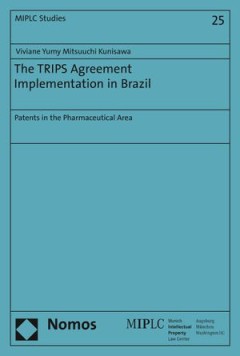
The TRIPS Agreement Implementation in Brazil : Patents in the Pharmaceutical …
Brazil’s insertion into the World Trade Organization (WTO) has stimulated economic growth, as the country has been benefiting from lower trade barriers. The country has accepted the Agreement on Trade-Related Aspects of Intellectual Property Rights (TRIPS) – Annex 1C of the WTO agreement – which sets out minimum standards of protection for Intellectual Property (IP) rights. Law No. 9,279,…
- Edition
- -
- ISBN/ISSN
- 9783845259628
- Collation
- 274 halaman
- Series Title
- -
- Call Number
- 340 KUN t
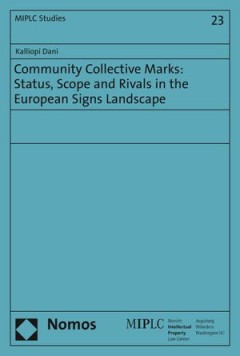
Community Collective Marks : Status, Scope and Rivals in The European Signs L…
n the modern marketplace characterised by a profusion of signs and labels, Community collective marks seem rather absent. Although provided for in the European trade mark legislation, they are underutilised in practice and quite neglected in legal theory, which, in its vast majority, is restricted in mere repetitions and reformulations of the legislative text. In those cases of commentaries whe…
- Edition
- -
- ISBN/ISSN
- 9783845256467
- Collation
- 68 halaman
- Series Title
- -
- Call Number
- 340 DAN c
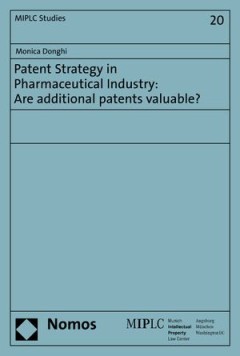
Patent Strategy in Pharmaceutical industry : Are Additional Patents Valuable?
This book investigates lifecycle management strategies used by pharmaceutical companies attempting to maximize the value of their product portfolio. Such strategies are sometimes referred to by generic drug companies as “evergreening”. The analysis focuses on two of these strategies, namely product improvements and product line extensions. In particular, an evaluation of the patents that fo…
- Edition
- -
- ISBN/ISSN
- 9783845251288
- Collation
- 84 halaman
- Series Title
- -
- Call Number
- 340 DON p
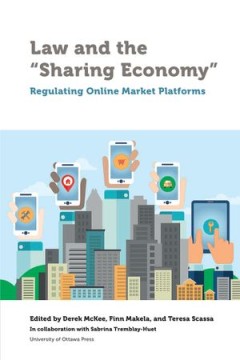
Law and the “Sharing Economy”
The rapid expansion of sharing economy platforms such as Airbnb and Uber has generated enormous controversy. This book brings legal and interdisciplinary perspectives to the labour, market and technology and other regulatory challenges that arise from this phenomenon that has taken the world by storm.
- Edition
- -
- ISBN/ISSN
- 9780776627526
- Collation
- -
- Series Title
- -
- Call Number
- -
 Computer Science, Information & General Works
  Philosophy & Psychology
  Religion
  Social Sciences
  Language
  Pure Science
  Applied Sciences
  Art & Recreation
  Literature
  History & Geography