Filter by

The Role of Anesthesiology in Global Health A Comprehensive Guide
This brilliantly assembled expert compendium provides a much-needed guide for the practical application of anesthesiology in medical practice in the most bereft underdeveloped and violence-afflicted regions of the globe.” —Seymour Topping, Professor Emeritus of International Journalism, Columbia University This is a comprehensive guide to the role of anesthesiologists in medical mis…
- Edition
- -
- ISBN/ISSN
- 978-3-319-09423-6
- Collation
- -
- Series Title
- -
- Call Number
- -

The Road to the Rule of Law in Modern China
This book is a grand review of the centurial development of rule of law in China. It covers the most important issues in this area and presents “political constitution,” a new interpretative framework that allows the Chinese experience of rule of law to be more fully and correctly expressed. It is especially useful to scholars involved in the study of modern China. The main chapters of this…
- Edition
- -
- ISBN/ISSN
- 978-3-662-45637-8
- Collation
- -
- Series Title
- -
- Call Number
- -

The Road to Universal Logic Festschrift for the 50th Birthday of Jean-Yves B…
This second volume of a collection of papers offers new perspectives and challenges in the study of logic. It is presented in honor of the fiftieth birthday of Jean-Yves Béziau. The papers touch upon a wide range of topics including paraconsistent logic, quantum logic, geometry of oppositions, categorical logic, computational logic, fundamental logic notions (identity, rule, quantification) an…
- Edition
- -
- ISBN/ISSN
- 978-3-319-15368-1
- Collation
- -
- Series Title
- -
- Call Number
- -

An EKG Interpretation Primer
This book teaches healthcare professionals the basics of EKG interpretation and is available as a Creative Commons resource.
- Edition
- -
- ISBN/ISSN
- -
- Collation
- -
- Series Title
- -
- Call Number
- 610 CHR e

ENG114 - Critical Reading and Response
This open textbook is created to accompany the course ENGL114 - Critical Reading and Response at Bay Path University.
- Edition
- -
- ISBN/ISSN
- -
- Collation
- -
- Series Title
- -
- Call Number
- 421 THO e

ENG124 - Research and Writing in the Disciplines
This open textbook is created to accompany the course ENGL124 - Research and Writing in the University at Bay Path University.
- Edition
- -
- ISBN/ISSN
- -
- Collation
- -
- Series Title
- -
- Call Number
- 421 THO e
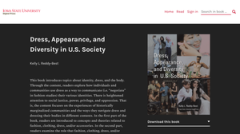
Dress, Appearance, and Diversity in U.S. Society
This is a free textbook geared towards college-level courses about dress and identity. The purpose of the book is to help students learn about dress, identity, and how these topics intersect with marginalized communities. Everyone interacts with different people in their day-to-day lives. Having a greater understanding of others can lead to a more equitable, just society. This textbook was crea…
- Edition
- -
- ISBN/ISSN
- -
- Collation
- -
- Series Title
- -
- Call Number
- 391.472 RED d
Introduction to Financial Mathematics Concepts and Computational Methods
Introduction to Financial Mathematics: Concepts and Computational Methods serves as a primer in financial mathematics with a focus on conceptual understanding of models and problem solving. It includes the mathematical background needed for risk management, such as probability theory, optimization, and the like. The goal of the book is to expose the reader to a wide range of basic problems, som…
- Edition
- -
- ISBN/ISSN
- -
- Collation
- -
- Series Title
- -
- Call Number
- 500
Quantitative Ecology : A New Unified Approach
Quantitative Ecology introduces and discusses the principles of ecology from populations to ecosystems including human populations, disease, exotic organisms, habitat fragmentation, biodiversity and global dynamics. The book also reformulates and unifies ecological equations making them more accessible to the reader and easier to teach.
- Edition
- -
- ISBN/ISSN
- 978-1-946135-53-7
- Collation
- -
- Series Title
- -
- Call Number
- 570 LEH q
Earth's climate response to a changing Sun
The Earth’s atmosphere, the thin envelope of air that surrounds our planet, consists of a mixture of gases, extending from the surface of the Earth to the edge of space and tied to the Earth mainly by its gravitational force, and partly by the magnetic field at high altitude. It comprises mainly molecular nitrogen (78% in mass) and molecular oxygen (21%), with the other 1% composed of trace …
- Edition
- -
- ISBN/ISSN
- -
- Collation
- -
- Series Title
- -
- Call Number
- 551 MAT e
 Computer Science, Information & General Works
  Philosophy & Psychology
  Religion
  Social Sciences
  Language
  Pure Science
  Applied Sciences
  Art & Recreation
  Literature
  History & Geography