Filter by
Bioenergy Crops for Ecosystem Health and Sustainability
The growing of crops for bioenergy has been subject to much recent criticism, as taking away land which could be used for food production or biodiversity conservation. This book challenges some commonly-held ideas about biofuels, bioenergy and energy cropping, particularly that energy crops pose an inherent threat to ecosystems, which must be mitigated. The book recognises that certain energy c…
- Edition
- -
- ISBN/ISSN
- 9781138838833
- Collation
- -
- Series Title
- -
- Call Number
- -

Bioeconomy: Shaping The Transition To a Sustainable, Biobased Economy
Sustainability; Biomass Management; Resource Management; Agriculture; Macroeconomics
- Edition
- -
- ISBN/ISSN
- 9783319681511
- Collation
- -
- Series Title
- -
- Call Number
- -

Pacific Missionary George Brown: 1835-1917 : Wesleyan Methodist Church
George Brown (1835-1917) was many things during his long life; leader in the Wesleyan Methodist Church in Australasia, explorer, linguist, political activist, apologist for the missionary enterprise, amateur anthropologist, writer, constant traveller, collector of artefacts, photographer and stirrer. He saw himself, at heart, as a missionary. The islands of the Pacific Ocean were the scene of h…
- Edition
- -
- ISBN/ISSN
- 9781921862984
- Collation
- -
- Series Title
- -
- Call Number
- 266.719 509 2 REE p
Bioanalytical Tools in Water Quality Assessment: Second Edition
The first edition of Bioanalytical Tools in Water Quality Assessment was released in 2012. The field has exploded since and the second edition updates and reviews the application of bioanalytical tools for water quality assessment including surveillance monitoring. The book focuses on applications to water quality assessment ranging from wastewater to drinking water, including recycled water, a…
- Edition
- -
- ISBN/ISSN
- 9781789061987
- Collation
- -
- Series Title
- -
- Call Number
- -

Ostranenie : On Shame and Knowing
Ostranenie, the term for defamiliarization introduced by Russian writer and critic Victor Shklovsky, means, among other things, to see in strangeness. To see in strangeness is to participate in an illusion that is more real than real. It may be achieved by (re)presenting the surface as the substance, the play as the thing, or by examining (from exigere: to drive out) what is present before oneâ…
- Edition
- -
- ISBN/ISSN
- 978-0615744797
- Collation
- -
- Series Title
- -
- Call Number
- 165 BOW o

Benchmarking of Control Strategies for Wastewater Treatment Plants
Wastewater treatment plants are large non-linear systems subject to large perturbations in wastewater flow rate, load and composition. Nevertheless these plants have to be operated continuously, meeting stricter and stricter regulations. Many control strategies have been proposed in the literature for improved and more efficient operation of wastewater treatment plants. Unfortunately, their eva…
- Edition
- -
- ISBN/ISSN
- 9781780401171
- Collation
- -
- Series Title
- -
- Call Number
- -
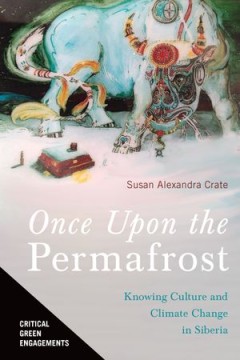
Once Upon the Permafrost : Knowing Culture and Climate Change in Siberia
Once Upon the Permafrost is a longitudinal climate ethnography about “knowing” a specific culture and the ecosystem that culture physically and spiritually depends on in the twenty-first-century context of climate change. The author, anthropologist Susan Alexandra Crate, has spent three decades working with Sakha, the Turkic-speaking horse and cattle agropastoralists of northeastern Siberia…
- Edition
- -
- ISBN/ISSN
- 9780816541546
- Collation
- -
- Series Title
- -
- Call Number
- 305.894 CRA o
Sustainable Water Management and Wetland Restoration Strategies in Northern C…
This book depicts the results of a research project in northern China, where an international and interdisciplinary team of researchers from Italy, Germany and China has applied a broad range of methodology in order to answer basic and applied research questions and derive comprehensive recommendations for sustainable water management and wetland restoration. The project primarily focused on ec…
- Edition
- -
- ISBN/ISSN
- 9788860460691
- Collation
- -
- Series Title
- -
- Call Number
- -
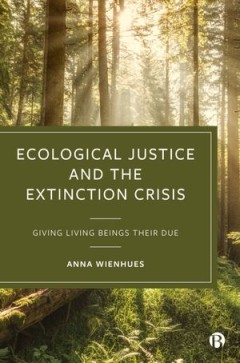
Ecological Justice and the Extinction Crisis
As the biodiversity crisis deepens, Anna Wienhues sets out radical environmental thinking and action to respond to the threat of mass species extinction. The book conceptualises large-scale injustice endangering non-humans, and signposts new approaches to the conservation of a shared planet. Developing principles of distributive ecological justice, it builds towards a bold vision of just conser…
- Edition
- -
- ISBN/ISSN
- 9781529208511
- Collation
- -
- Series Title
- -
- Call Number
- -
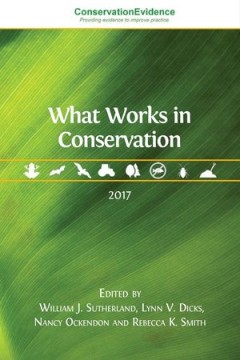
What Works in Conservation 2017
What Works in Conservation has been created to provide practitioners with answers to these and many other questions about practical conservation. This book provides an assessment of the effectiveness of 763 conservation interventions based on summarized scientific evidence. Chapters cover the practical global conservation of amphibians, bats, birds and forests, conservation of European farmland…
- Edition
- -
- ISBN/ISSN
- 9781783743100
- Collation
- -
- Series Title
- -
- Call Number
- -
 Computer Science, Information & General Works
 Philosophy & Psychology
 Religion
 Social Sciences
 Language
 Pure Science
 Applied Sciences
 Art & Recreation
 Literature
 History & Geography