Filter by

Unlocking the Secrets of White Dwarf Stars
Hugh Van Horn’s entire career since 1965 has been dedicated to conducting research into the properties of dense matter and applying that knowledge to objects such as white dwarfs and neutron stars. For almost 30 years, he led a research team investigating these topics at the University of Rochester, and a number of his former students have gone on to distinguished careers in astrophysics them…
- Edition
- -
- ISBN/ISSN
- 978-3-319-09369-7
- Collation
- -
- Series Title
- -
- Call Number
- -
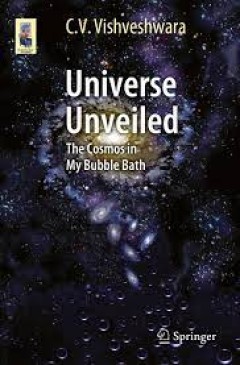
Universe Unveiled The Cosmos in My Bubble Bath
The bubbles were swirling all around me, massaging my body. As I luxuriated in this fantastic bath, I gasped realizing that those bubbles carried with them miniature galaxies bringing the entire Cosmos into my bathtub... Alfie is back. And so are George and other characters from the author’s previous book Einstein’s Enigma or Black Holes in My Bubble Bath. While the present book, Univers…
- Edition
- -
- ISBN/ISSN
- 978-3-319-08213-4
- Collation
- -
- Series Title
- -
- Call Number
- -

The Sounds of the Cosmos: Gravitational Waves and the Birth of Multi-Messenge…
In 2016, the LIGO and Virgo Collaborations made headlines when they announced the detection of gravitational waves—a century after Albert Einstein first predicted their existence with his general theory of relativity. With unprecedented perspective as physicists at the forefront of this discovery, Mario Díaz, Gabriela González, and Jorge Pullin provide a comprehensive and accessible account…
- Edition
- -
- ISBN/ISSN
- 9780262372794
- Collation
- -
- Series Title
- -
- Call Number
- -

Astronomical Discoveries You Can Make, Too!: Replicating the Work of the Grea…
You too can follow in the steps of the great astronomers such as Hipparchus, Galileo, Kepler and Hubble, who all contributed so much to our modern understanding of the cosmos. This book gives the student or amateur astronomer the following tools to replicate some of these seminal observations from their own homes: With your own eyes: Use your own observations and measurements to disc…
- Edition
- Ed. 1
- ISBN/ISSN
- 978-3-319-15660-6
- Collation
- XIII, 549
- Series Title
- Springer Praxis Books
- Call Number
- 520 BUC a

Astrobiological Neurosystems: Rise and Fall of Intelligent Life Forms in the …
This book explains why scientists believe that life may be more common in the Universe than previously considered possible. It presents the tools and strategies astronomers and astrobiologists are using in their formal search for habitable exoplanets as well as more advanced forms of life in other parts of our galaxy. The author then summarizes what is currently known about how and where organi…
- Edition
- Ed. 1
- ISBN/ISSN
- 978-3-319-10419-5
- Collation
- IX, 204
- Series Title
- Astronomers' Universe
- Call Number
- 611 CRA a
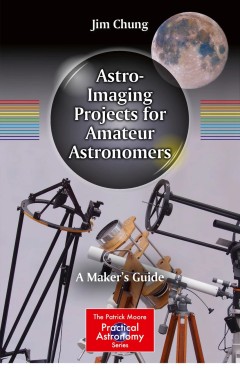
Astro-Imaging Projects for Amateur Astronomers: A Maker’s Guide
This is the must-have guide for all amateur astronomers who double as makers, doers, tinkerers, problem-solvers, and inventors. In a world where an amateur astronomy habit can easily run into the many thousands of dollars, it is still possible for practitioners to get high-quality results and equipment on a budget by utilizing DIY techniques. Surprisingly, it's not that hard to modify existing …
- Edition
- Ed. 1
- ISBN/ISSN
- 978-3-319-18546-0
- Collation
- XII, 246
- Series Title
- The Patrick Moore Practical Astronomy Series
- Call Number
- 520 CHU a

Asteroseismology of Stellar Populations in the Milky Way
The detection of radial and non-radial solar-like oscillations in thousands of G-K giants with CoRoT and Kepler is paving the road for detailed studies of stellar populations in the Galaxy. The available average seismic constraints allow largely model-independent determination of stellar radii and masses, and can be used to determine the position and age of thousands of stars in different regio…
- Edition
- Ed. 1
- ISBN/ISSN
- 978-3-319-10993-0
- Collation
- XIII, 185
- Series Title
- Astrophysics and Space Science Proceedings
- Call Number
- 520 AST a
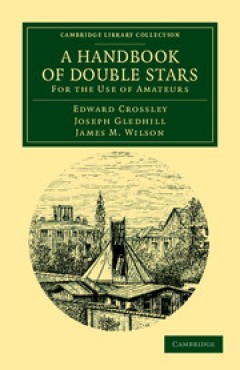
A Handbook of Double Stars For the Use of Amateurs
Used to describe both binary systems and optical doubles, the term 'double star' has been familiar to astronomers since the seventeenth century. This book, first published in 1879, outlines the history of their study, and describes the methods and equipment needed in order to observe the fascinating phenomenon. Written for non-specialists by Fellows of the Royal Society Edward Crossley (1841–…
- Edition
- -
- ISBN/ISSN
- 9781139108980
- Collation
- -
- Series Title
- Cambridge Library Collection - Astronomy
- Call Number
- -
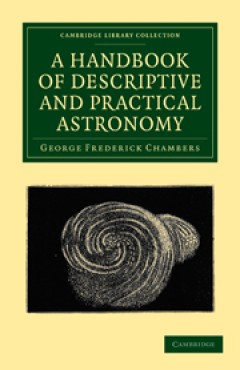
A Handbook of Descriptive and Practical Astronomy
This handbook by George Frederick Chambers (1841–1915), a young and enthusiastic amateur astronomer, became a best-seller soon after its publication in 1861 and made Chambers' reputation as a popular astronomy writer. The work is divided into ten parts covering the following topics: the planets of our solar system; eclipses; gravity and tides; phenomena including aberration and refraction; co…
- Edition
- -
- ISBN/ISSN
- 9780511709937
- Collation
- -
- Series Title
- Cambridge Library Collection - Astronomy
- Call Number
- -

Return to the Far Side of Planet Moore!
The result of an exhaustive study of Sir Patrick Moore’s observations of the Moon and planets for more than 60 years, this book is a fantastic companion to the extremely popular, “It Came From Outer Space Wearing an RAF Blazer!” written by the same author. Moore recorded his telescopic observations in his logbooks, which are reproduced and described here in detail, along with his sketches…
- Edition
- Ed. 1
- ISBN/ISSN
- 978-3-319-15780-1
- Collation
- -
- Series Title
- -
- Call Number
- -
 Computer Science, Information & General Works
  Philosophy & Psychology
  Religion
  Social Sciences
  Language
  Pure Science
  Applied Sciences
  Art & Recreation
  Literature
  History & Geography