Filter by

Chapter 16 George Orwell’s Dystopian Socialism
In this volume, John Farrell shows that political utopias—societies with laws and customs designed to short-circuit the foibles of human nature for the benefit of our collective existence—have a perennial opponent, the honor-based culture of aristocracy that dominated most of the world from ancient times into early modernity and whose status-based competitive psychology persists to the pres…
- Edition
- -
- ISBN/ISSN
- 9781032431574
- Collation
- 22
- Series Title
- -
- Call Number
- 900 THE f
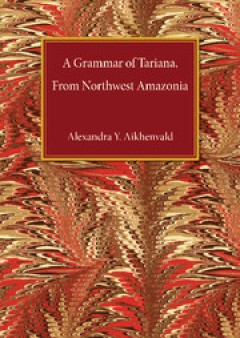
A Grammar of Tariana, from Northwest Amazonia
This is a comprehensive reference grammar of Tariana, an endangered Arawak language from a remote region in the northwest Amazonian jungle. Its speakers traditionally marry someone speaking a different language, and as a result most people are fluent in five or six languages. Because of this rampant multilingualism, Tariana combines a number of features inherited from the protolanguage with pro…
- Edition
- -
- ISBN/ISSN
- 9781107050952
- Collation
- -
- Series Title
- -
- Call Number
- -
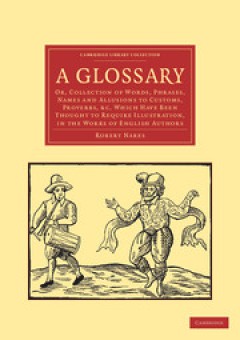
A Glossary Or, Collection of Words, Phrases, Names and Allusions to Customs,…
Originally published in 1822, Robert Nares' glossary of antiquated Elizabethan terms is the result of a personal interest in and love of Elizabethan literature. Nares (1753–1829), well known as a scholar and clergyman, was also a keen philologist and antiquary. This glossary was undertaken in his spare time, and compiled over forty years as he was often occupied with various academic and cler…
- Edition
- -
- ISBN/ISSN
- 9781139093781
- Collation
- -
- Series Title
- Cambridge Library Collection - Literary Studies
- Call Number
- -
Keeping up Her Geography
Recently, literary critics and some historians have argued that to use the language of separate spheres is to "mistake fiction for reality." However, the tendency in this criticism is to ignore the work of feminist political theorists who argue that a range of ideologies of the public and private consistently work to mask gender inequalities. In Keeping Up Her Geography, Tanya Ann Kenedy argues…
- Edition
- -
- ISBN/ISSN
- 9781135863289
- Collation
- -
- Series Title
- -
- Call Number
- -
The Disaster of the Third Princess
These seven essays by the most recent English translator of The Tale of Genji emphasize three major interpretive issues. What is the place of the hero (Hikaru Genji) in the work? What story gives the narrative underlying continuity and form? And how does the closing section of the tale (especially the ten “Uji chapters”) relate to what precedes it? Written over a period of nine years, the e…
- Edition
- -
- ISBN/ISSN
- 320414329
- Collation
- -
- Series Title
- -
- Call Number
- -
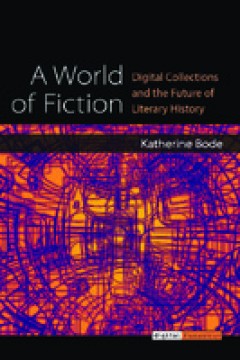
A World of Fiction: Digital Collections and the Future of Literary History
During the 19th century, throughout the Anglophone world, most fiction was first published in periodicals. In Australia, newspapers were not only the main source of periodical fiction, but the main source of fiction in general. Because of their importance as fiction publishers, and because they provided Australian readers with access to stories from around the world—from Britain, America and …
- Edition
- -
- ISBN/ISSN
- 9780472130856
- Collation
- -
- Series Title
- -
- Call Number
- -

Studies in Goethe's Lyric Cycles
The book presents a series of interpretive readings of the "Römische Elegien", "Sonette", "Chinesisch-deutsche Jarhes- und Tageszeiten", several trilogies, and the shorter cycles of 1821, taking into account the variety of literary devices Goethe employs to link poems together into a cycle. The author examines Goethe's role in the history of the lyric cycle and, in stressing structural design,…
- Edition
- -
- ISBN/ISSN
- 9781469657783
- Collation
- -
- Series Title
- -
- Call Number
- -

English Aristocratic Women and the Fabric of Piety, 1450-1550
- Edition
- -
- ISBN/ISSN
- 9789048537228
- Collation
- -
- Series Title
- -
- Call Number
- -
- Edition
- -
- ISBN/ISSN
- 9789048537228
- Collation
- -
- Series Title
- -
- Call Number
- -
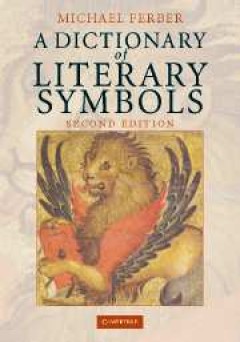
A Dictionary of Literary Symbols
This is the first dictionary of symbols to be based on literature, rather than 'universal' psychological archetypes or myths. It explains and illustrates the literary symbols that we all frequently encounter (such as swan, rose, moon, gold), and gives hundreds of cross-references and quotations. The dictionary concentrates on English literature, but its entries range widely from the Bible and c…
- Edition
- -
- ISBN/ISSN
- 9780511481475
- Collation
- -
- Series Title
- -
- Call Number
- -

A Dictionary of Literary Symbols
This is an expansion of the first dictionary of symbols to be based on literature, rather than on 'universal' psychological archetypes or myths. It explains and illustrates the literary symbols that we frequently encounter (such as swan, rose, moon, gold) and gives thousands of cross-references and quotations. The dictionary concentrates on English literature, but its entries range widely from …
- Edition
- -
- ISBN/ISSN
- 9781316771426
- Collation
- -
- Series Title
- -
- Call Number
- -
 Computer Science, Information & General Works
 Philosophy & Psychology
 Religion
 Social Sciences
 Language
 Pure Science
 Applied Sciences
 Art & Recreation
 Literature
 History & Geography