Filter by
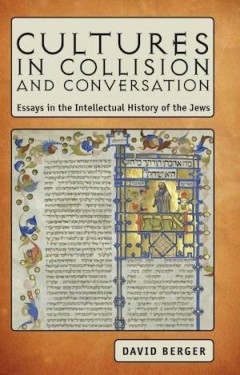
Cultures In Collision And Conversation : Essays In The Intellectual History O…
In Cultures in Collision and Conversation, David Berger addresses three broad themes in Jewish intellectual history: Jewish approaches to cultures external to Judaism and the controversies triggered by this issue in medieval and modern times; the impact of Christian challenges and differing philosophical orientations on Jewish interpretation of the Bible; and Messianic visions, movements, and d…
- Edition
- -
- ISBN/ISSN
- 9781936235247
- Collation
- 384 halaman
- Series Title
- Judaism and Jewish Life
- Call Number
- 900 BER c

Identity and Personhood
This book approaches the concept of identity from both logical-linguistic and socio-cultural perspectives, and explores its implications for our understanding of who or what we persons really are. In the process, it bridges disciplines that often remain disconnected - most notably analytic philosophy and the social sciences - and offers a novel critique of citizenship and moral education, "iden…
- Edition
- 1
- ISBN/ISSN
- 978-981-287-481-8
- Collation
- Filosofi
- Series Title
- -
- Call Number
- 150
Imaginative Animals : Leibniz's Logic Of Imagination
Through the reconstruction of Leibniz's theory of the degrees of knowledge, this book investigates and explores the intrinsic relationship of imagination with space and time. The inquiry into this relationship defines the logic of imagination that characterizes both human and non-human animals, albeit differently, making them two different species of imaginative animals. Lucia Oliveri explains …
- Edition
- -
- ISBN/ISSN
- 9780000000723
- Collation
- -
- Series Title
- -
- Call Number
- 100 OLI i
Why Be Moral?
What reasons do we have to be moral, and are these reasons more compelling than the reasons we have to pursue non-moral projects? Ever since the Sophists first raised this question, it has been a focal point of debate. Why be Moral? is a collection of new essays on this fundamental philosophical problem, written by an international team of leading scholars in the field.
- Edition
- -
- ISBN/ISSN
- 9783110366396
- Collation
- 278 halaman
- Series Title
- -
- Call Number
- 100 LOU w

Emotional Minds : The Passions And The Limits Of Pure Inquiry In Early Modern…
The thoroughly contemporary question of the relationship between emotion and reason was debated with such complexity by the philosophers of the 17th century that their concepts remain a source of inspiration for today`s research about the emotionality of the mind. The analyses of the works of Descartes, Spinoza, Leibniz, and many other thinkers collected in this volume offer new insights into t…
- Edition
- -
- ISBN/ISSN
- 9783110260908
- Collation
- 320 halaman
- Series Title
- -
- Call Number
- 100 EMO

Foucault's Archaeology : Science And Transformation
This book provides a new perspective on Foucault's The Archaeology of Knowledge by revealing the extent to which its approach to language was influenced by the mathematical sciences. Setting out this background to Foucault's analysis makes The Archaeology of Knowledge both accessible in a new way, and relevant to issues that are at the heart of much contemporary debate over the nature of critic…
- Edition
- -
- ISBN/ISSN
- 9780748624218
- Collation
- 192 halaman
- Series Title
- -
- Call Number
- 100 WEB f

Confucian Role Ethics : A Moral Vision For The 21st Century?
The essays collected in this volume establish Confucian role ethics as a term of art in the contemporary ethical discourse. The holistic philosophy presented here is grounded in the primacy of relationality and a narrative understanding of person, and is a challenge to a foundational liberal individualism that has defined persons as discrete, autonomous, rational, free, and often self-intereste…
- Edition
- -
- ISBN/ISSN
- 9783847106050
- Collation
- -
- Series Title
- -
- Call Number
- 100 CON

Idiotism : Capitalism And The Privatisation Of Life
Idiotism examines society in late capitalism where the market logic of neoliberalism has become the new ‘common sense’. Using the Greek word idios, meaning 'private', Neal Curtis calls this privatisation of the world ‘idiotism’. Through constructing a new vocabulary with which to understand our society, Curtis examines 'idiotism' across the spheres of economics, politics and culture, dr…
- Edition
- -
- ISBN/ISSN
- 9780745331560
- Collation
- 184 halaman
- Series Title
- -
- Call Number
- 100 CUR i
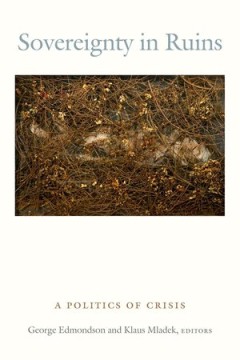
Sovereignty In Ruins : A Politics Of Crisis
Featuring essays by some of the most prominent names in contemporary political and cultural theory, Sovereignty in Ruins presents a form of critique grounded in the conviction that political thought is itself an agent of crisis. Aiming to develop a political vocabulary capable of critiquing and transforming contemporary political frameworks, the contributors advance a politics of crisis that co…
- Edition
- -
- ISBN/ISSN
- 9781478091066
- Collation
- 360 halaman
- Series Title
- -
- Call Number
- 320 EDM s
Incapacity : Wittgenstein, Anxiety, And Performance Behavior
In this highly original study of the nature of performance, Spencer Golub uses the insights of Ludwig Wittgenstein into the way language works to analyze the relationship between the linguistic and the visual in the work of a broad range of dramatists, novelists, and filmmakers, among them Richard Foreman, Mac Wellman, Peter Handke, David Mamet, and Alfred Hitchcock. Like Wittgenstein, these ar…
- Edition
- -
- ISBN/ISSN
- 9780810129924
- Collation
- -
- Series Title
- -
- Call Number
- 100 GOL i
 Computer Science, Information & General Works
  Philosophy & Psychology
  Religion
  Social Sciences
  Language
  Pure Science
  Applied Sciences
  Art & Recreation
  Literature
  History & Geography