Filter by

Finite Difference Computing with PDEs: A Modern Software Approach
This book is open access under a CC BY 4.0 license. This easy-to-read book introduces the basics of solving partial differential equations by means of finite difference methods. Unlike many of the traditional academic works on the topic, this book was written for practitioners. Accordingly, it especially addresses: the construction of finite difference schemes, formulation and implementation…
- Edition
- -
- ISBN/ISSN
- 9783319554563
- Collation
- XXIII, 507
- Series Title
- -
- Call Number
- -

Programming for Computations - MATLAB/Octave: A Gentle Introduction to Numeri…
This book presents computer programming as a key method for solving mathematical problems. There are two versions of the book, one for MATLAB and one for Python. The book was inspired by the Springer book TCSE 6: A Primer on Scientific Programming with Python (by Langtangen), but the style is more accessible and concise, in keeping with the needs of engineering students. The book outlines the s…
- Edition
- -
- ISBN/ISSN
- 9783319324524
- Collation
- XVI, 216
- Series Title
- -
- Call Number
- -

Researching Elites and Power: Theory, Methods, Analyses
This open access book describes how elite studies theoretically and methodologically construct their object, i.e. how particular conceptualizations of elites are turned into research practice using different methods for collecting, dealing with and analyzing empirical data. The first of four sections focuses on what Mills named the power elite and includes Bourdieu’s field of power. The secon…
- Edition
- 1
- ISBN/ISSN
- 9783030451752
- Collation
- XII, 276
- Series Title
- -
- Call Number
- -
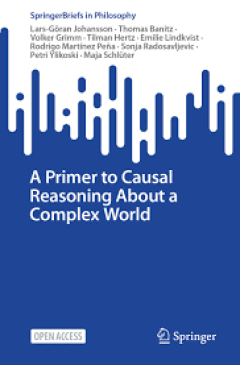
A Primer to Causal Reasoning About a Complex World
This open access book is about causal thinking and the use of causal language, with a focus on introducing philosophical ideas about causation to students and researchers of Social-Ecological Systems (SES). It takes a systematic approach to three central topics: the meanings of different causal expressions, sufficiency of evidence for inferences from observations to causal relations, and how t…
- Edition
- -
- ISBN/ISSN
- 978-3-031-59135-8
- Collation
- XII, 150
- Series Title
- SpringerBriefs in Philosophy (BRIEFSPHILOSOPH)
- Call Number
- 501 JOH p

Non-Equilibrium Social Science and Policy: Introduction and Essays on New and…
The overall aim of this book, an outcome of the European FP7 FET Open NESS project, is to contribute to the ongoing effort to put the quantitative social sciences on a proper footing for the 21st century. A key focus is economics, and its implications on policy making, where the still dominant traditional approach increasingly struggles to capture the economic realities we observe in the world …
- Edition
- -
- ISBN/ISSN
- 9783319424248
- Collation
- VIII, 232
- Series Title
- -
- Call Number
- -

European Language Grid: A Language Technology Platform for Multilingual Europe
This open access book provides an in-depth description of the EU project European Language Grid (ELG). Its motivation lies in the fact that Europe is a multilingual society with 24 official European Union Member State languages and dozens of additional languages including regional and minority languages. The only meaningful way to enable multilingualism and to benefit from this rich linguistic …
- Edition
- 1
- ISBN/ISSN
- 978-3-031-17258-8
- Collation
- -
- Series Title
- Cognitive Technologies
- Call Number
- XXX, 360
Micro-, Meso- and Macro-Dynamics of the Brain
This book brings together leading investigators who represent various aspects of brain dynamics with the goal of presenting state-of-the-art current progress and address future developments. The individual chapters cover several fascinating facets of contemporary neuroscience from elementary computation of neurons, mesoscopic network oscillations, internally generated assembly sequences in th…
- Edition
- 1st Edition
- ISBN/ISSN
- 9783319288024
- Collation
- XIII, 172
- Series Title
- -
- Call Number
- -
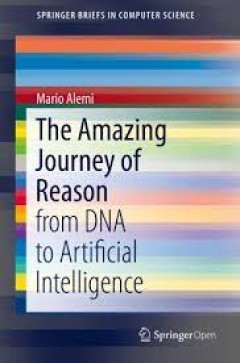
The Amazing Journey of Reason : from DNA to Artificial Intelligence
This Open Access book explores questions such as why and how did the first biological cells appear? And then complex organisms, brains, societies and –now– connected human societies? Physicists have good models for describing the evolution of the universe since the Big Bang, but can we apply the same concepts to the evolution of aggregated matter –living matter included? The Amazing Journ…
- Edition
- -
- ISBN/ISSN
- 978-3-030-25962-4
- Collation
- XVI, 113 halaman
- Series Title
- Springer Briefs in Computer Science
- Call Number
- 005 ALE a

Innovative Learning Environments in STEM Higher Education : Opportunities, Ch…
As explored in this open access book, higher education in STEM fields is influenced by many factors, including education research, government and school policies, financial considerations, technology limitations, and acceptance of innovations by faculty and students. In 2018, Drs. Ryoo and Winkelmann explored the opportunities, challenges, and future research initiatives of innovative learning …
- Edition
- -
- ISBN/ISSN
- 978-3-030-58948-6
- Collation
- XV, 137
- Series Title
- SpringerBriefs in Statistics (BRIEFSSTATIST)
- Call Number
- 300 INN

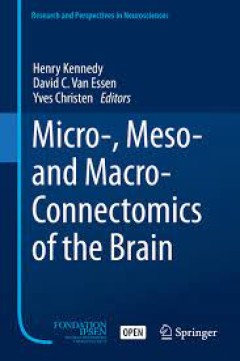
Micro-, Meso- and Macro-Connectomics of the Brain
This book has brought together leading investigators who work in the new arena of brain connectomics. This includes ‘macro-connectome’ efforts to comprehensively chart long-distance pathways and functional networks; ‘micro-connectome’ efforts to identify every neuron, axon, dendrite, synapse, and glial process within restricted brain regions; and ‘meso-connectome’ efforts to systema…
- Edition
- 1
- ISBN/ISSN
- 978-3-319-27776-9
- Collation
- X, 166
- Series Title
- Research and Perspectives in Neurosciences
- Call Number
- -
 Computer Science, Information & General Works
  Philosophy & Psychology
  Religion
  Social Sciences
  Language
  Pure Science
  Applied Sciences
  Art & Recreation
  Literature
  History & Geography