Filter by
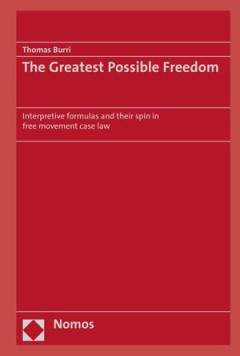
The Greatest Possible Freedom : Interpretive formulas and their spin in free …
The greatest possible freedom’ is a formula which originated in the very first preliminary ruling of the Court of Justice of the European Union in social security, the judgment inHoekstra, 1964. Ever since then, the Court has regularly relied on this formula, most recently inDumont, 2013. The evolution and the power of formulas like ‘the greatest possible freedom’ are the topic of this bo…
- Edition
- 1
- ISBN/ISSN
- 9783845265490
- Collation
- 606 halaman
- Series Title
- -
- Call Number
- 340 BUR g

Manifest Madness : Mental incapacity in The Criminal Law
Whether it is a question of the age below which a child cannot be held liable for their actions, or the attribution of responsibility to defendants with mental illnesses, mental incapacity is a central concern for legal actors, policy makers, and legislators when it comes to crime and justice. Understanding the terrain of mental incapacity in criminal law is notoriously difficult; it involves t…
- Edition
- -
- ISBN/ISSN
- 9780199698592
- Collation
- -
- Series Title
- -
- Call Number
- 340 LOU m
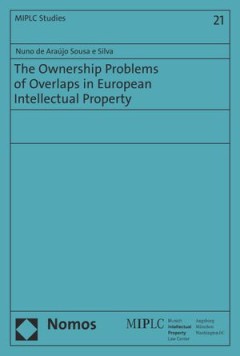
The Ownership Problems of Overlaps in European Intellectual Property
Intellectual Property rights are expanding and, thus, overlapping more than ever before. This poses challenges to a system devised as comprising a set of isolated compartments, each with its defined purpose.The diverging rules concerning ownership and entitlement can lead to different rights on the same object being owned by different persons. What happens then? This question is addressed under…
- Edition
- 1
- ISBN/ISSN
- 9783845254494
- Collation
- -
- Series Title
- -
- Call Number
- 340 SIL o
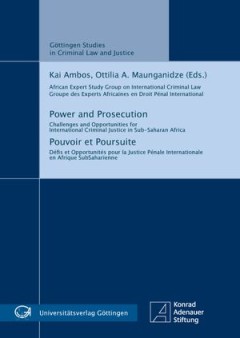
Power and Prosecution : Challenges and opportunities for international crimin…
This book contains some of the papers that were presented at the first meeting of the newly formed African Expert Study Group on International Criminal Law / Groupe des Experts Africaines en Droit Pénal International held in September 2011 in Brussels, Belgium. The group was established under the auspices of the Multinational Development Policy Dialogue (hereinafter ‘MDPD’) and the Rule of…
- Edition
- -
- ISBN/ISSN
- 9783863950781
- Collation
- -
- Series Title
- -
- Call Number
- 340 POW
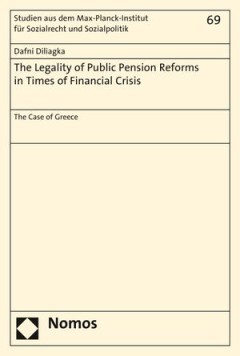
The Legality of Public Pension Reforms in Times of Financial Crisis : The Cas…
The right to old-age pension benefits is enshrined in a litany of constitutional and international rights. The aim of chapter three is to explore the protection of this right by outlining the respective legal provisions that address the right to pension entitlements. The role of the Greek Constitution and wider international law in protecting this right becomes even more important in instances …
- Edition
- 1
- ISBN/ISSN
- 9783845291574
- Collation
- -
- Series Title
- -
- Call Number
- 340 DIL l
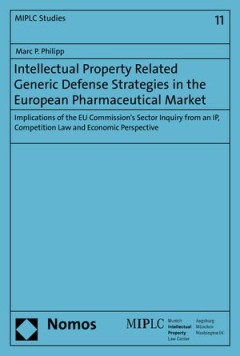
Intellectual Property Related Generic Defense Strategies in the European Phar…
This book discusses the implications of the 2009 EU Commission’s Pharmaceutical Sector Inquiry on originator’s opportunities to apply Intellectual Property related measures in defending against generic competition. It argues that on the one hand recent developments in EU competition law do indeed impose potential limitations on an originator’s ability to block or delay generic market entr…
- Edition
- 1
- ISBN/ISSN
- 9783845231037
- Collation
- 92 halaman
- Series Title
- -
- Call Number
- 340 PHI i
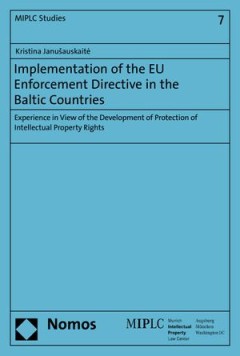
Implementation of the EU Enforcement Directive in the Baltic Countries : Expe…
How did the implementation of the EU Enforcement Directive on IP rights, which was adopted just before the expansion of the EU in May 2004, affect new EU Member States? This monograph is focused on three Baltic countries (Lithuania, Latvia and Estonia) and is aimed to present the collected information on the most relevant historic, social, economic and legal factors of those countries and to ex…
- Edition
- 1
- ISBN/ISSN
- 9783845226934
- Collation
- -
- Series Title
- -
- Call Number
- 340 JAN i
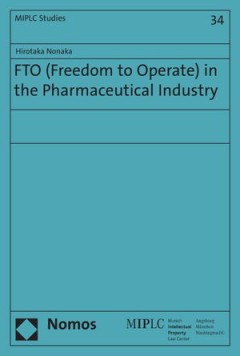
FTO (Freedom to Operate) in the Pharmaceutical Industry
When a company intends to place a new product or service on the market, it must understand the risk of infringing the third parties’ intellectual property. It is a common practice for the company to conduct a Freedom-to-Operate (FTO)¹ search to determine and reduce the risks of potential patent infringement prior to launching a new product or service. The FTO search is performed to find rele…
- Edition
- 1
- ISBN/ISSN
- 9783845294018
- Collation
- 64 halaman
- Series Title
- -
- Call Number
- 340 NON f
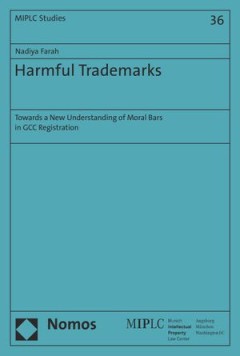
Harmful Trademarks : Towards a New Understanding of Moral Bars in GCC Registr…
Ever since a legal concept of ‘trademark’ began to emerge after 1860,2 the law regulating trademarks has often been asked to define the contours of this ‘brand’ of property right. Modern day developments continue to raise the issue of the boundaries of trademark rights and the influence of signs and symbols on society. Terrorist attacks, political upheaval, revolutions, changing so…
- Edition
- 1
- ISBN/ISSN
- 9783845294568
- Collation
- -
- Series Title
- Law / Commercial
- Call Number
- 340 FAR h
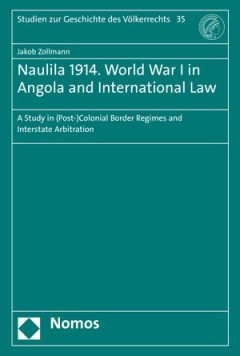
Naulila 1914, World War I in Angola and International Law : A Study in (Post-…
In 1885, Germany and Portugal became neighbours in Africa. The newly founded colony of German Southwest Africa prevented the southwards expansion of the ancient colony of Angola. The border along the Cunene and Kavango Rivers remained under dispute. After the outbreak of World War I in Europe, Portugal’s neutrality was questioned in German Southwest Africa, and when a group of German official…
- Edition
- 1
- ISBN/ISSN
- 9783845271606
- Collation
- 516 halaman
- Series Title
- Studien zur Geschichte des Völkerrechts
- Call Number
- 340 ZOL n
 Computer Science, Information & General Works
  Philosophy & Psychology
  Religion
  Social Sciences
  Language
  Pure Science
  Applied Sciences
  Art & Recreation
  Literature
  History & Geography