Filter by

Indecision Points: George W. Bush and the Israeli-Palestinian Conflict
"Although George W. Bush memorably declared, 'I'm the decider, ' as president he was remarkably indecisive when it came to U.S. policy toward the Israeli-Palestinian conflict. His administration's policymaking featured an ongoing clash between moderate realists and conservative hard-liners inspired by right-wing religious ideas and a vision of democracy as cure-all. Riven by these competing age…
- Edition
- -
- ISBN/ISSN
- 9780262326186
- Collation
- 1 online resource (xi, 227 pages).
- Series Title
- -
- Call Number
- -
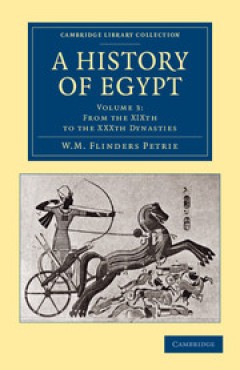
A History of Egypt
Published in six volumes between 1894 and 1905, this collection served as a valuable reference work for students and scholars of Egyptology at a time when ongoing archaeological excavations were adding significantly to the understanding of one of the world's oldest civilisations. At the forefront of this research was Sir William Matthew Flinders Petrie (1853–1942), whose pioneering methods ma…
- Edition
- -
- ISBN/ISSN
- 9781107325166
- Collation
- -
- Series Title
- Cambridge Library Collection - Egyptology
- Call Number
- -
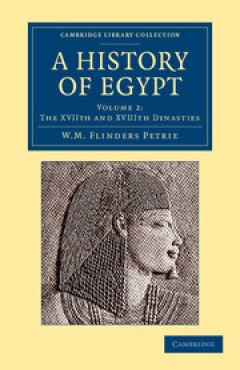
A History of Egypt
Published in six volumes between 1894 and 1905, this collection served as a valuable reference work for students and scholars of Egyptology at a time when ongoing archaeological excavations were adding significantly to the understanding of one of the world's oldest civilisations. At the forefront of this research was Sir William Matthew Flinders Petrie (1853–1942), whose pioneering methods ma…
- Edition
- -
- ISBN/ISSN
- 9781107325159
- Collation
- -
- Series Title
- Cambridge Library Collection - Egyptology
- Call Number
- -
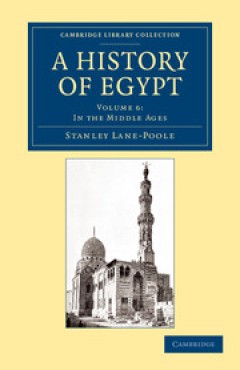
A History of Egypt
Published in six volumes between 1894 and 1905, this collection served as a valuable reference work for students and scholars of Egyptology at a time when ongoing archaeological excavations were adding significantly to the understanding of one of the world's oldest civilisations. At the forefront of this research was Sir William Matthew Flinders Petrie (1853–1942), whose pioneering methods ma…
- Edition
- -
- ISBN/ISSN
- 9781107325197
- Collation
- -
- Series Title
- Cambridge Library Collection - Archaeology
- Call Number
- -
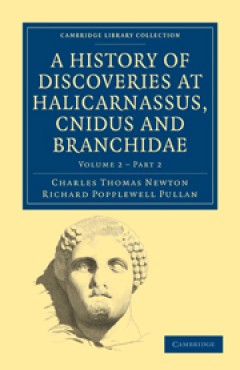
A History of Discoveries at Halicarnassus, Cnidus and Branchidae
Charles Thomas Newton (1816–1894) was a British archaeologist specialising in Greek and Roman artefacts. He studied at Christ Church, Oxford before joining the British Museum. Newton left the Museum in 1852 to explore the coast of Asia Minor, and in 1856 he discovered the remains of the Mausoleum of Halicarnassus, one of the seven ancient wonders of the world. This study, first published in 1…
- Edition
- -
- ISBN/ISSN
- 9780511910302
- Collation
- -
- Series Title
- Cambridge Library Collection - Archaeology
- Call Number
- -
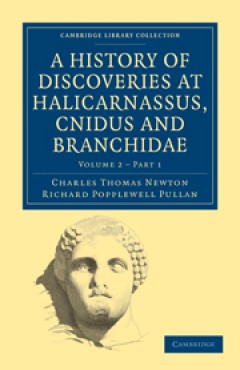
A History of Discoveries at Halicarnassus, Cnidus and Branchidae
Charles Thomas Newton (1816–1894) was a British archaeologist specialising in Greek and Roman artefacts. He studied at Christ Church, Oxford before joining the British Museum. Newton left the Museum in 1852 to explore the coast of Asia Minor, and in 1856 he discovered the remains of the Mausoleum of Halicarnassus, one of the seven ancient wonders of the world. This study, first published in 1…
- Edition
- -
- ISBN/ISSN
- 9780511910296
- Collation
- -
- Series Title
- Cambridge Library Collection - Archaeology
- Call Number
- -
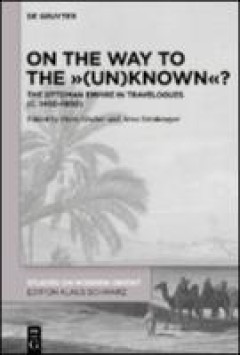
On the Way to the (Un)Known?: The Ottoman Empire in Travelogues (c. 1450-1900)
Twenty-two authors from various countries analyze travelogues on the Ottoman Empire between the fifteenth and the nineteenth centuries. The volume discusses questions of perceptions of "otherness", the circulation of knowledge, intermedial relations, gender roles, and explores possibilities and limits of digital analysis.
- Edition
- Ed. 1
- ISBN/ISSN
- 9783110698046, 9783110697605
- Collation
- 420
- Series Title
- Studies on Modern Orient, 36
- Call Number
- 297 ONT o

Al-Maqrīzī’s al-Ḫabar ʿan al-bašar, Vol. V, Section 4: Persia and Its…
Al-Maqrīzī's (d. 845/1442) last work, al-Ḫabar ʿan al-bašar, was completed a year before his death. This volume, edited by Jaakko Hämeen-Anttila, covers the history of pre-Islamic Iran from the Creation to the Parthians. Readership: All interested in Mamluk historiography or pre-Islamic history of Iran.
- Edition
- -
- ISBN/ISSN
- 9789004355996
- Collation
- -
- Series Title
- -
- Call Number
- -
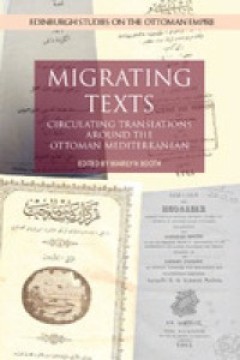
Migrating Texts : Circulating Translations around the Eastern Mediterranean
Explores translation in the context of the multi-lingual, multi-ethnic late-Ottoman Mediterranean world. Fénelon, Offenbach and the Iliad in Arabic, Robinson Crusoe in Turkish, the Bible in Greek-alphabet Turkish, excoriated French novels circulating through the Ottoman Empire in Greek, Arabic and Turkish: literary translation at the eastern end of the Mediterranean offered worldly vistas and …
- Edition
- -
- ISBN/ISSN
- 9781474438995
- Collation
- 368 halaman
- Series Title
- Edinburgh Studies on the Ottoman Empire
- Call Number
- 900 MIG

Regimes of Mobility: Borders and State Formation in the Middle East, 1918-1946
For the past two decades, insights gained from the burgeoning field of borderlands studies have enabled a new generation of scholars to challenge popular depictions of the emergence of the modern Middle East. For them, the region’s borderlands were not just mere sites of peripheral activity, but rather liminal spaces criss-crossed by global flows and circulations central to state- and nation-…
- Edition
- -
- ISBN/ISSN
- 9781474487986
- Collation
- -
- Series Title
- -
- Call Number
- -
 Computer Science, Information & General Works
  Philosophy & Psychology
  Religion
  Social Sciences
  Language
  Pure Science
  Applied Sciences
  Art & Recreation
  Literature
  History & Geography