Filter by
Biological Toxins and Bioterrorism
Biological toxins are an important part of our world, a reality with which we need to cope, so in parallel with understanding their mechanisms of action and thereby improving our fundamental knowledge, there are successful efforts to utilize them as therapeutics against some debilitating human and animal diseases. In view of the complexity of different types of biotoxins and the broad range of …
- Edition
- -
- ISBN/ISSN
- -
- Collation
- -
- Series Title
- -
- Call Number
- 615.4

Biological Effects of Metal Nanoparticles
This book offers a comprehensive overview of recent studies conducted on the biological effects of metal nanoparticles. It also provides a solid theoretical foundation and various metal nanoparticle synthesis methods. Part I reviews the main chemical methods used for synthesizing metal nanoparticles in a solution and describes original method of biochemical synthesis, as well as some special…
- Edition
- -
- ISBN/ISSN
- 978-3-319-30906-4
- Collation
- -
- Series Title
- -
- Call Number
- 615.4

Tryptophan Metabolism: Implications for Biological Processes, Health and Disease
This book discusses the relationship between cellular immunity and tryptophan metabolism, as well as its products, serotonin and melatonin, in the development of several diseases and reappraises the common signal transduction pathways of the neurodegenerative diseases, carcinogenesis, immune tolerance, inflammation, hypersensitivity reactions, neuropsychiatric disorders, in addition to bacteria…
- Edition
- -
- ISBN/ISSN
- 978-3-319-15630-9
- Collation
- 4 b/w illustrations, 17 illustrations in colour
- Series Title
- -
- Call Number
- -
The Emerging Discipline of Quantitative Systems Pharmacology
In 2011, the National Institutes of Health (NIH), in collaboration with leaders from the pharmaceutical industry and the academic community, published a white paper describing the emerging discipline of Quantitative Systems Pharmacology (QSP), and recommended the establishment of NIH-supported interdisciplinary research and training programs for QSP. QSP is still in its infancy, but has tremend…
- Edition
- -
- ISBN/ISSN
- -
- Collation
- -
- Series Title
- -
- Call Number
- 615 LEI e
Advances in Cancer Biomarkers: From biochemistry to clinic for a critical rev…
At present there are a growing number of biomolecules under investigation to understand their potential role as cancer biomarker for diagnostic, prognostic and therapeutic purposes. Intriguingly, the state of art on cancer biomarkers research shows interesting and promising results together to clamorous failures. Also from a clinical point of view, there are contradictory results on routine cl…
- Edition
- Ed. 1
- ISBN/ISSN
- 978-94-017-7215-0
- Collation
- IX, 372
- Series Title
- Advances in Experimental Medicine and Biology
- Call Number
- 616.994 ADV a
Textbook of Personalized Medicine
Advances in the technology used in personalized medicine and increased applications for clinical use have created a need for this expansion and revision of Kewal K. Jain’s Textbook of Personalized Medicine. As the first definitive work on this topic, this book reviews the fundamentals and development of personalized medicine and subsequent adoptions of the concepts by the biopharmaceutical in…
- Edition
- -
- ISBN/ISSN
- 978-1-4939-2553-7
- Collation
- XL, 732
- Series Title
- -
- Call Number
- -
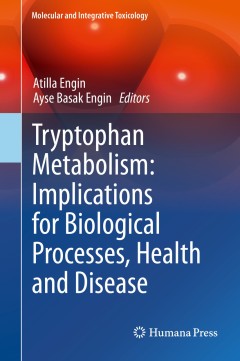
Tryptophan Metabolism: Implications for Biological Processes, Health and Disease
This book discusses the relationship between cellular immunity and tryptophan metabolism, as well as its products, serotonin and melatonin, in the development of several diseases and reappraises the common signal transduction pathways of the neurodegenerative diseases, carcinogenesis, immune tolerance, inflammation, hypersensitivity reactions, neuropsychiatric disorders, in addition to bacteria…
- Edition
- -
- ISBN/ISSN
- 978-3-319-15630-9
- Collation
- XI, 382
- Series Title
- -
- Call Number
- -
Lasso Peptides: Bacterial Strategies to Make and Maintain Bioactive Entangled…
Lasso peptides form a growing family of fascinating ribosomally-synthesized and post-translationally modified peptides produced by bacteria. They contain 15 to 24 residues and share a unique interlocked topology that involves an N-terminal 7 to 9-residue macrolactam ring where the C-terminal tail is threaded and irreversibly trapped. The ring results from the condensation of the N-terminal amin…
- Edition
- -
- ISBN/ISSN
- 978-1-4939-1010-6
- Collation
- -
- Series Title
- -
- Call Number
- -
Tactics in Contemporary Drug Design
Medicinal chemistry is both science and art. The science of medicinal chemistry offers mankind one of its best hopes for improving the quality of life. The art of medicinal chemistry continues to challenge its practitioners with the need for both intuition and experience to discover new drugs. Hence sharing the experience of drug research is uniquely beneficial to the field of medicinal chemist…
- Edition
- -
- ISBN/ISSN
- 978-3-642-55041-6
- Collation
- XII, 394
- Series Title
- Topics in Medicinal Chemistry
- Call Number
- -

Modeling in Biopharmaceutics, Pharmacokinetics and Pharmacodynamics
The state of the art in Biopharmaceutics, Pharmacokinetics, and Pharmacodynamics Modeling is presented in this new second edition book. It shows how advanced physical and mathematical methods can expand classical models in order to cover heterogeneous drug-biological processes and therapeutic effects in the body. The book is divided into four parts; the first deals with the fundamental princ…
- Edition
- 2
- ISBN/ISSN
- 978-3-319-27596-3
- Collation
- XXII, 483
- Series Title
- Interdisciplinary Applied Mathematics
- Call Number
- -
 Computer Science, Information & General Works
  Philosophy & Psychology
  Religion
  Social Sciences
  Language
  Pure Science
  Applied Sciences
  Art & Recreation
  Literature
  History & Geography