Filter by

Chapter 4 'Now, back to our Virchow': German Medical and Political Traditions…
When the war was over in 1945, Germany was a country with no government, little functioning infrastructure, millions of refugees and homeless people, and huge foreign armies living largely off the land. Large parts of the country were covered in rubble, with no clean drinking water, electricity, or gas. Hospitals overflowed with patients, but were short of beds, medicines, and medical personnel…
- Edition
- -
- ISBN/ISSN
- -
- Collation
- -
- Series Title
- -
- Call Number
- -

Bonded Labour
Parallel to the abolition of Atlantic slavery, new forms of indentured labour stilled global capitalisms need for cheap, disposable labour. The famous coolie trade - mainly Asian labourers transferred to French and British islands in the Indian Ocean, Australia, Indonesia, South Africa, the Caribbean, the Americas, as well as to Portuguese colonies in Africa - was one of the largest migration m…
- Edition
- -
- ISBN/ISSN
- 9783839437339
- Collation
- -
- Series Title
- -
- Call Number
- -

Chapter 4 Mapping the Evolution of Designed Landscapes with GIS : Stourhead L…
"The relational complexity of urban and rural landscapes in space and in time. The development of historical geographical information systems (HGIS) and other methods from the digital humanities have revolutionised historical research on cultural landscapes. Additionally, the opening up of increasingly diverse collections of source material, often incomplete and difficult to interpret, has led …
- Edition
- -
- ISBN/ISSN
- 9789462701731
- Collation
- -
- Series Title
- -
- Call Number
- -

Chapter 4 Godofredo and Francoise Travel Around the World : Phantoms, Radioio…
This chapter focuses on Françoise, a dummy figure of the upper part of the female human body used for calibrating radiation detectors in laboratories around the world. From spring 1962 to the end of 1965, Godofredo Gómez Crespo, a Spanish physicist employed by the International Atomic Energy Agency, travelled the world carrying Françoise in a box-like suitcase that also included a number of …
- Edition
- -
- ISBN/ISSN
- 9781032459097
- Collation
- -
- Series Title
- -
- Call Number
- -
Chapter 1 Rachel Cusk
In The New Midlife Self-Writing, Wittman treats recent self-writing by Rachel Cusk, Roxane Gay, Sarah Manguso, and Maggie Nelson, carefully situating these vital midlife works within the history of self-writing. She argues that they renew and redirect the autobiographical trajectories characteristic of earlier self-writing by switching their orientation to face the future and by celebrating mid…
- Edition
- -
- ISBN/ISSN
- 9781032017884
- Collation
- oer.unej.ac.id
- Series Title
- -
- Call Number
- -
Chapter 1 Patterns of Death, 1800-2020
This chapter provides a brief introduction to mortality patterns over the last two centuries, from a global perspective. The period witnessed enormous and ubiquitous rises in life expectancy at birth, from a global average of perhaps 30 years in 1800 to an estimated average of 72.6 years in 2019. Remarkably, these changes took place despite a perhaps seven- to eight-fold increase of the world 
- Edition
- -
- ISBN/ISSN
- 9780367137168
- Collation
- oer.unej.ac.id
- Series Title
- -
- Call Number
- -

Chapter 1 Law and record keeping
African countries; law; record keeping; thema EDItEUR::N History and Archaeology::NH History::NHH African history; thema EDItEUR::G Reference, Information and Interdisciplinary subjects::GL Library and information sciences / Museology::GLC Library, archive and information management; thema EDItEUR::G Reference, Information and Interdisciplinary subjects::GL Library and information sciences / Mu…
- Edition
- -
- ISBN/ISSN
- 9781032066370
- Collation
- oer.unej.ac.id
- Series Title
- -
- Call Number
- -
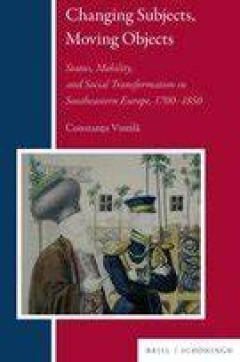
Changing Subjects, Moving Objects
This is a book about people caught between home and abroad, crossing imperial boundaries in southeastern Europe at the beginning of the modern age. Through a series of life stories, which the author reconstructs with the aid of many new sources, readers discover how certain men and women defined and adapted their loyalties and affiliations, how they fashioned their identities, how they enrolled…
- Edition
- -
- ISBN/ISSN
- 9783506704870
- Collation
- -
- Series Title
- -
- Call Number
- -

Changing environment, just transition and job creation
The world in which we currently live is characterised by a multiplicity of challenges that we must face with urgency if we want to avoid future catastrophes. Those challenges, because of the globalisation of systems, have also become global challenges, and need global responses. One of the most important of those challenges faced by the current global community remains the environmental crisis,…
- Edition
- -
- ISBN/ISSN
- 9789877223491
- Collation
- -
- Series Title
- -
- Call Number
- -
 Computer Science, Information & General Works
 Philosophy & Psychology
 Religion
 Social Sciences
 Language
 Pure Science
 Applied Sciences
 Art & Recreation
 Literature
 History & Geography