Filter by

Spirituality across Disciplines: Research and Practice
This book collects multiple disciplinary voices which explore current research and perspectives to discuss how spirituality is understood, interpreted and applied in a range of contexts. It addresses spirituality in combination with such topics as Christian mysticism, childhood and adolescent education, midwifery, and sustainability. It links spirituality to a variety of disciplines, including …
- Edition
- -
- ISBN/ISSN
- 978-3-319-31380-1
- Collation
- -
- Series Title
- -
- Call Number
- -

Why Not "Russellism"? : alias "Millennial Dawnism"
Why Not "Russellism"? Alias "Millennial Dawnism" is a critical examination of the beliefs and teachings of Charles Taze Russell, founder of the Bible Student movement and the origin of what later became known as Jehovah’s Witnesses. This work addresses Russell’s interpretations of biblical prophecy, his approach to eschatology, and his controversial Millennial Dawn teachings, which outlined…
- Edition
- -
- ISBN/ISSN
- -
- Collation
- p. 159-270
- Series Title
- -
- Call Number
- -

Handbook of Positive Psychology, Religion, and Spirituality
This handbook aims to bridge the gap between the fields of positive psychology and the psychology of religion and spirituality. It is the authoritative guide to the intersections among religion, spirituality, and positive psychology and includes the following sections: (1) historical and theoretical considerations, (2) methodological considerations, (3) cultural considerations, (4) developmenta…
- Edition
- 1
- ISBN/ISSN
- 978-3-031-10274-5
- Collation
- -
- Series Title
- -
- Call Number
- XXIV, 513

Medical Missionaries and Colonial Knowledge in West Africa and Europe, 1885-1914
This open access book offers an entangled history of hygiene by showing how knowledge of purity, health and cleanliness was shaped by evangelical medical missionaries and their encounters with people in West Africa. By tracing the interactions and negotiations of six Basel Mission doctors, who practised on the Gold Coast and in Cameroon from 1885 to 1914, the author demonstrates how notions of …
- Edition
- -
- ISBN/ISSN
- 978-3-031-27128-1
- Collation
- XVIII, 454
- Series Title
- -
- Call Number
- -

Milk and Honey: Technologies of Plenty in the Making of a Holy Land
An innovative historical analysis of the intersection of religion and technology in making the modern state, focusing on bodily production and reproduction across the human-animal divide. In Milk and Honey, Tamar Novick writes a revolutionary environmental history of the state that centers on the intersection of technology and religion in modern Palestine/Israel. Focusing on animals and the …
- Edition
- -
- ISBN/ISSN
- 9780262374552
- Collation
- -
- Series Title
- -
- Call Number
- 215
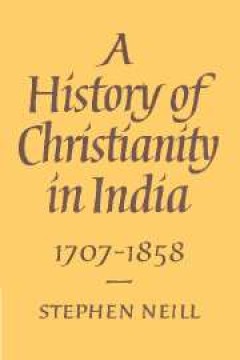
A History of Christianity in India 1707–1858
This book, a sequel to Bishop Neill's A History of Christianity in India: The Beginnings to 1707, traces its subject from the death of Aurunzib to the so-called Indian Mutiny. The history of India since 1498 is of a tremendous confrontation of cultures and religions. Since 1757, the chief part in this confrontation has been played by Britain; and the Christian missionary enterprise, especially …
- Edition
- -
- ISBN/ISSN
- 9780511520563
- Collation
- -
- Series Title
- -
- Call Number
- -

Beyond Heaven and Earth: A Cognitive Theory of Religion
An approach to understanding religion that draws on both humanities and natural science but rejects approaches that employ simple monisms and radical dualisms. In Beyond Heaven and Earth, Gabriel Levy argues that collective religious narratives and beliefs are part of nature; they are the basis for the formation of the narratives and beliefs of individuals. Religion grows out of the universe…
- Edition
- -
- ISBN/ISSN
- 9780262367684
- Collation
- -
- Series Title
- -
- Call Number
- -

Beyond heaven and earth :a cognitive theory of religion
"An argument for using Donald Davidson's metaphysics for briding the growing divide between scientiific and humanistic understanding of religion"--OCLC-licensed vendor bibliographic record.
- Edition
- -
- ISBN/ISSN
- 0262367688
- Collation
- 1 online resource.
- Series Title
- -
- Call Number
- -
A natural history of natural theology :the cognitive science of theology and …
"Questions about the existence and attributes of God form the subject matter of natural theology, which seeks to gain knowledge of the divine by relying on reason and experience of the world. Arguments in natural theology rely largely on intuitions and inferences that seem natural to us, occurring spontaneously--at the sight of a beautiful landscape, perhaps, or in wonderment at the complexity …
- Edition
- -
- ISBN/ISSN
- 0262326833
- Collation
- 1 online resource (xvii, 246 pages)
- Series Title
- -
- Call Number
- -
Jesuit science and the republic of letters
A reassessment of the Jesuit contributions to the emergence of the scientific worldview.Founded in 1540, the Society of Jesus was viewed for centuries as an impediment to the development of modern science. The Jesuit educational system was deemed conservative and antithetical to creative thought, while the Order and its members were blamed by Galileo, Descartes, and their disciples for virtuall…
- Edition
- -
- ISBN/ISSN
- 9780262272537
- Collation
- 1 online resource (xi, 483 pages) :illustrations.
- Series Title
- -
- Call Number
- -
 Computer Science, Information & General Works
 Philosophy & Psychology
 Religion
 Social Sciences
 Language
 Pure Science
 Applied Sciences
 Art & Recreation
 Literature
 History & Geography