Filter by
Universe and Inner Self in Early Indian and Early Greek Thought
From the sixth century BCE onwards there occurred a revolution in thought, with novel ideas such as such as that understanding the inner self is both vital for human well-being and central to understanding the universe. This intellectual transformation is sometimes called the beginning of philosophy. And it occurred – independently it seems - in both India and Greece, but not in the vast…
- Edition
- -
- ISBN/ISSN
- 9781474411004
- Collation
- 320
- Series Title
- -
- Call Number
- 100 UNI
Cognitive pluralism
An argument that we understand the world through many special-purpose mental models of different content domains, and an exploration of the philosophical implications. Philosophers have traditionally assumed that the basic units of knowledge and understanding are concepts, beliefs, and argumentative inferences. In Cognitive Pluralism, Steven Horst proposes that another sort of unit--a mental mo…
- Edition
- -
- ISBN/ISSN
- 0262333627
- Collation
- 1 online resource (xii, 360 pages) :illustrations, maps
- Series Title
- -
- Call Number
- -
Essays on Plato’s Epistemology
Through a careful survey of several significant Platonic texts, mainly focussing on the nature of knowledge, Essays on Plato's Epistemology offers the reader a fresh and promising approach to Plato's philosophy as a whole. From the very earliest reception of Plato's philosophy, there has been a conflict between a dogmatic and a sceptical interpretation of his work and thou…
- Edition
- -
- ISBN/ISSN
- 9789462700598
- Collation
- 336 halaman
- Series Title
- Ancient and Medieval Philosophy - Series 1
- Call Number
- 100 TRA e
Chapter 1 from Quantum Physics to Classical Metaphysics
"In this chapter, I argue that Aristotle's doctrine of hylomorphism, which con- ceived the natural world as consisting of substances which are metaphysically composed of matter and form, is ripe for rehabilitation in the light of quantum physics. I begin by discussing Aristotle's conception of matter and form, as it was understood by Aquinas, and how Aristotle's doctrine of hylomorphism wa…
- Edition
- -
- ISBN/ISSN
- 9780367637149
- Collation
- Pages 46
- Series Title
- -
- Call Number
- 100 SIM c
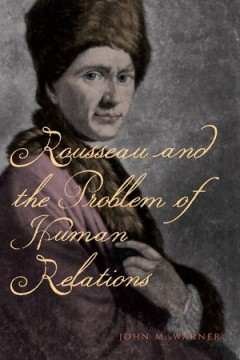
Rousseau and the Problem of Human Relations
Among Jean-Jacques Rousseau's chief preoccupations was the problem of self-interest implicit in all social relationships. A person with divided loyalties (i.e., to both himself and his cohorts) was, in Rousseau's thinking, a divided person. According to John Warner's Rousseau and the Problem of Human Relations, not only did Rousseau never solve this problem, he believed it was fundamentally uns…
- Edition
- -
- ISBN/ISSN
- 9780271071008
- Collation
- -
- Series Title
- -
- Call Number
- 210.1
Derrida After the End of Writing: Political Theology and New Materialism
This book explores some of the implications of interpreting Derrida through the new materialist lens of technicity or plasticity, attending to the significance of ethics, religion and politics in his later work. Here the intersection of religion and politics becomes the site for Derrida to develop a “political theology without sovereignty.” By reading Derrida from a new materialist perspect…
- Edition
- -
- ISBN/ISSN
- 9780823277834
- Collation
- -
- Series Title
- -
- Call Number
- 297.272
A world to live in :an ecologist's vision for a plundered planet
A century of industrial development is the briefest of moments in the half billion years of the earth's evolution. And yet our current era has brought greater changes to the earth than any period in human history. The biosphere, the globe's life-giving envelope of air and climate, has been changed irreparably. In A World to Live In, the distinguished ecologist George Woodwell shows that the bio…
- Edition
- -
- ISBN/ISSN
- 9780262333689
- Collation
- 1 online resource (xvi, 227 pages)
- Series Title
- -
- Call Number
- -
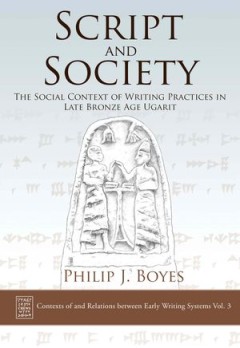
Script and Society the Social Context of Writing Practices in Late Bronze Age…
By the 13th century BC, the Syrian city of Ugarit hosted an extremely diverse range of writing practices. As well as two main scripts – alphabetic and logographic cuneiform - the site has also produced inscriptions in a wide range of scripts and languages, including Hurrian, Sumerian, Hittite, Egyptian hieroglyphs, Luwian hieroglyphs and Cypro-Minoan. This variety in script and language is ac…
- Edition
- -
- ISBN/ISSN
- 9781789255867
- Collation
- -
- Series Title
- -
- Call Number
- -

Writing Self, Writing Empire: Chandar Bhan Brahman and the Cultural World of …
Writing Self, Writing Empire examines the life, career, and writings of the Mughal state secretary, or munshi, Chandar Bhan Brahman (d. ca. 1670), one of the great Indo-Persian poets and prose stylists of early modern South Asia. Chandar Bhan’s life spanned the reigns of four emperors: Akbar (1556–1605), Jahangir (1605–1627), Shah Jahan (1628–1658), and Aurangzeb ‘Alamgir (1658–1707…
- Edition
- Ed. 1
- ISBN/ISSN
- 9780520961685
- Collation
- -
- Series Title
- -
- Call Number
- 927 KIN w

Thinking and Killing : Philosophical Discourse in the Shadow of the Third Reich
This book explores the phenomenon of the Third Reich from a philosophical perspective. It concentrates on the ways in which the subjects and experiences of Nazi Germany, the Holocaust and Anti-Semitism are conceived by eight German thinkers from the Continental tradition. This title was made Open Access by libraries from around the world through Knowledge Unlatched.
- Edition
- -
- ISBN/ISSN
- 9781614511021
- Collation
- 116 halaman
- Series Title
- -
- Call Number
- 100 SEG t
 Computer Science, Information & General Works
  Philosophy & Psychology
  Religion
  Social Sciences
  Language
  Pure Science
  Applied Sciences
  Art & Recreation
  Literature
  History & Geography