Filter by
Constitutional Challenges in the Algorithmic Society
The law struggles to address the constitutional challenges of the algorithmic society. This book is for scholars and lawyers interested in the intersections of law and technology. It addresses the challenges for fundamental rights and democracy, the role of policy and regulation, and the responsibilities of private actors.
- Edition
- -
- ISBN/ISSN
- 9781108914857, 9781108843126
- Collation
- -
- Series Title
- -
- Call Number
- -

Chapter The Price of Uncertainty in Present-Biased Planning
The tendency to overestimate immediate utility is a common cognitive bias. As a result people behave inconsistently over time and fail to reach long-term goals. Behavioral economics tries to help affected individuals by implementing external incentives. However, designing robust incentives is often difficult due to imperfect knowledge of the parameter β ∈ (0, 1] quantifying a person’s pres…
- Edition
- -
- ISBN/ISSN
- -
- Collation
- -
- Series Title
- -
- Call Number
- -

Chapter 30 The Role of Participants in Online Privacy Research Ethical and P…
Online privacy research considers the determinants, dimensions, and consequences of information disclosure on the internet. In this endeavor, researchers often are interested in uncovering personal and potentially sensitive details about media use and (privacy-related) attitudes and behavior. This focus raises a number of ethical questions that researchers need to address. Ethical questions rel…
- Edition
- -
- ISBN/ISSN
- -
- Collation
- -
- Series Title
- -
- Call Number
- -

Algorithmic aspects of resource allocation and multiwinner voting: theory and…
This thesis is concerned with investigating elements of computational social choice in the light of real-world applications. We contribute to a better understanding of the areas of fair allocation and multiwinner voting. For both areas, inspired by real-world scenarios, we propose several new notions and extensions of existing models. Then, we analyze the complexity of answering the computation…
- Edition
- -
- ISBN/ISSN
- Publisher
- Collation
- 241 hlm; ill., lamp.,
- Series Title
- -
- Call Number
- -

Artificial Intelligence and the Internet of Things
Through algorithms and artificial intelligence (AI), objects and digital services now demonstrate new skills they did not have before, right up to replacing human activity through pre-programming or by making their own decisions. As part of the internet of things, AI applications are already widely used today, for example in language processing, image recognition and the tracking and processing…
- Edition
- -
- ISBN/ISSN
- 9781911534822
- Collation
- online resource
- Series Title
- CAMRI Policy Briefs,
- Call Number
- -

Abrasive Technology
The subject matter of this book is the information on the abrasive technology methods, the characteristics of the methods (for example, the technological parameters, tools, and machines), innovative methods, characteristics of surface structure and surface properties after this type of mechanical process, and application in various industrial branches and other technical and technological domai…
- Edition
- -
- ISBN/ISSN
- 9781838816803
- Collation
- oer.unej.ac.id
- Series Title
- -
- Call Number
- -
Today's TBB Today's TBB = C++ Parallel Programming with Threading Building B…
This open-access book serves as a comprehensive guide for C++ programmers looking to master Threading Building Blocks (TBB). Authored by two experts in TBB and parallel programming, the book distills decades of collective experience in developing and teaching parallel programming concepts, presenting insights in a clear and accessible manner. Today’s TBB starts with foundational principles, …
- Edition
- -
- ISBN/ISSN
- 9798868812705
- Collation
- LXXI, 447 hlm,: ill, lamp; 21 cm
- Series Title
- -
- Call Number
- -
Pro TBB = C++ Parallel Programming with Threading Building Blocks
This open access book is a modern guide for all C++ programmers to learn Threading Building Blocks (TBB). Written by TBB and parallel programming experts, this book reflects their collective decades of experience in developing and teaching parallel programming with TBB, offering their insights in an approachable manner. Throughout the book the authors present numerous examples and best practice…
- Edition
- 1
- ISBN/ISSN
- 9781484243985
- Collation
- LXVI, 754 hlm; ill., lamp.,
- Series Title
- -
- Call Number
- -
Boosting: Foundations and Algorithms
A remarkably rich theory has evolved around boosting, with connections to a range of topics including statistics, game theory, convex optimization, and information geometry. Boosting algorithms have also enjoyed practical success in such fields as biology, vision, and speech processing. At various times in its history, boosting has been perceived as mysterious, controversial, even paradoxical. …
- Edition
- -
- ISBN/ISSN
- 9780262301183
- Collation
- 1 online resource (xv, 526 pages) :illustrations
- Series Title
- -
- Call Number
- -
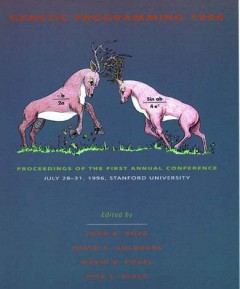
Genetic programming 1996 : Proceedings of the First Annual Conference, July 2…
Genetic programming is a domain-independent method for automatic programming that evolves computer programs that solve, or approximately solve, problems. Starting with a primordial ooze of thousands of randomly created computer programs composed of functions and terminals appropriate to a problem, a population of programs is progressively evolved over many generations using the Darwinian princi…
- Edition
- -
- ISBN/ISSN
- 9780262315876
- Collation
- 1 online resource (xviii, 568 pages) : illustrations.
- Series Title
- -
- Call Number
- 005 GEN
 Computer Science, Information & General Works
 Philosophy & Psychology
 Religion
 Social Sciences
 Language
 Pure Science
 Applied Sciences
 Art & Recreation
 Literature
 History & Geography