Filter by

Contested Legitimacies Repression and Revolt in Post-Revolutionary Egypt
Since the military overthrow of President Mursi in mid-2013, Egypt has witnessed an authoritarian rollback. Through a combination of repression and nationalist securitizing discourses, popular pressure for reform was successfully channelled into a state-centric model of governance. But despite state violence and the restriction of public spaces, protests have anything but ceased. Contested Legi…
- Edition
- -
- ISBN/ISSN
- 9789048553457
- Collation
- -
- Series Title
- -
- Call Number
- -

The Tomb of the Priests of Amun : Burial Assemblages at the National Museum o…
Previously unpublished, the Danish Lot of antiquities from the Tomb of the Priests of Amun (Bab el-Gasus) is thoroughly examined in this book. The in-depth analysis of the objects is followed by an assessment of how these objects were crafted, designed, used and recycled in the Theban necropolis, a procedure that not only reveals to be instrumental in the dating of the objects, as it sheds ligh…
- Edition
- -
- ISBN/ISSN
- 9789004524804
- Collation
- 536 hlm; ill., lamp.,
- Series Title
- Culture and History of the Ancient Near East, Volume: 130 Gate of the Priests, Volume: 130
- Call Number
- -

Judeans in Babylonia : A Study of Deportees in the Sixth and Fifth Centuries BCE
In Judeans in Babylonia, Tero Alstola presents a comprehensive investigation of deportees in the sixth and fifth centuries BCE. By using cuneiform documents as his sources, he offers the first book-length social historical study of the Babylonian Exile, commonly regarded as a pivotal period in the development of Judaism. The results are considered in the light of the wider Babylonian society a…
- Edition
- -
- ISBN/ISSN
- 978-90-04-36542-1
- Collation
- xii, 353
- Series Title
- Culture and History of the Ancient Near East, Volume: 109
- Call Number
- -

The Tomb of the Priests of Amun = Burial Assemblages in the Egyptian Museum o…
The Tomb of the Priests of Amun, also known as Bab el-Gasus, was uncovered in 1891 at Deir el-Bahari (Thebes). The site proved to be the largest undisturbed tomb ever found in Egypt, as there were found the intact burials of 153 individuals that lived under the 21st Dynasty (ca. 1069-945 BC). This outstanding find was subsequently divided in lots of antiquities and dispersed by 17 nations. …
- Edition
- -
- ISBN/ISSN
- 9789004386501
- Collation
- 576hlm; ill., lamp.,
- Series Title
- Culture and History of the Ancient Near East, Volume: 97 Gate of the Priests, Volume: 97
- Call Number
- -

The Saqqara Necropolis through the New Kingdom = Biography of an Ancient Egyp…
This book is the first comprehensive monographic treatment of the New Kingdom (1539–1078 BCE) necropolis at Saqqara, the burial ground of the ancient Egyptian city of Memphis, and addresses questions fundamental to understanding the site’s development through time. For example, why were certain areas of the necropolis selected for burial in certain time periods; what were the tombs’ spati…
- Edition
- -
- ISBN/ISSN
- 9789004467149
- Collation
- 560 hlm; ill., lamp.,
- Series Title
- Culture and History of the Ancient Near East, Volume: 131
- Call Number
- -

The Phoebe A. Hearst Expedition to Naga ed-Deir, Cemeteries N 2000 and N 2500
The Phoebe A. Hearst Expedition to Naga ed-Deir, Cemeteries N 2000 and N 2500 presents the results of excavations directed by George A. Reisner and led by Arthur C. Mace. The site of Naga ed-Deir, Egypt, is unusual for its continued use over a long period of time (c. 3500 BCE–650 CE). Burials in N 2000 and N 2500 date to the First Intermediate Period/Middle Kingdom and the Coptic era. In keep…
- Edition
- -
- ISBN/ISSN
- 978900439690
- Collation
- 544 hlm; ill., lamp.,
- Series Title
- Harvard Egyptological Studies, Volume: 10
- Call Number
- -
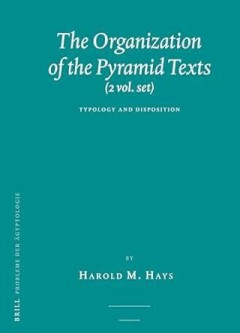
The Organization of the Pyramid Texts (2 vols.) = Typology and Disposition
The ancient Egyptian Pyramid Texts form the oldest sizable body of religious texts in the world. Discovered in the late nineteenth century, they had been inscribed on the interior stone walls of the pyramid tombs of third-millennium kings and queens. From their content it is clear that they were concerned with the afterlife state of the tomb owner, but the historical meaning of their emergence …
- Edition
- -
- ISBN/ISSN
- 9789004227491
- Collation
- 348 hlm; ill., lamp.,
- Series Title
- Probleme der Ägyptologie, Volume: 31
- Call Number
- -

Ancient Egypt, New Technology: The Present and Future of Computer Visualizati…
This volume of collected studies takes stock of most recent developments in Egyptology and the Digital Humanities, considering future directions for the application of new technologies in Egyptology. The book presents the results of an international conference held in 2019 at Indiana University – Bloomington, in which Egyptologists and digital humanists with interest in Egyptology gathered in…
- Edition
- Volume: 17
- ISBN/ISSN
- 978-90-04-50129-4
- Collation
- -
- Series Title
- -
- Call Number
- -

A History of Egypt
Published in six volumes between 1894 and 1905, this collection served as a valuable reference work for students and scholars of Egyptology at a time when ongoing archaeological excavations were adding significantly to the understanding of one of the world's oldest civilisations. At the forefront of this research was Sir William Matthew Flinders Petrie (1853–1942), whose pioneering methods ma…
- Edition
- -
- ISBN/ISSN
- 9781107325166
- Collation
- -
- Series Title
- Cambridge Library Collection - Egyptology
- Call Number
- -
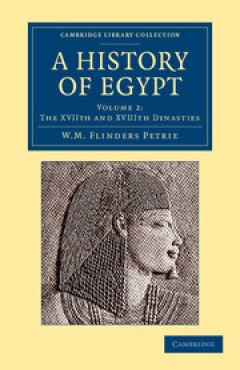
A History of Egypt
Published in six volumes between 1894 and 1905, this collection served as a valuable reference work for students and scholars of Egyptology at a time when ongoing archaeological excavations were adding significantly to the understanding of one of the world's oldest civilisations. At the forefront of this research was Sir William Matthew Flinders Petrie (1853–1942), whose pioneering methods ma…
- Edition
- -
- ISBN/ISSN
- 9781107325159
- Collation
- -
- Series Title
- Cambridge Library Collection - Egyptology
- Call Number
- -
 Computer Science, Information & General Works
  Philosophy & Psychology
  Religion
  Social Sciences
  Language
  Pure Science
  Applied Sciences
  Art & Recreation
  Literature
  History & Geography