Filter by

Chapter The Imperial Image of Theoderic: the Case of the Regisole of Pavia
The contribution intends to retrace the history of Pavia’s famous equestrian statue, known as the “Regisole”, destroyed in 1796. The statue, in gilded bronze, represented a Roman emperor and was transferred from Rome to Ravenna, most likely by Theoderic. At a certain point, probably between the eighth and tenth centuries, the Regisole arrived in Pavia, even if it is difficult to establish…
- Edition
- -
- ISBN/ISSN
- 9788855186643
- Collation
- -
- Series Title
- -
- Call Number
- -

Chapter The Creation of Two Ethnographic Identities: The Cases of the Ostrogo…
The aim of this paper is to analyse two ethnographic identities constructed for two barbarian peoples – the Ostrogoths and the Langobards. As I try to argue, the first identity was constructed to show that the Ostrogoths were a civilized people and a better version of the Romans, and moreover, this identity communicated that the Ostrogoths could not be called a barbaric and savage people. The…
- Edition
- -
- ISBN/ISSN
- 9788855186643
- Collation
- -
- Series Title
- -
- Call Number
- -

Chapter The Centres of Public Power Between the Cities and the Countryside, i…
The paper aims to illustrate, especially through the results of recent archaeological studies, the articulation and forms of the centres of public power between the Gothic and the Carolingian periods, in the dialectic between the city as a seat of the institutions and their protagonists, and the countryside, which contains the production centres and controls their resources. We will consider th…
- Edition
- -
- ISBN/ISSN
- 9788855186643
- Collation
- -
- Series Title
- -
- Call Number
- -

Chapter Epigraphic Stratigraphy: is There Any Trace of the Ostrogoths in Earl…
The short but significant experiment of the Ostrogothic Kingdom in Italy left politically ephemeral albeit culturally surprisingly durable traces in the peninsula. Among them, epigraphy takes centre stage when discussing decrees, laws, and public documents, which are a direct expression of the rulers’ will to gain greater visibility and disseminate their voice. However, epigraphy is also cruc…
- Edition
- -
- ISBN/ISSN
- 9788855186643
- Collation
- oer.unej.ac.id
- Series Title
- Reti Medievali E-Book,
- Call Number
- -
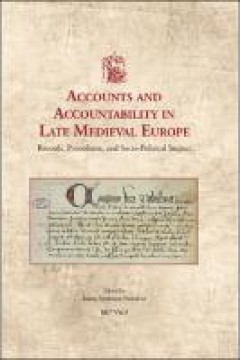
Accounts and Accountability in Late Medieval Europe
This volume stems from a conference organised in November 2018 at the University of Bucharest in the frame of the European Research Council project CASTELLANY ACCOUNTS, “Record-keeping, fiscal reform, and the rise of institutional accountability in late-medieval Savoy: A source-oriented approach”. Both the conference and the volume have received funding from the European Research Council (E…
- Edition
- -
- ISBN/ISSN
- 9782503588537
- Collation
- oer.unej.ac.id
- Series Title
- UTRECHT STUDIES IN MEDIEVAL LITERACY,
- Call Number
- -
Social and Intellectual Networking in the Early Middle Ages
Social and Intellectual Networking in the Early Middle Ages seeks to expand our understanding of early medieval connectivity by interrogating social and intellectual collaborations, competitions, and communications among persons, places, things, and ideas in the European and Mediterranean West during the second half of the first millennium CE. In so doing, its contributors explore the existence…
- Edition
- -
- ISBN/ISSN
- 9781685710552
- Collation
- -
- Series Title
- -
- Call Number
- -

Complexity and dynamics Settlement and landscape from the Bronze Age to the …
How did people organize their settlements in later prehistoric societies? How do architecture, spatial organization, land divisions, and landscape use relate to different modes of social organization? The papers in this book contribute to a greater understanding of the complexity and dynamics of settlement and landscape organization in the Nordic countries from the Late Bronze Age to the Renais…
- Edition
- -
- ISBN/ISSN
- 9789464270440
- Collation
- -
- Series Title
- -
- Call Number
- -

Erotic Medievalisms Medieval Pleasures Empowering Marginalized People
Erotic, Sexualities, BDSM,Middle Ages, Beowulf, Chaucer,Santiago García
- Edition
- -
- ISBN/ISSN
- 9781003278542
- Collation
- -
- Series Title
- -
- Call Number
- -
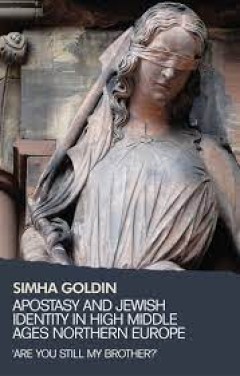
Apostasy and Jewish identity in High Middle Ages Northern Europe 'Are you st…
The attitude of Jews living in the medieval Christian world to Jews who converted to Christianity or to Christians seeking to join the Jewish faith reflects the central traits that make up Jewish self-identification. The Jews saw themselves as a unique group chosen by God, who expected them to play a specific and unique role in the world. This study researches fully for the first time the vario…
- Edition
- -
- ISBN/ISSN
- 9781526129345
- Collation
- -
- Series Title
- -
- Call Number
- -
 Computer Science, Information & General Works
  Philosophy & Psychology
  Religion
  Social Sciences
  Language
  Pure Science
  Applied Sciences
  Art & Recreation
  Literature
  History & Geography