Filter by

Chapter The Historiae Florentini populi by Poggio Bracciolini. Genesis and Fo…
During the last years of his life, Poggio Bracciolini (1380-1459), former Apostolic Secretary and Chancellor of Florence, was working on a long text that he characterized, in a letter written in 1458, as lacking a well-defined structure. This was most probably his history of the people of Florence (Historiae Florentini populi, the title given in Jacopo’s dedication copy to Frederick of Montef…
- Edition
- -
- ISBN/ISSN
- 9788864539683
- Collation
- -
- Series Title
- -
- Call Number
- -

Chapter 6 On Top of the Hierarchy
This volume is an interdisciplinary attempt to insert a broader, historically informed perspective into current political and academic debates on the issue of evidence and the reliability of scientific knowledge. The tensions between competing paradigms, different bodies of knowledge and the relative hierarchies between them are a crucial element of the historical and contemporary dynamics of s…
- Edition
- -
- ISBN/ISSN
- 9781032037059
- Collation
- 26 hlm.
- Series Title
- -
- Call Number
- -

Archives and Records
This open access book addresses the protection of privacy and personality rights in public records, records management, historical sources, and archives; and historical and current access to them in a broad international comparative perspective. Considering the question “can archiving pose a security risk to the protection of sensitive data and human rights?”, it analyses data security and …
- Edition
- -
- ISBN/ISSN
- 9783031186677
- Collation
- oer.unej.ac.id
- Series Title
- -
- Call Number
- -
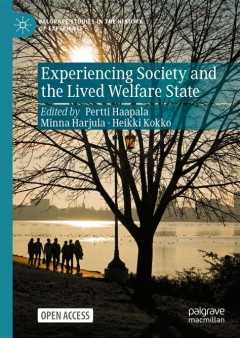
Experiencing Society and the Lived Welfare State
This open access book presents a new approach to the history of welfare state. By applying the concepts of experiencing society and the lived welfare state, the collection introduces theoretical, methodological and empirical insights for bridging the everyday life and institutional structures. The chapters analyze how the welfare state as a particular individual-society relationship has become …
- Edition
- 1
- ISBN/ISSN
- 9783031216633
- Collation
- XX, 379 hlm,: ill, lamp;
- Series Title
- -
- Call Number
- -

Histories of Experience in the World of Lived Religion
'At a historic moment, when religion shows all its social and political strength in various post-modern societies around our globe, this fascinating collection of studies from the Middle Ages to twentieth-century Europe demonstrates all the richness and innovative force of investigating individual and shared experiences when questioning the cultural, political and social place of religion in so…
- Edition
- 1
- ISBN/ISSN
- 9783030921408
- Collation
- XIII, 305 hlm,: ill, lamp;
- Series Title
- -
- Call Number
- -

Lived Nation as the History of Experiences and Emotions in Finland, 1800-2000
This open access book uses Finland in the nineteenth and twentieth centuries as an empirical case in order to study the emergence, shaping and renewal of a nation through histories of experience and emotions. It revolves around the following questions: What kinds of experiences have engendered national mobilization and feelings of national belonging? How have political and societal conflicts tu…
- Edition
- 1
- ISBN/ISSN
- 9783030698829
- Collation
- XXI, 392 hlm,: ill, lamp;
- Series Title
- -
- Call Number
- -

Documenting the Armenian Genocide
This open access book brings together contributions from an internationally diverse group of scholars to celebrate Taner Akçam’s role as the first Turkish intellectual to publicly recognize the Armenian Genocide. As a researcher, lecturer, and mentor to a new generation of scholars, Akçam has led the effort to utilize previously unknown, ignored, or under-studied sources, whether in Turkish…
- Edition
- 1
- ISBN/ISSN
- 978-3-031-36753-3
- Collation
- -
- Series Title
- Palgrave Studies in the History of Genocide
- Call Number
- XII, 308

Theories of History: History Read across the Humanities
This book considers ‘history’ through its supplementary function to the field rather than the ground of a study, bringing new insights into historical thinking and historiography across the humanities. It fosters engagement from around the disciplines in historical thinking and invites historians and philosophers of history to see the impact of their work outside of their own specific field…
- Edition
- Ed. 1
- ISBN/ISSN
- 9781474271301, 9781474271301
- Collation
- -
- Series Title
- -
- Call Number
- 907 THE t

The Cold War in the classroom : international perspectives on textbooks and m…
This book explores how the socially disputed period of the Cold War is remembered in today’s history classroom. Applying a diverse set of methodological strategies, the authors map the dividing lines in and between memory cultures across the globe, paying special attention to the impact the crisis-driven age of our present has on images of the past. Authors analysing educational media point t…
- Edition
- -
- ISBN/ISSN
- 9783030119997
- Collation
- -
- Series Title
- -
- Call Number
- 909.825072
Trajectories of Memory: Excavating the Past in Indonesia
This book is a collection of essays in Indonesian history and archaeology dealing with different and multiple trajectories, along four broad themes. The first part of the book covers competing or evolving representations of events, customs or traditions, and historical personae in Indonesian official and popular expression, as they are shaped by economic, political, and cultural forces. The sec…
- Edition
- Ed. 1
- ISBN/ISSN
- 9789819919956, 9789819919949
- Collation
- 316
- Series Title
- -
- Call Number
- 907.2 TRA t
 Computer Science, Information & General Works
 Philosophy & Psychology
 Religion
 Social Sciences
 Language
 Pure Science
 Applied Sciences
 Art & Recreation
 Literature
 History & Geography