Filter by

Chapter The Existential byt’ in the Translations of I.A. Bunin’s The Gent…
This article deals with the translations of a Bunin’s story The Gentleman from San Francisco into Japanese and English. Japanese translations of the phrase with the existential verb byt’ reflect a different understanding of death. A comparison of the original text with the translations also helps us understand the image of the gentleman’s being, bytie, which changes as the story develops.
- Edition
- -
- ISBN/ISSN
- 9791221502381
- Collation
- -
- Series Title
- -
- Call Number
- -
Chapter 5 Historical overview of lesson study
This book provides a comprehensive overview of the history and current status of policy, research and practices of curriculum, classroom instruction and assessment in Japan. It outlines the mechanism of curriculum organization and the history of the National Courses of Study, and assesses the theories of academic ability model. It also discusses in detail the history of "Lesson Study" – a cha…
- Edition
- -
- ISBN/ISSN
- 9781138604551
- Collation
- -
- Series Title
- -
- Call Number
- -
Japan's Twenty-One Demands and Anglo-Japanese relations
The decline of British power in Asia, from a high point in 1905, when Britain’s ally Japan vanquished the Russian Empire, apparently reducing the perceived threat that Russia posed to its influence in India and China, to the end of the twentieth century, when British power had dwindled to virtually nothing, is one of the most important themes in understanding the modern history of East and So…
- Edition
- -
- ISBN/ISSN
- 9781138543317
- Collation
- 23
- Series Title
- -
- Call Number
- -

Chapter 1 Rethinking the Maria Luz Incident
This chapter adopts methodological cosmopolitanism to revisit the Maria Luz Incident (1872), a colourful diplomatic episode that involved two civil suits brought before a court created for the specific purpose of adjudicating whether the ship’s captain ill-treated and abused his Chinese ‘passengers’ while the ship was anchored for repairs in Yokohama Port. The chapter argues that the Mari…
- Edition
- -
- ISBN/ISSN
- 9780367406806
- Collation
- oer.unej.ac.id
- Series Title
- -
- Call Number
- -

Chapter 4 Post-Fukushima anti-nuclear movement
The chapter analyzes the cycle of the anti-nuclear movement that followed the Fukushima accident in March 2011. Employing functional typology, the chapter categorizes the movement’s organizations into seven types (direct action, research and education, policy advocacy, aid, watchdog, legal, and other) and shows that the post-Fukushima wave of protests was much broader in scope and more divers…
- Edition
- -
- ISBN/ISSN
- 9781032017020
- Collation
- -
- Series Title
- -
- Call Number
- -

Founding Territorial Cults in Early Japan
The first book that deals with the territorial cults of early Japan by focusing on how such cults were founded in ownerless regions. Numerous ancient Japanese myths and legends are discussed to show that the typical founding ritual was a two-phase ritual that turned the territory into a horizontal microcosm, complete with its own ‘terrestrial heaven’ inhabited by local deities. Reversing M…
- Edition
- -
- ISBN/ISSN
- 978-90-04-68645-8
- Collation
- oer.unej.ac.id
- Series Title
- Brill's Japanese Studies Library, Volume: 76
- Call Number
- -
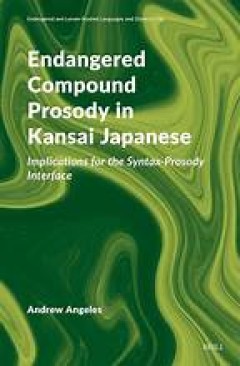
Endangered Compound Prosody in Kansai Japanese
This book examines the diverse prosody of compound nouns in Kansai Japanese, with a special focus on a class of compounds with particularly variable prosody, whose unique prosody is potentially endangered due to their structure and influence from Tokyo Japanese. These compounds serve as important evidence for recursion in prosodic structure in theories of the syntax-prosody interface, as they s…
- Edition
- -
- ISBN/ISSN
- 978-90-04-67764-7
- Collation
- oer.unej.ac.id
- Series Title
- Endangered and Lesser-Studied Languages and Dialects, Volume: 2
- Call Number
- -

The Formation of Japan-ROK Security Relations = Meeting the Evolving Cold War…
This open access book argues that Japan-ROK security relations were formed in the process of adjusting the threat perception gap and policy conflict between the two countries. Conventional analyses using a “cooperation or conflict” dichotomy are too limited to capture the complex coordination of interests that security relations entail. In comparison, this book focuses on how, as they inter…
- Edition
- 1
- ISBN/ISSN
- 9789819784790
- Collation
- XI, 216 hlm; ill., lamp.,
- Series Title
- -
- Call Number
- -

Japan’s Arduous Rejuvenation as a Global Power = Democratic Resilience and …
This open access book assesses the profound impact of Japan’s aspirations to become a great power on Japanese security, democracy and foreign relations. Rather than viewing the process of normalization and rejuvenation as two decades of remilitarization in face of rapidly changing strategic environment and domestic political circumstances, this volume contextualizes Japan’s contemporary in…
- Edition
- 1
- ISBN/ISSN
- 9789811361906
- Collation
- XIII, 242 ill; lamp
- Series Title
- -
- Call Number
- -

Modern Japan’s Place in World History
This Open Access book includes chapters on the key turning points in modern Japanese history from the Meiji Restoration to Japan-China diplomatic normalization in the 1970s and beyond. The topics covered include the First Sino-Japanese War, the Russo-Japanese War, the First and Second World Wars, the Manchurian Crisis, the US Occupation, postwar Japan-China relations, and postwar decolonization…
- Edition
- 1
- ISBN/ISSN
- 978-981-19-9592-7
- Collation
- XVIII, 211
- Series Title
- -
- Call Number
- -
 Computer Science, Information & General Works
  Philosophy & Psychology
  Religion
  Social Sciences
  Language
  Pure Science
  Applied Sciences
  Art & Recreation
  Literature
  History & Geography