Filter by

Aspects of Polyurethanes
Polyurethanes are formed by reacting a polyol (an alcohol with more than two reactive hydroxyl groups per molecule) with a diisocyanate or a polymeric isocyanate in the presence of suitable catalysts and additives. Because a variety of diisocyanates and a wide range of polyols can be used to produce polyurethane, a broad spectrum of materials can be produced to meet the needs of specific applic…
- Edition
- -
- ISBN/ISSN
- 9789535135463
- Collation
- -
- Series Title
- -
- Call Number
- -
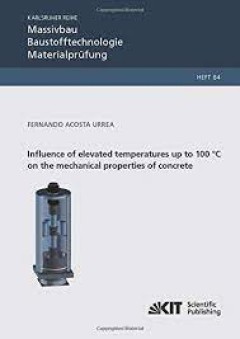
Influence of elevated temperatures up to 100 °C on the mechanical properties…
Experiments to characterize the effects of moisture content and temperature on the mechanical properties of concrete were conducted. Based on these experiments, a new overall material model capable of predicting the mechanical behaviour of concrete subject to elevated temperatures up to 100 °C was developed. The material model estimates the time, temperature and moisture dependency of the comp…
- Edition
- -
- ISBN/ISSN
- 978-3-7315-0795-6
- Collation
- -
- Series Title
- -
- Call Number
- 624 URR i
 Computer Science, Information & General Works
  Philosophy & Psychology
  Religion
  Social Sciences
  Language
  Pure Science
  Applied Sciences
  Art & Recreation
  Literature
  History & Geography