Filter by
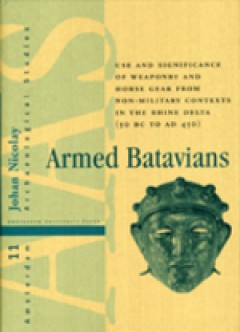
Armed Batavians
Using a life-cycle model for Roman soldiers, Johan Nicolay interprets the large quantity of first-century finds as personal memorabilia brought home by ex-soldiers as a reminder of their twenty-five years of service and a symbol of their newly-acquired veteran status. Underpinning Nicolay's research is an extensive inventory of militaria from urban centers, rural settlements, rivers, and graves…
- Edition
- -
- ISBN/ISSN
- 9789048515790
- Collation
- oer.unej.ac.id
- Series Title
- Amsterdam Archaeological Studies,
- Call Number
- -

Armed Batavians
This study explores the use and significance of Roman weaponry and horse gear from non-military contexts in the eastern Rhine delta – the territory of the Batavians. Using a life-cycle model for Roman soldiers, the author interprets the large quantity of 1st-century finds as personal memorabilia brought home by ex-soldiers as a reminder of their 25 years of service, symbolising their newly-ac…
- Edition
- -
- ISBN/ISSN
- 9789053562536
- Collation
- -
- Series Title
- -
- Call Number
- -
Armed Batavians
This study explores the use and significance of Roman weaponry and horse gear from non-military contexts in the eastern Rhine delta – the territory of the Batavians. Using a life-cycle model for Roman soldiers, the author interprets the large quantity of 1st-century finds as personal memorabilia brought home by ex-soldiers as a reminder of their 25 years of service, symbolising their newly-ac…
- Edition
- -
- ISBN/ISSN
- 9789053562536
- Collation
- -
- Series Title
- -
- Call Number
- 300
 Computer Science, Information & General Works
  Philosophy & Psychology
  Religion
  Social Sciences
  Language
  Pure Science
  Applied Sciences
  Art & Recreation
  Literature
  History & Geography