Filter by
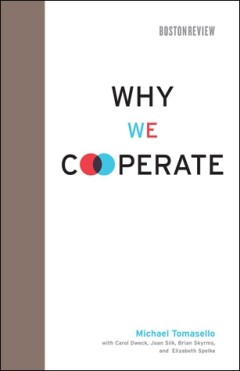
Why we cooperate
Drop something in front of a two-year-old, and she's likely to pick it up for you. This is not a learned behavior, psychologist Michael Tomasello argues. Through observations of young children in experiments he himself has designed, Tomasello shows that children are naturally—and uniquely—cooperative. Put through similar experiments, for example, apes demonstrate the ability to work togethe…
- Edition
- -
- ISBN/ISSN
- 9780262259255
- Collation
- 1 online resource (xviii, 206 pages).
- Series Title
- -
- Call Number
- -

Peer Pedagogies on Digital Platforms: Learning with Minecraft Let's Play Videos
Every day millions of children around the world watch video gameplay on YouTube in the form of a popular entertainment genre known as Let's Play videos. These videos, which present a player's gameplay and commentary, offer children opportunities for interaction and learning not available in traditional television viewing or solo video gameplay. In this book, Michael Dezuanni examines why Let's …
- Edition
- -
- ISBN/ISSN
- 9780262360746
- Collation
- 1 online resource
- Series Title
- -
- Call Number
- -
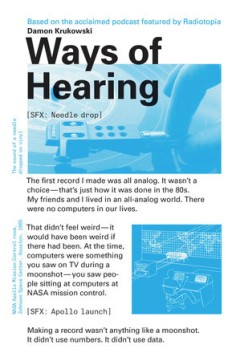
Ways of hearing
A writer-musician examines how the switch from analog to digital audio is changing our perceptions of time, space, love, money, and power. Our voices carry farther than ever before, thanks to digital media. But how are they being heard In this book, Damon Krukowski examines how the switch from analog to digital audio is changing our perceptions of time, space, love, money, and power. In Ways of…
- Edition
- -
- ISBN/ISSN
- 9780262352154
- Collation
- 1 online resource (136 pages) :illustrations
- Series Title
- -
- Call Number
- -

Sherrie Levine
The artist Sherrie Levine (b. 1947) is best known for her appropriations of work by other artists—most famously for her rephotographs of canonical images by Edward Weston, Eliot Porter, and other masters of modern photography. Since those works of the early 1980s, she has continued to work on and “after” artists whose names have come to define modernism, making sculpture after Brancusi an…
- Edition
- -
- ISBN/ISSN
- 9780262348447
- Collation
- 1 online resource.
- Series Title
- -
- Call Number
- -

The Prime Number Conspiracy: The Biggest Ideas in Math from
"If you're a science and data nerd like me, you may be interested in Alice and Bob Meet the Wall of Fire and The Prime Number Conspiracy from Quanta Magazine and Thomas Lin."—Bill Gates These stories from Quanta Magazine map the routes of mathematical exploration, showing readers how cutting-edge research is done, while illuminating the productive tension between conjecture and proof, theo…
- Edition
- -
- ISBN/ISSN
- 9780262350549
- Collation
- 1 online resource
- Series Title
- -
- Call Number
- -

Alice and Bob Meet the Wall of Fire: The Biggest Ideas in Science from Alic…
“If you're a science and data nerd like me, you may be interested in Alice and Bob Meet the Wall of Fire... from Quanta Magazine and Thomas Lin.”—Bill Gates These stories reveal the latest efforts to untangle the mysteries of the universe. Bringing together the best and most interesting science stories appearing in Quanta Magazine over the past five years, Alice and Bob Meet the Wall o…
- Edition
- -
- ISBN/ISSN
- 9780262350518
- Collation
- 1 online resource
- Series Title
- -
- Call Number
- -

How History Gets Things Wrong: The Neuroscience of Our Addiction to Stories
To understand something, you need to know its history. Right? Wrong, says Alex Rosenberg in How History Gets Things Wrong. Feeling especially well-informed after reading a book of popular history on the best-seller list? Don't. Narrative history is always, always wrong. It's not just incomplete or inaccurate but deeply wrong, as wrong as Ptolemaic astronomy. We no longer believe that the earth …
- Edition
- -
- ISBN/ISSN
- 9780262348416
- Collation
- -
- Series Title
- -
- Call Number
- -

Dependent, Distracted, Bored: Affective Formations in Networked Media
In this book, Susanna Paasonen takes on a dominant narrative repeated in journalistic and academic accounts for more than a decade: that we are addicted to devices, apps, and sites designed to distract us, that drive us to boredom, with detrimental effect on our capacities to focus, relate, remember, and be. Paasonen argues instead that network connectivity is a matter of infrastructure and nec…
- Edition
- -
- ISBN/ISSN
- 9780262363365
- Collation
- -
- Series Title
- -
- Call Number
- -

Beyond the valley :how innovators around the world are overcoming inequality …
In this provocative book, Ramesh Srinivasan describes the internet as both an enabler of frictionless efficiency and a dirty tangle of politics, economics, and other inefficient, inharmonious human activities. We may love the immediacy of Google search results, the convenience of buying from Amazon, and the elegance and power of our Apple devices, but it's a one-way, top-down process. We're not…
- Edition
- -
- ISBN/ISSN
- 9780262355650
- Collation
- 1 online resource (392 pages).
- Series Title
- -
- Call Number
- -
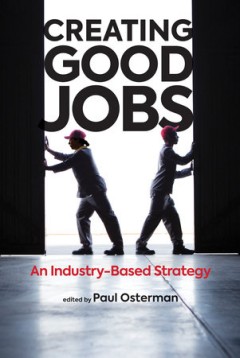
Creating good jobs :an industry-based strategy
Experts discuss improving job quality in low-wage industries including retail, residential construction, hospitals and long-term healthcare, restaurants, manufacturing, and long-haul trucking. Americans work harder and longer than our counterparts in other industrialized nations. Yet prosperity remains elusive to many. Workers in such low-wage industries as retail, restaurants, and home constru…
- Edition
- -
- ISBN/ISSN
- 9780262357364
- Collation
- 1 online resource (336 pages).
- Series Title
- -
- Call Number
- -
 Computer Science, Information & General Works
  Philosophy & Psychology
  Religion
  Social Sciences
  Language
  Pure Science
  Applied Sciences
  Art & Recreation
  Literature
  History & Geography