Filter by
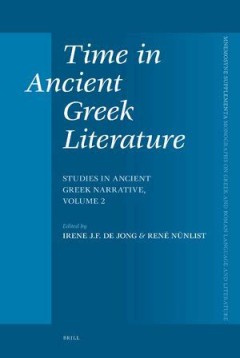
Time in Ancient Greek Literature = Studies in Ancient Greek Narrative, Volume 2
This is the second volume in a series of volumes which together will provide an entirely new history of ancient Greek (narrative) literature. Its organization is formal rather than biographical. It traces the history of central narrative devices, such as the narrator and his narratees,time, focalization, characterization, and space. It offers not only analyses of the handling of such a device b…
- Edition
- -
- ISBN/ISSN
- '9789047422938
- Collation
- 556 hlm; ill., lamp.,
- Series Title
- Mnemosyne, Supplements, Volume: 291
- Call Number
- -

Early Modern Privacy Sources and Approaches
Privacy is often considered a modern phenomenon. Early Modern Privacy: Sources and Approaches challenges this view. This collection examines instances, experiences, and spaces of early modern privacy, and opens new avenues to understanding the structures and dynamics that shape early modern societies. Scholars of architectural history, art history, church history, economic history, gender histo…
- Edition
- -
- ISBN/ISSN
- 978-90-04-15307-3
- Collation
- oer.unej.ac.id
- Series Title
- Intersections, Volume: 78
- Call Number
- -

Early Greek Poets' Lives The Shaping of the Tradition
This book examines the formation and development of the biographical traditions about early Greek poets, focusing on the traditions of Hesiod, Stesichorus, Archilochus, Hipponax, Terpander and Sappho. The study provides a detailed overview of the traditions and chronographical material about these poets and seeks to clarify who were the creators of the particular traditions; what were the sourc…
- Edition
- -
- ISBN/ISSN
- 978-90-04-19328-4
- Collation
- oer.unej.ac.id
- Series Title
- Mnemosyne, Supplements, Volume: 322
- Call Number
- -

The Skandapurāṇa Volume IIb = Adhyāyas 31-52. The Vāhana and Naraka Cycles
Skandapurāṇa IIb presents a critical edition of Adhyāyas 31-52 from the Skandapurāṇa, with an introduction and English synopsis. The text edited in this volume includes central myths of early Śaivism, such as the destruction of Dakṣa's sacrifice and Śiva acquiring the bull for his vehicle. Also included is an extensive description of the thirteen hells (Naraka).
- Edition
- -
- ISBN/ISSN
- 9789004277137
- Collation
- 384 hlm; ill., lamp.,
- Series Title
- -
- Call Number
- -

The School of Salamanca: A Case of Global Knowledge Production
Over the past few decades, a growing number of studies have highlighted the importance of the ‘School of Salamanca’ for the emergence of colonial normative regimes and the formation of a language of normativity on a global scale. According to this influential account, American and Asian actors usually appear as passive recipients of normative knowledge produced in Europe. This book proposes…
- Edition
- -
- ISBN/ISSN
- 9789004516441
- Collation
- 296 hlm; ill., lamp.,
- Series Title
- Thomas Duve, José Luis Egío, and Christiane Birr
- Call Number
- -

The Quest for an Appropriate Past in Literature, Art and Architecture
This volume explores the various strategies by which appropriate pasts were construed in scholarship, literature, art, and architecture in order to create “national”, regional, or local identities in late medieval and early modern Europe. Because authority was based on lineage, political and territorial claims were underpinned by historical arguments, either true or otherwise. Literature, s…
- Edition
- -
- ISBN/ISSN
- 9789004378216
- Collation
- 820 hlm; ill., lamp.,
- Series Title
- Intersections, Volume: 60
- Call Number
- -

The Production of Knowledge of Normativity in the Age of the Printing Press =…
This volume explores the production of knowledge of normativity in the age of early modern globalisation by looking at an extraordinarily pragmatic and normative book: Manual de Confessores, by the Spanish canon law professor Martín de Azpilcueta (1492-1586). Intertwining expertise, methods, and questions of legal history and book history, this book follows the actors and analyses the factors …
- Edition
- -
- ISBN/ISSN
- 9789004687042
- Collation
- 452 hlm; ill., lamp.,
- Series Title
- Max Planck Studies in Global Legal History of the Iberian Worlds, Volume: 4
- Call Number
- -
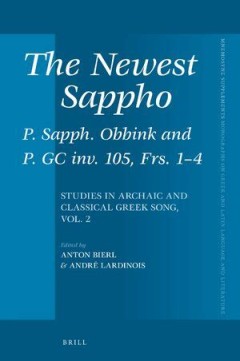
The Newest Sappho: P. Sapph. Obbink and P. GC inv. 105, Frs. 1-4 = Studies in…
Retraction Notice: Postscript (March, 2021): The Publisher notifies the readers that Chapter 2 of this volume (Dirk Obbink, “Ten Poems of Sappho: Provenance, Authenticity, and Text of the New Sappho Papyri”) has been retracted. For more information please view the statement by the editors in the Retraction Notice in the front matter of this volume and on page 9 of the Introduction. The reas…
- Edition
- -
- ISBN/ISSN
- 9789004314832
- Collation
- 560 hlm; ill., lamp.,
- Series Title
- Mnemosyne, Supplements, Volume: 392
- Call Number
- -
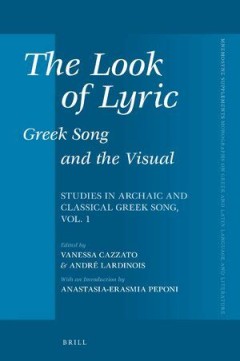
The Look of Lyric: Greek Song and the Visual = Studies in Archaic and Classic…
The Look of Lyric: Greek Song and the Visual addresses the various modes of interaction between ancient Greek lyric poetry and the visual arts as well as more general notions of visuality. It covers diverse poetic genres in a range of contexts radiating outwards from the original performance(s) to encompass their broader cultural settings, the later reception of the poems, and finally also thei…
- Edition
- -
- ISBN/ISSN
- 9789004314849
- Collation
- 404 hlm,: ill, lamp;
- Series Title
- Mnemosyne, Supplements
- Call Number
- -

The Lead Books of the Sacromonte and the Parchment of the Torre Turpiana: Gra…
The Archive of the Sacromonte Abbey in Granada preserves a historical treasure: Arabic texts on a sheet of parchment and on numerous small tablets of lead, which were discovered in Granada at the end of the sixteenth century in the tower of the old Friday Mosque and in caves of the "Valparaíso" hillock, from then on called "Sacromonte". They became the object of heated discussions in Europe an…
- Edition
- -
- ISBN/ISSN
- 9789004685277
- Collation
- 617 hlm; ill., lamp.,
- Series Title
- Texts and Sources in the History of Religions
- Call Number
- -
 Computer Science, Information & General Works
  Philosophy & Psychology
  Religion
  Social Sciences
  Language
  Pure Science
  Applied Sciences
  Art & Recreation
  Literature
  History & Geography